
Lawn Care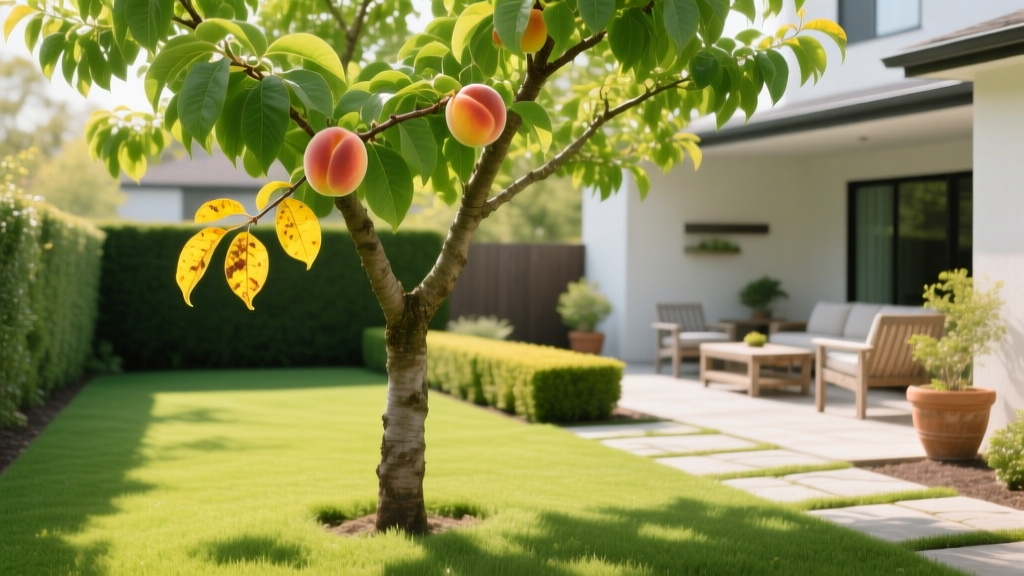
Peach Plant Leaves Turning Yellow? Establishment & Care Guide
The Critical First 90 Days: Reading Your Tree's Foliage
Integrating a fruit-bearing tree into a managed turfgrass landscape requires bridging two distinct horticultural disciplines. When establishing a new peach tree (Prunus persica), the root system is entirely confined to the original nursery pot or burlap root ball. Because the roots cannot yet forage for water and nutrients, your peach plant leaves act as a real-time diagnostic dashboard. Monitoring foliage color, turgidity, and texture during the first 90 days is the most reliable way to gauge transplant shock, soil compatibility, and irrigation accuracy.
Pro-Tip: The 'Tug Test' for Transplant Shock
If your peach plant leaves are drooping but the soil is moist, do not add more water. Instead, perform a gentle tug test on a lower branch. If it snaps cleanly, the tissue is dead. If it bends and resists, the tree is merely conserving moisture due to transplant shock. Overwatering during this phase will suffocate the fine root hairs and induce fatal root rot.
Lawn Competition and Soil Preparation
The most common mistake homeowners make is planting a peach tree directly into an existing lawn without modifying the surrounding turf environment. Cool-season grasses like Kentucky Bluegrass and Tall Fescue are aggressive competitors for shallow soil moisture. According to Clemson University Extension, a young peach tree cannot outcompete established turfgrass for nutrients during its first two years.
Establishing the Grass-Free Radius
You must clear a minimum 3-foot diameter circle of turfgrass around the trunk. Apply a 2 to 3-inch layer of coarse arborist wood chips over the exposed soil. Keep the mulch exactly 3 inches away from the root flare to prevent crown rot and rodent girdling. This mulch ring regulates soil temperature, retains moisture, and prevents string trimmers from damaging the thin bark of the young trunk.
Exact pH and Amendment Targets
Peach trees require a soil pH between 6.0 and 6.5. Most suburban lawns in the eastern and midwestern United States are heavily limed to maintain turfgrass, often pushing the pH above 7.0. In alkaline soils, iron and manganese become chemically locked out, leading to severe chlorosis in the foliage. Before planting, test your soil. If the pH is above 7.0, incorporate elemental sulfur or a specialized acidifier like Espoma Organic Soil Acidifier into the backfill at a rate of 1.5 pounds per 100 square feet to gradually lower the pH.
Diagnostic Matrix: Decoding Peach Plant Leaves
When your peach plant leaves exhibit distress, the specific pattern of discoloration points directly to the underlying physiological or pathological issue. Use this diagnostic matrix to identify the exact problem and apply the correct targeted treatment.
| Leaf Symptom | Underlying Cause | Specific Treatment Protocol |
|---|---|---|
| Yellowing between green veins (interveinal chlorosis) | Iron deficiency due to high soil pH (above 7.0) | Apply chelated iron (Fe-EDDHA formulation) as a soil drench; avoid Fe-EDTA which fails in alkaline soils. |
| Red, purple, or distorted curling of new spring growth | Peach Leaf Curl (Taphrina deformans fungal infection) | Apply Bonide Liquid Copper Fungicide at 90% leaf drop in autumn and again in late winter before bud swell. |
| Uniform pale green to yellow color across the entire leaf | Nitrogen deficiency or severe root waterlogging | Check soil drainage first. If draining well, apply 1/2 lb of 10-10-10 granular fertilizer per year of tree age. |
| Scorched, crispy brown margins and leaf tips | Potassium deficiency, salt burn, or drought stress | Deep soak the root zone with 15 gallons of water; apply Muriate of Potash (0-0-60) if soil test confirms low K. |
| Stippling, bronze discoloration, and fine webbing | Two-spotted spider mites (Tetranychus urticae) | Spray foliage with horticultural oil or insecticidal soap; avoid broad-spectrum insecticides that kill predatory mites. |
Watering Protocols for Deep Root Establishment
Turfgrass irrigation schedules are fatal to young peach trees. Lawns require frequent, shallow watering to maintain root density in the top 2 inches of soil. Peach trees, conversely, require infrequent, deep soaking to drive taproots and lateral anchors downward. Penn State Extension emphasizes that shallow watering encourages surface roots, making the tree highly susceptible to summer drought stress and winter freeze damage.
The 'Deep Soak' Method vs. Daily Sprinkling
During the first growing season, your peach tree needs 15 to 20 gallons of water per week, applied in one or two concentrated sessions. Relying on standard lawn sprinklers will result in wet foliage (promoting fungal diseases like brown rot) and dry root balls.
- Treegator Original Slow Release Watering Bag: Zip two 20-gallon bags around the trunk and fill them weekly. The micro-perforations deliver water directly to the root zone over 5 to 7 hours, eliminating runoff.
- Drip Irrigation Emitters: If integrating into an existing landscape drip system, install two 2-gallon-per-hour (GPH) pressure-compensating emitters placed 12 inches from the trunk on opposite sides.
Moisture Verification: Do not guess when to water. Insert a 12-inch steel soil probe or a digital moisture meter into the root ball. If the top 4 inches are dry but the lower 8 inches remain muddy, hold off on watering. The goal is consistent field capacity, not saturation.
Fertilization Timeline: Feeding Without Burning
Over-fertilizing a newly established peach tree forces rapid, weak vegetative growth that is highly attractive to aphids and prone to winter dieback. University of Minnesota Extension recommends withholding all fertilizer at the time of planting to prevent chemical burns on sensitive new root hairs.
Year 1 and Year 2 Application Schedule
Wait until the tree shows 6 inches of new terminal growth in its first spring before applying any synthetic nutrients.
- Early Spring (Post-Leaf Out): Broadcast 1/2 pound of a balanced 10-10-10 granular fertilizer (such as Miracle-Gro Performance Organics All Purpose) in a circle starting 6 inches from the trunk and extending to the drip line.
- Early Summer (June): Apply a second, lighter dose of 1/4 pound of 10-10-10 if growth has stalled and peach plant leaves appear pale.
- Autumn Restriction: Never apply nitrogen after July 1st. Late-season nitrogen delays dormancy, leaving the tree vulnerable to fatal cold snaps in November and December.
Frequently Asked Questions
Why are the leaves on my newly planted peach tree dropping in July?
Mid-summer leaf drop in a first-year tree is typically a self-preservation mechanism known as 'drought abscission.' The tree sheds older, interior leaves to reduce transpiration surface area because its limited root system cannot supply enough water to support the full canopy during peak heat. Increase your deep-soak volume by 20% and ensure the mulch ring is intact.
Can I use lawn weed-and-feed products near my peach tree?
Absolutely not. Most broadleaf herbicides used in lawn care (such as 2,4-D and dicamba) are highly toxic to peach trees. Even trace amounts absorbed through surface roots or volatilized in high heat will cause severe leaf cupping, stunting, and potentially tree death. Maintain a strict 5-foot buffer zone where no lawn chemicals are applied.

