
Lawn Care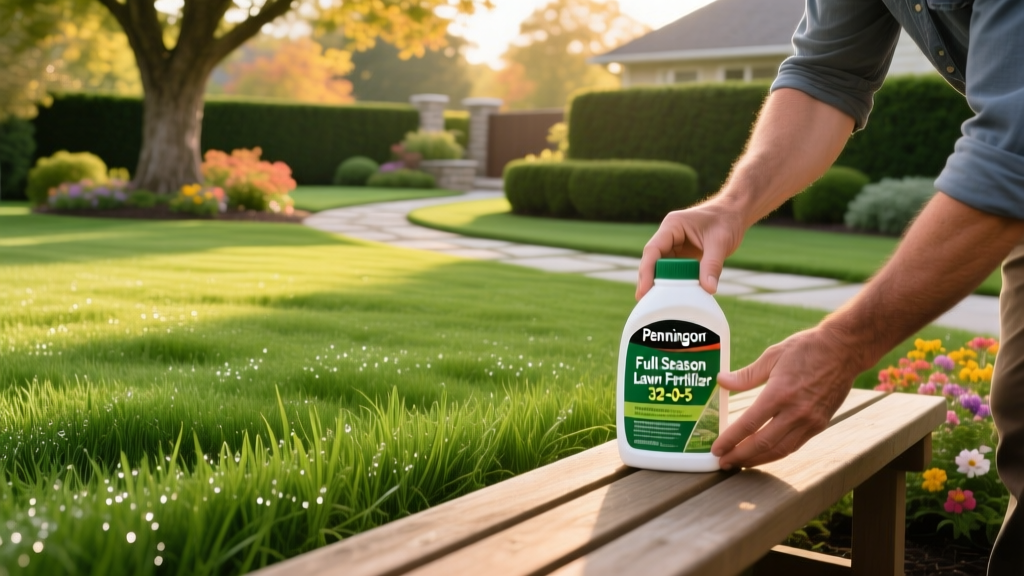
When to Apply Pennington Full Season Lawn Fertilizer 32-0-5 by Region
Decoding the 32-0-5 NPK Ratio: Why Timing is Everything
The Pennington Full Season Lawn Fertilizer 32-0-5 formulation is highly specialized. Understanding its NPK (Nitrogen-Phosphorus-Potassium) ratio is the first step in determining when it belongs on your lawn. With 32% nitrogen, 0% phosphorus, and 5% potassium, this blend is engineered exclusively for established lawns that require aggressive vegetative growth and deep greening.
The complete absence of phosphorus (the middle number) aligns with 2026 environmental regulations in numerous states that ban phosphorus application unless a soil test explicitly indicates a deficiency or you are establishing new seed. The low potassium content (5%) means this product lacks the necessary nutrients for winter root hardening. Therefore, it is a spring and early-summer growth driver, not a late-fall winterizer.
The Application Math
A standard 50-pound bag of 32-0-5 contains exactly 16 pounds of actual nitrogen (50 x 0.32 = 16). The university-recommended standard for a single application is 1 pound of nitrogen per 1,000 square feet. Consequently, one 50-pound bag covers 16,000 square feet at the full 1 lb/1,000 sq ft rate. Applying more than this in a single pass risks fertilizer burn and rapid thatch accumulation.
Cool-Season Grass Calendar (Northern & Transition Zones)
Cool-season grasses like Tall Fescue, Kentucky Bluegrass, and Perennial Ryegrass experience their peak growth cycles in the cooler temperatures of spring and fall. According to University of Minnesota Extension turfgrass research, timing nitrogen applications to coincide with these natural growth spurts maximizes uptake and minimizes nutrient leaching.
| Application Window | Target Soil Temperature | Application Rate (lbs N / 1,000 sq ft) | Purpose & Notes |
|---|---|---|---|
| Early Spring (Late April - May) | 50°F - 55°F | 0.5 to 0.75 | Moderate green-up. Avoid heavy spring N to prevent summer disease susceptibility. |
| Late Spring (Late May - Early June) | 60°F - 65°F | 0.75 to 1.0 | Primary growth push before summer dormancy. Use slow-release features of the 32-0-5 blend. |
| Early Fall (September) | 65°F - 70°F | 1.0 | Critical recovery application. Rebuilds carbohydrate reserves after summer stress. |
| Late Fall (November) | Below 50°F | DO NOT USE 32-0-5 | Switch to a high-potassium winterizer (e.g., 10-0-14). 32-0-5 will force blade growth at the expense of root hardening. |
Warm-Season Grass Calendar (Southern Zones)
Warm-season grasses operate on a completely different biological clock. Bermuda, Zoysia, and Centipedegrass thrive when soil temperatures consistently exceed 65°F. Texas A&M Aggie Turf guidelines emphasize that applying high-nitrogen fertilizers to warm-season grasses before they fully break dormancy feeds winter weeds and promotes fungal diseases like large patch.
Bermudagrass & Zoysia Timing
- Initial Application: Wait until 3 weeks after the lawn has fully greened up (usually mid-to-late May). Apply 1.0 lb N per 1,000 sq ft.
- Peak Summer Maintenance: Reapply every 6 to 8 weeks through August at 0.5 to 1.0 lb N per 1,000 sq ft. Bermuda is a heavy feeder and tolerates the 32% nitrogen load exceptionally well.
- Final Application: Stop applying 32-0-5 by late August. Late nitrogen forces tender growth that will be killed by the first frost.
Warning: Centipedegrass & St. Augustine Sensitivity
Do not apply Pennington 32-0-5 to Centipedegrass at the full 1 lb N rate. Centipedegrass is highly sensitive to excessive nitrogen and phosphorus, which triggers 'centipede decline' and iron chlorosis. If you must use this product on Centipede, dilute the application to 0.25 lbs N per 1,000 sq ft. St. Augustine grass tolerates higher nitrogen but is prone to thatch buildup; limit applications to twice per year.
The Transition Zone Dilemma
Homeowners in the Transition Zone (stretching from Kansas to Virginia) often manage Tall Fescue lawns that endure brutal summer heat. The strategy here requires strict discipline. Apply the 32-0-5 fertilizer in early May to build density, but completely cease nitrogen applications from June through August. Summer nitrogen on Tall Fescue in the Transition Zone promotes Pythium blight and Brown Patch. Resume the 32-0-5 schedule only in early September when nighttime temperatures drop below 70°F.
Spreader Calibration & Edge Cases
Relying on the generic settings printed on the fertilizer bag is a primary cause of application striping and edge-burn. Spreader mechanisms degrade over time, and humidity alters granule flow rates. Follow this precise calibration protocol:
- Measure a Test Area: Mark off exactly 250 square feet of your lawn (e.g., 10 ft x 25 ft).
- Weigh the Product: Calculate the exact weight of fertilizer needed for 250 sq ft based on your target N rate. For a 1 lb N/1,000 sq ft rate, you need 3.12 ounces of 32-0-5 product for 250 sq ft.
- The Catch Pan Method: Attach a catch pan or duct tape a plastic bag to your spreader's chute. Walk the 250 sq ft test area at your normal walking speed (approx. 3 mph).
- Adjust and Verify: Weigh the captured granules on a digital kitchen scale. Adjust the spreader dial up or down and repeat until the captured weight matches 3.12 ounces.
Edge Case: If your lawn borders a waterway, storm drain, or paved driveway, maintain a mandatory 3-foot buffer zone. Turn off the spreader's edge guard only when overlapping interior lawn passes.
Frequently Asked Questions
Can I use Pennington 32-0-5 on newly seeded lawns?
No. New grass seedlings require high levels of phosphorus (the middle number in the NPK ratio) to develop robust root systems. Because this product contains 0% phosphorus, it will not support seedling establishment. Use a dedicated starter fertilizer (e.g., 18-24-12) for the first 60 days after seeding.
How soon after applying 32-0-5 should I water the lawn?
Water the lawn within 24 hours of application to dissolve the granules and move the nitrogen into the soil profile. Apply approximately 0.25 inches of water. Leaving urea-based nitrogen on the surface of the soil in direct sunlight for more than 48 hours can result in nitrogen volatilization, where the gas escapes into the atmosphere rather than feeding the roots.
Is this fertilizer safe for pets?
When used as directed, it is safe. However, pets should be kept off the lawn during application and until the granules have been watered in and the grass blades are completely dry. Ingestion of concentrated nitrogen granules directly from the spreader hopper or bag can cause severe gastrointestinal distress in dogs and cats.

