
Lawn Care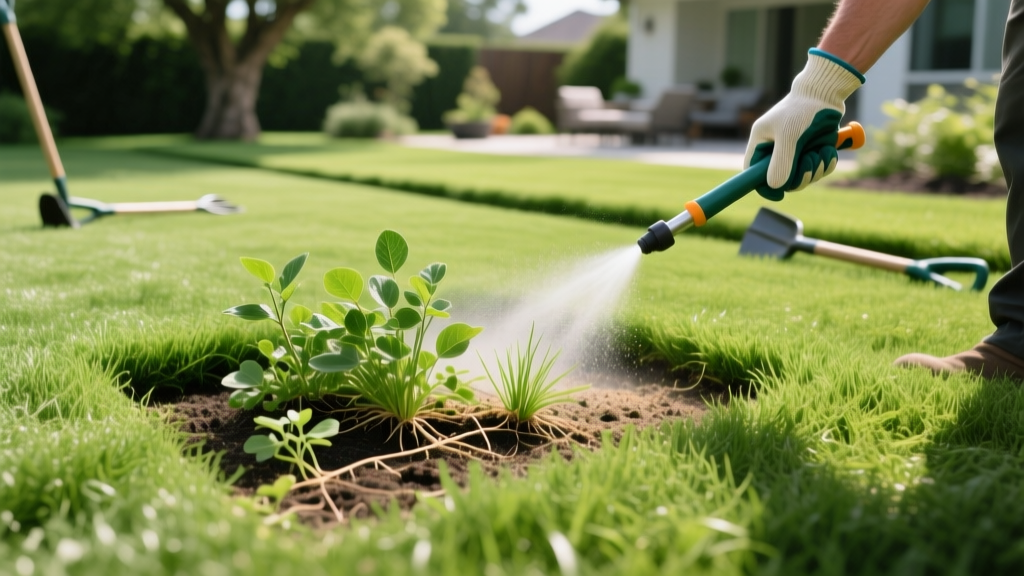
Spot-Treatment Guide for Common Perennial Grassy Weeds
Perennial grassy weeds represent the most frustrating challenge in residential lawn care. Unlike broadleaf weeds (such as dandelions or clover) or annual grasses (like crabgrass) that complete their lifecycle in one year, perennial grassy weeds establish deep root systems, rhizomes, or stolons that allow them to survive winter and aggressively reclaim territory year after year. Because they share the same biological classification as your desired turf, eradicating them without causing collateral damage to your lawn requires precise identification and highly specific spot-treatment protocols.
⚠️ The Monocot Dilemma: Because perennial grassy weeds are monocots—just like Kentucky bluegrass, bermudagrass, and fescue—standard broadleaf herbicides containing 2,4-D, dicamba, or MCPP will not harm them. Furthermore, standard pre-emergent herbicides (like prodiamine) only stop seeds from germinating; they do nothing to stop the vegetative spread of established perennial grassy weeds via underground rhizomes or above-ground stolons.
Identification Matrix: Knowing Your Adversary
Successful spot-treatment begins with accurate identification. Misidentifying a grassy weed often leads to the application of the wrong active ingredient, wasting money and stunting your turf. Below is a diagnostic matrix for the four most destructive perennial grassy weeds found in North American lawns.
| Weed Species | Leaf Blade & Growth Habit | Distinctive Features | Primary Turf Threat |
|---|---|---|---|
| Dallisgrass (Paspalum dilatatum) |
Coarse, clump-forming bunchgrass with wide (up to 1/2 inch) leaf blades. | Distinctive, thick, dark seedheads with 3-5 finger-like spikes. Grows faster than surrounding turf. | Warm-season lawns (Bermuda, Zoysia). Creates unsightly, fast-growing clumps. |
| Bahiagrass (Paspalum notatum) |
Tough, fibrous leaves with a prominent V-shaped or Y-shaped seedhead. | Extremely deep, woody root system. Seedheads shoot up rapidly after mowing. | Centipede and St. Augustine lawns. Highly resistant to mechanical pulling. |
| Quackgrass (Elymus repens) |
Blue-green tint, broad leaves with a prominent, clasping auricle at the collar. | Aggressive white underground rhizomes that snap easily when pulled. | Cool-season lawns (Fescue, KBG). Spreads rapidly via rhizome fragmentation. |
| Nimblewill (Muhlenbergia schreberi) |
Short, narrow, gray-green leaves. Spreads via above-ground stolons. | Warm-season weed that turns straw-brown in fall/winter, standing out in dormant cool-season turf. | Cool-season lawns. Forms dense, mat-like patches that choke out fescue. |
For definitive visual confirmation, the NC State Turffiles database provides high-resolution macro photography of ligules, auricles, and seedheads, which are critical for differentiating between similar species like quackgrass and annual ryegrass.
Selective Herbicide Protocols by Turf Type
The active ingredient you choose is entirely dependent on the turfgrass species you are trying to protect. Using the wrong selective graminicide can result in severe phytotoxicity, stunting your lawn for an entire growing season.
Warm-Season Turf Protocols (Bermudagrass, Zoysiagrass)
If you are battling dallisgrass or bahiagrass in a warm-season lawn, Fluazifop-p-butyl (commonly sold as Fusilade II) is the industry standard for suppression. While it will not eradicate mature dallisgrass in a single pass, it severely stunts its growth and allows your bermudagrass to outcompete it.
- Mixing Rate: 0.25 oz of Fusilade II per 1,000 sq ft, mixed in 1 gallon of water.
- Surfactant Requirement: You must add a non-ionic surfactant (NIS) at a rate of 0.5% v/v (roughly 1/3 oz per gallon). Without a surfactant, the waxy cuticle of dallisgrass will repel the herbicide.
- Application Schedule: Apply every 21 to 28 days during active spring and early summer growth. Expect 3 to 4 applications for full suppression.
- Cost Expectation: A pint of Fusilade II costs approximately $45-$55 and will treat roughly 24,000 sq ft, making spot treatments highly economical.
Cool-Season Turf Protocols (Tall Fescue, Kentucky Bluegrass)
Cool-season lawns face the unique threat of nimblewill and quackgrass. Because these weeds are biologically similar to your turf, selective options are limited and often cause temporary cosmetic damage.
- For Nimblewill: Mesotrione (Tenacity) is highly effective. Mix at a rate of 1 teaspoon per 2 gallons of water for spot treatments. Mesotrione acts as a bleaching herbicide; the nimblewill will turn stark white before dying over 2 to 3 weeks. Note: Tenacity will also temporarily bleach desirable Kentucky bluegrass, so keep spot treatments strictly confined to the weed patches.
- For Quackgrass: Selective eradication of quackgrass in cool-season turf is virtually impossible with over-the-counter chemicals. Quackgrass requires non-selective spot treatment (detailed below) followed by renovation.
Non-Selective Spot Treatment: The Surgical Approach
When selective herbicides fail, or when dealing with quackgrass in fescue, you must use a non-selective herbicide like Glyphosate (Roundup Pro or generic 41% concentrates). Because glyphosate kills any plant it touches, the application method is just as important as the chemical itself.
'When spot-treating perennial grassy weeds with glyphosate, homeowners often make the mistake of spraying the entire weed clump. For rhizomatous weeds like quackgrass, you must treat a 6-inch buffer zone beyond the visible green foliage to ensure the herbicide translocates into the outermost underground rhizomes.' — University of California IPM Guidelines
Precision Application Tools
Never use a standard broadcast nozzle for non-selective spot treatments. Wind drift and overspray will kill your desirable turf. Invest in one of the following precision tools:
- Shielded Cone Sprayer: Purchase a cheap 1-gallon pump sprayer and attach a plastic spray shield (available for under $10 at hardware stores). This creates a physical barrier, allowing you to spray the weed down to the soil line without droplets bouncing onto adjacent fescue.
- Wick Applicators: For tall dallisgrass clumps that tower above your bermudagrass, a rope-wick or sponge applicator is ideal. You saturate the sponge with a 2% glyphosate solution and physically wipe it only onto the tall weed blades. The shorter desirable turf remains completely untouched.
- Paintbrush Method: For isolated, single-blade weeds near flowerbeds or delicate turf, dipping a small foam brush into a concentrated glyphosate solution and painting the leaves offers 100% accuracy with zero drift risk.
Post-Eradication Soil and Turf Recovery
Killing the weed is only half the battle. Perennial grassy weeds leave behind bare patches that are highly vulnerable to secondary invasions by annual weeds like crabgrass or goosegrass.
According to Clemson University Extension, bare soil exposed to direct sunlight triggers the germination of opportunistic weed seeds. To prevent this, execute the following recovery protocol immediately after the grassy weed turns completely brown (usually 10-14 days post-treatment):
- Dethatch and Rake: Vigorously rake out the dead weed material to expose the soil surface.
- Core Aeration: If the patch is larger than 2 square feet, use a manual step-aerator to pull 3-4 cores from the bare spot, relieving compaction and creating seed-to-soil contact channels.
- Overseed and Topdress: Apply a turf-type tall fescue blend (for cool-season lawns) at a rate of 8-10 seeds per square inch. Cover lightly with 1/4 inch of peat moss or compost to retain moisture.
- Starter Fertilizer: Apply a high-phosphorus starter fertilizer (e.g., 18-24-12) to accelerate root development in the new grass, allowing it to establish before the next weed germination cycle.
By combining precise biological identification with targeted chemical protocols and immediate turf renovation, you can systematically eliminate perennial grassy weeds and restore a uniform, dense lawn canopy.

