
Lawn Care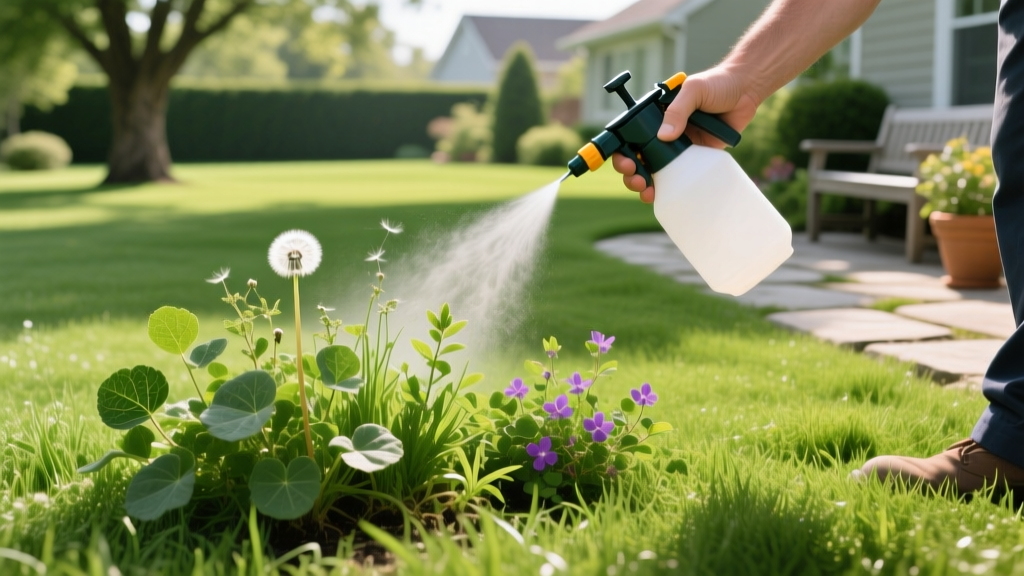
How to Remove Weeds Permanently: Spot Treatment Guide by Species
Understanding how to remove weeds permanently requires shifting your focus from the visible foliage to the hidden reproductive structures beneath the soil. Pulling weeds by hand or applying generic, ready-to-use aerosol sprays rarely achieves permanent eradication. True permanence demands species-specific systemic herbicides, precise surfactant integration, and targeted application timing that aligns with the weed's biological growth cycles. This guide details the exact chemical protocols, mixing ratios, and failure-mode avoidances required to eliminate the three primary weed architectures found in residential turf.
The Biology of Permanent Eradication
Weeds survive human intervention through three distinct root and stem architectures. If your spot-treatment protocol does not account for the specific architecture of the target weed, regrowth is mathematically guaranteed.
- Taproots (Dandelion, Curly Dock, Broadleaf Plantain): A single, deep primary root. The critical failure point is the 'crown'—the half-inch node situated exactly at the soil line. If the crown is not destroyed, the taproot will regenerate a new rosette within 14 days.
- Rhizomes and Stolons (Creeping Charlie, Field Bindweed, Bermudagrass): Horizontal underground (rhizomes) or above-ground (stolons) stems that node and root every few inches. Cutting or burning the top growth leaves dozens of viable nodes intact in the soil.
- Fibrous Roots (Crabgrass, Poa Annua): Shallow, dense root masses that rely on massive seed banks in the top inch of soil rather than deep root regeneration for survival.
Protocol 1: Taproot Weeds (Dandelion, Dock, Thistle)
For deep taproots, you need a systemic broadleaf herbicide that translocates from the leaf tissue down to the root tip. The industry standard is a three-way herbicide blend containing 2,4-D, Dicamba, and MCPP (Mecoprop-p). Products like Ortho WeedClear or Southern Ag Amine 2,4-D are highly effective when mixed correctly.
Temperature Volatilization Warning: Never apply 2,4-D or Dicamba when ambient temperatures exceed 85°F. At high temperatures, these chemicals vaporize and drift, causing severe twisting and cupping damage to nearby desirable broadleaf plants, shrubs, and trees. Target a 48-hour weather window where highs remain between 60°F and 80°F.
Exact Mixing Protocol: Mix 1.5 fluid ounces of three-way concentrate per gallon of water. Add 1/3 fluid ounce of a non-ionic surfactant (detailed below). Spray the weed until the leaves are visibly wet and dripping, but avoid creating puddles on the soil surface. The chemical must enter through the stomata in the leaves, not the soil.
Protocol 2: Rhizomatous & Stoloniferous Weeds (Creeping Charlie, Bindweed)
According to University of Minnesota Extension, creeping Charlie (Ground Ivy) and Field Bindweed are notoriously resistant to standard 2,4-D blends due to their waxy leaf cuticles and extensive nodal networks. To remove these permanently, you must upgrade to Triclopyr.
Triclopyr is available in two formulations: amine (water-soluble) and ester (oil-soluble). For waxy weeds like Plantain, Creeping Charlie, and wild violet, Triclopyr ester is mandatory. The ester formulation physically penetrates the waxy cuticle layer that repels amine-based sprays. As of 2026, professional-grade Triclopyr ester (such as Cool Power or Turflon Ester) costs approximately $65 to $85 per gallon, but it is highly concentrated, requiring only 1 to 2 fluid ounces per gallon of water.
| Active Ingredient | Target Weed Architecture | Mix Rate (Per Gallon) | Optimal Season |
|---|---|---|---|
| 2,4-D + Dicamba + MCPP | Taproots (Dandelion) | 1.5 fl oz | Spring / Early Fall |
| Triclopyr (Ester) | Rhizomes (Creeping Charlie) | 1.0 - 2.0 fl oz | Mid-Autumn (Post-frost) |
| Quinclorac | Fibrous (Crabgrass) | 0.75 fl oz | Summer (Pre-tiller) |
| Glyphosate (41%) | All (Non-selective spot) | 2.5 fl oz | Active Growth Phase |
Note: Triclopyr is highly toxic to certain warm-season grasses. Do not use on St. Augustine or Centipedegrass. It is safe for Tall Fescue, Kentucky Bluegrass, and Bermudagrass.
Protocol 3: Grassy Annuals (Crabgrass, Poa Annua)
Grassy weeds cannot be treated with broadleaf herbicides. For active Crabgrass infestations, Quinclorac (found in products like Drive XLR8 or Ortho Weed B Gon Plus Crabgrass Control) is the only reliable post-emergent option. However, Quinclorac efficacy drops precipitously once crabgrass reaches the 'tillering' stage (when it splits into multiple stems and forms a star shape). If the crabgrass has tillered, you must apply Quinclorac twice, spaced 14 days apart, at a rate of 0.75 fluid ounces per gallon.
For Poa Annua (Annual Bluegrass), post-emergent options are virtually non-existent for homeowners without killing the surrounding turf. Permanent removal of Poa Annua relies entirely on pre-emergent applications of Prodiamine or Dithiopyr in late summer (when soil temperatures drop below 70°F) to prevent seed germination.
The Surfactant Multiplier
The most common reason DIY spot treatments fail is the omission of a surfactant. Water has high surface tension, causing it to bead up and roll off the waxy leaves of weeds like Plantain and Bindweed. A non-ionic surfactant (such as Hi-Yield Spreader Sticker or Southern Ag Surfactant) breaks this surface tension, forcing the herbicide to spread flat and penetrate the leaf tissue. Mix surfactant at a 0.25% v/v ratio—roughly 1/3 teaspoon per gallon of water. This $15 investment effectively doubles your herbicide's kill rate.
Calibrating for Spot Treatment
Overdosing herbicides burns the leaf tissue before the chemical can translocate to the root, resulting in top-kill only and guaranteed regrowth. To calibrate a standard 2-gallon pump sprayer (like a Chapin ProSeries):
- Mark out a 200 square foot test area on your driveway (e.g., 10x20 feet).
- Fill the sprayer with plain water and spray the area at your normal walking pace and pumping pressure.
- Measure how much water was used. If you used 32 ounces of water to cover 200 sq ft, your application rate is 1.5 gallons per 1,000 sq ft.
- Multiply your chemical's label rate by 1.5 to determine the exact amount of concentrate to add to a full 1.5-gallon tank.
Always add a few drops of Blue Marker Dye to your tank. This temporary colorant shows you exactly which weeds you have sprayed, preventing accidental double-dosing that causes rapid leaf burn and systemic failure.
Post-Eradication Turf Recovery
According to NC State Extension, leaving bare soil after a successful weed kill is an invitation for new weed seeds to germinate. Once the target weed has completely browned and died (usually 14 to 21 days post-application), rake out the dead debris. For taproot voids, fill the hole with a 50/50 mix of topsoil and compost. Overseed the spot immediately using a turf-type tall fescue blend at a heavy rate of 8 to 10 pounds per 1,000 square feet to ensure rapid canopy closure, shading out any remaining weed seeds in the soil bank.

