
Lawn Care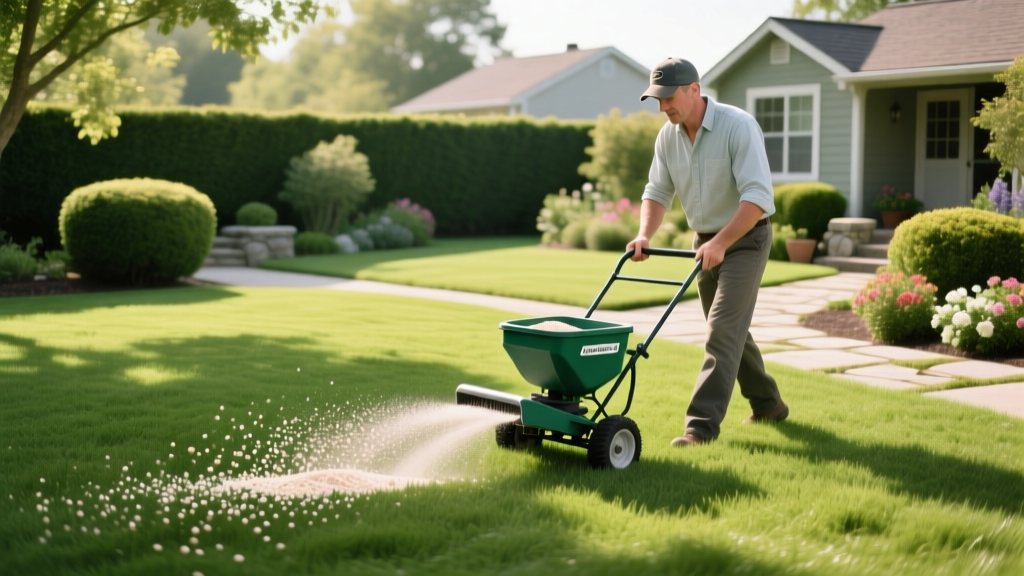
Phosphorus Fertilizer for Lawns: When, Why, and How to Apply It
The Biochemical Role of Phosphorus in Turfgrass
In the N-P-K ratio printed on every bag of lawn food, phosphorus (P) is the middle number. While nitrogen drives foliar blade growth and potassium regulates cellular water pressure and stress tolerance, phosphorus is the undisputed engine of root development and energy transfer. At a cellular level, phosphorus is a structural component of ATP (adenosine triphosphate), the primary energy currency of the grass plant. Without adequate phosphorus, a newly germinated seedling lacks the metabolic energy to push root hairs deep into the soil profile.
However, a widespread misconception in the lawn care industry is that established turf requires continuous phosphorus applications. In reality, mature cool-season grasses (like Kentucky Bluegrass and Tall Fescue) and warm-season grasses (like Bermuda and Zoysia) recycle phosphorus efficiently from decaying root tissue and thatch. Applying phosphorus fertilizer to an established lawn with sufficient soil reserves provides zero agronomic benefit and actively harms local watersheds.
⚠️ Regulatory Warning: As of 2026, over 15 U.S. states—including New York, Minnesota, Michigan, and Florida—have enacted strict bans on the retail sale and application of phosphorus-containing fertilizers on established lawns. Exemptions are typically only granted if you are establishing a new lawn from seed or sod, or if a certified soil test explicitly documents a deficiency.
Decoding Your Soil Test: Do You Actually Need Phosphorus?
Before purchasing any starter fertilizer or soil amendment, you must pull a core soil sample and send it to a university extension lab or a private agronomic testing facility. Labs typically measure phosphorus using either the Mehlich-3 extraction method (common in the South and Midwest) or the Bray P1 method (common in the North). Do not rely on cheap, color-change DIY soil test kits from hardware stores; they cannot accurately measure parts-per-million (PPM) phosphorus concentrations.
| Soil P Level (PPM) | Agronomic Status | Action Plan for Lawns |
|---|---|---|
| Less than 15 PPM | Deficient | Apply 1.0 to 1.5 lbs of P2O5 per 1,000 sq ft. Use a high-phosphorus starter fertilizer. |
| 15 to 30 PPM | Marginal | Apply 0.5 lbs of P2O5 per 1,000 sq ft during seeding or spring green-up. |
| 31 to 50 PPM | Optimal | No phosphorus needed. Use a zero-phosphorus maintenance fertilizer (e.g., 32-0-10). |
| Greater than 50 PPM | Excessive | Halt all P applications. High levels can induce iron and zinc micronutrient lockout. |
Selecting the Right Phosphorus Fertilizer Products
When your soil test confirms a deficiency, or you are laying new sod and hydroseed, you need a product with a high middle number. Below is a breakdown of industry-standard phosphorus fertilizers used by lawn care professionals and serious homeowners.
1. Scotts Turf Builder Starter Food for New Grass (24-25-4)
- Best For: Overseeding, bare patch repair, and new sod establishment.
- Phosphorus Load: 25% P2O5 by weight.
- Cost: Approximately $38 for a 15,000 sq ft coverage bag.
- Expert Insight: This is a quick-release synthetic blend. The high nitrogen (24%) will push rapid blade growth simultaneously with root development. Do not use this on an established lawn in mid-summer, as the salt index can burn dormant warm-season grasses.
2. The Andersons Professional PGF Balanced (10-10-10)
- Best For: Spring kick-off applications on lawns with marginally low soil P levels.
- Phosphorus Load: 10% P2O5 by weight.
- Cost: Approximately $55 for a 50 lb bag.
- Expert Insight: Features ultra-fine homogeneous particles (SGN 100) for incredibly even spreader distribution. The lower P concentration prevents accidental overloading while still supplying necessary early-season root energy.
3. Milorganite Organic Nitrogen Fertilizer (5-4-0)
- Best For: Gentle, long-term maintenance in states with strict P regulations (where allowed as a natural exception).
- Phosphorus Load: 4% P2O5 by weight (derived from heat-dried microbial biomass).
- Cost: Approximately $22 for a 32 lb bag.
- Expert Insight: Because the phosphorus is organically bound, it will not leach into groundwater or bind immediately to soil cation exchange sites. It requires microbial activity to break down, making it a true slow-release option.
Calculating Exact Application Rates (The Math)
The most common failure point in DIY lawn care is guessing the spreader setting. To apply exactly 1.0 lb of actual P2O5 per 1,000 square feet using a 24-25-4 starter fertilizer, follow this calculation:
- Identify the target: 1.0 lb of P2O5 per 1,000 sq ft.
- Identify the concentration: The middle number is 25, meaning the bag contains 0.25 lbs of P2O5 per 1 lb of product.
- Divide target by concentration: 1.0 ÷ 0.25 = 4.0 lbs of product.
- Result: You must apply exactly 4.0 lbs of the 24-25-4 granular product per 1,000 square feet to hit your phosphorus target.
Pro Tip: Calibrate your rotary spreader by weighing out 4.0 lbs of product, setting it to cover exactly a 1,000 sq ft test area (e.g., a 20x50 ft section of your driveway), and adjusting the dial until the hopper empties precisely at the end of the area.
Environmental Safeguards and Runoff Mechanics
Phosphorus is highly reactive in the soil. Unlike nitrogen, which moves freely through the soil profile with water, phosphorus binds tightly to soil particles (particularly clay and organic matter). However, when phosphorus fertilizer is applied to frozen ground, sloped lawns, or compacted soil prior to heavy rainfall, the physical soil particles themselves wash away into storm drains.
According to the U.S. Environmental Protection Agency, phosphorus is typically the limiting nutrient in freshwater ecosystems. When excess lawn phosphorus enters local lakes and ponds, it triggers explosive cyanobacteria (blue-green algae) blooms that deplete dissolved oxygen and cause massive fish kills. To mitigate this, the U.S. Geological Survey recommends maintaining dense turf buffers near waterways and sweeping any stray fertilizer granules off concrete driveways immediately after application.
Frequently Asked Questions
Can I use bone meal as a phosphorus fertilizer for my lawn?
While bone meal (typically 3-15-0) is an excellent organic phosphorus source for garden beds and flowering bulbs, it is highly impractical for lawns. Bone meal requires soil incorporation to break down effectively; top-dressing it on an established lawn results in the material sitting in the thatch layer, attracting scavengers like raccoons and neighborhood dogs, without reaching the root zone.
Will adding extra phosphorus make my grass roots grow deeper?
No. Once the soil's cation exchange capacity and available PPM thresholds are met, adding excess phosphorus will not stimulate further root growth. In fact, excessive soil phosphorus can antagonize the uptake of vital micronutrients like iron, manganese, and zinc, leading to severe interveinal chlorosis (yellowing of the grass blades) even when nitrogen levels are adequate.
How often should I re-test my soil for phosphorus?
Because phosphorus accumulates in the soil and does not leach out like nitrogen, you only need to perform a comprehensive lab soil test every 2 to 3 years. If you are actively trying to raise deficient soil P levels, test annually in the early spring until your lab results show a consistent reading above 30 PPM.

