
Lawn Care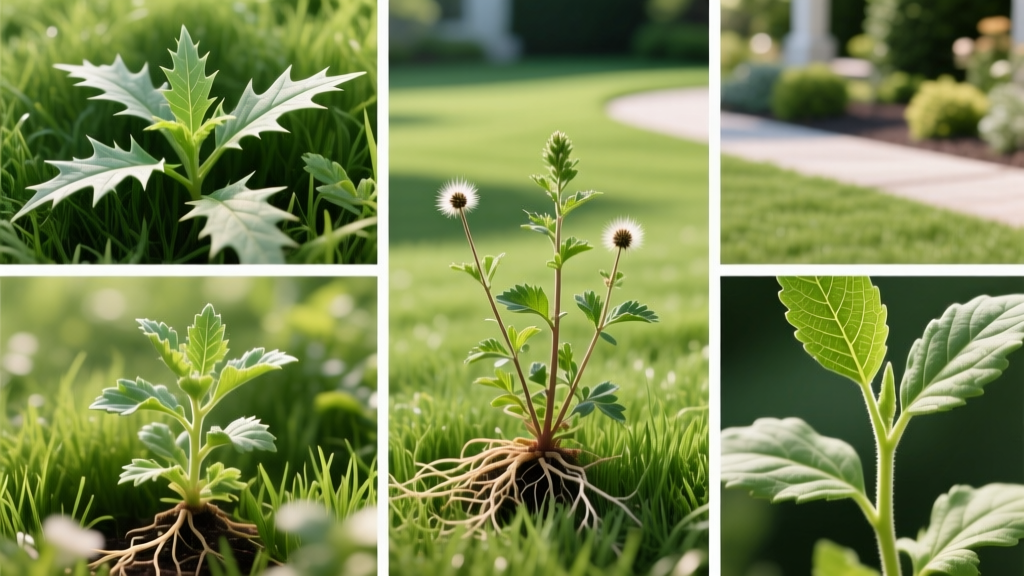
Photos of Weeds in Grass: Identification and Spot-Treatment Guide
The Diagnostic Value of Visual Weed Identification
Applying broad-spectrum herbicides without confirming the exact species of your lawn invaders is the most common—and expensive—mistake in residential turf management. A single 8-ounce bottle of a specialized post-emergent herbicide can cost between $50 and $85 in 2026. If you misidentify a grassy weed as a broadleaf weed, that chemical will fail entirely, wasting your budget and stressing your turf. Comparing high-resolution reference photos of weeds in grass against the morphological traits of the invader in your yard is the critical first step in a successful spot-treatment protocol.
Effective weed management relies on distinguishing between three primary botanical categories: broadleaf weeds (dicots), grassy weeds (monocots), and sedges. Each category requires a fundamentally different active ingredient and application strategy. According to NC State University Turfgrass Science, accurate visual identification of leaf venation, ligule presence, and stem cross-sections dictates the entire chemical intervention plan.
The Visual Identification Framework
When analyzing photos of weeds in grass or inspecting your own lawn, focus on three structural markers:
- Venation Pattern: Broadleaf weeds exhibit net-like (reticulate) venation, while grassy weeds and sedges feature parallel veins running the length of the leaf blade.
- Stem Cross-Section: Grassy weeds have round, hollow stems. Sedges have solid, triangular stems (remember the adage: "sedges have edges"). Broadleaf weeds typically have solid, round, or square stems.
- Collar Region: Part the grass at the base of the leaf blade. Look for a ligule (a membranous or hairy appendage) and auricles (claw-like structures wrapping the stem). Grassy weeds possess these; broadleaf weeds do not.
Diagnostic Tip: If you are comparing your lawn to photos of weeds in grass and cannot determine if a plant is a sedge or a grass, perform the "roll test." Pinch the base of the stem and roll it between your thumb and index finger. If it rolls smoothly, it is a grassy weed. If it catches or feels distinctly triangular, you are dealing with a sedge.
Broadleaf Weed Profile and Spot-Treatment Matrix
Broadleaf weeds are generally the easiest to control selectively in both cool-season and warm-season turfgrasses. The key is utilizing synthetic auxins (Group 4 herbicides) that mimic plant growth hormones, causing the dicot weed to grow itself to death while leaving the monocot turf unharmed.
| Weed Species | Visual Cue (from photos) | Active Ingredient Required | Product Example & 2026 Cost |
|---|---|---|---|
| Creeping Charlie (Ground Ivy) | Scalloped, round leaves; square stems; minty odor when crushed. | Triclopyr + 2,4-D | Turflon Ester Ultra (~$75 / pint) |
| Dandelion | Deeply lobed rosette leaves; hollow stems exuding milky sap. | 2,4-D + Dicamba | Trimec Classic (~$45 / gallon) |
| White Clover | Trifoliate leaves (three leaflets) with white chevrons; creeping stolons. | Quinclorac + Dicamba | Drive XLR8 (~$90 / 2.5 gal) |
| Broadleaf Plantain | Wide, ribbed, oval leaves growing in a tight, low basal rosette. | Mecoprop (MCPP) | MCPP-P Amine (~$60 / quart) |
Grassy Weed Tactics: The Selective Challenge
Grassy weeds like Crabgrass (Digitaria sanguinalis), Goosegrass (Eleusine indica), and Poa Annua are notoriously difficult to spot-treat because they share the same monocot biology as your desirable turf. Selective post-emergent control relies on exploiting minor metabolic differences between the weed and the turfgrass.
Crabgrass and Goosegrass
For mature crabgrass in cool-season lawns (Kentucky Bluegrass, Tall Fescue), Quinclorac is the industry standard. It causes the crabgrass to exhibit severe epinasty (twisting) and necrosis. However, Quinclorac is highly toxic to certain warm-season grasses, specifically St. Augustine and Centipede grass. If you have a St. Augustine lawn, you must use Metolachlor for pre-emergent control, as post-emergent options are severely limited.
Poa Annua (Annual Bluegrass)
Poa Annua is identifiable by its light green color, boat-shaped leaf tips, and prolific seed head production even at low mowing heights. Post-emergent control in dormant warm-season turf (like Bermudagrass in winter) can be achieved using Foramsulfuron (Revolver). In cool-season turf, Poa Annua is usually managed via pre-emergents (Prodiamine) in late summer, as selective post-emergents will severely injure the host turf.
Volatilization Warning: Never apply ester-based broadleaf herbicides (like Triclopyr esters) or Quinclorac when ambient temperatures exceed 85°F (29°C). At high temperatures, these chemicals volatilize—turning into a gas that drifts onto and severely damages nearby ornamental shrubs, vegetable gardens, and desirable turf.
Sedge Control: The "Not-Grass" Imposters
Yellow Nutsedge (Cyperus esculentus) and Purple Nutsedge (Cyperus rotundus) thrive in poorly drained, compacted soils. They grow twice as fast as surrounding turf during the heat of summer, creating highly visible yellow-green patches. Standard grassy weed herbicides (like Quinclorac) and broadleaf herbicides (like 2,4-D) have zero efficacy on sedges.
To eradicate sedges, you must use Halosulfuron-methyl (sold as SedgeHammer). This sulfonylurea herbicide inhibits the ALS enzyme, stopping amino acid synthesis in the sedge. A typical 5-pack of 13.5g water-soluble bags costs around $25 in 2026 and treats up to 43,000 square feet. According to the University of California IPM Weed Gallery, repeated applications 6 to 10 weeks apart are often necessary to deplete the extensive subterranean nutlet (tuber) system that allows nutsedge to survive winter and drought.
Execution: Precision Spot-Spraying Protocol
Spot-treating requires precision to minimize chemical load on your lawn and prevent turf phytotoxicity. Follow this exact protocol for optimal results:
- Equipment Selection: Use a dedicated 1-gallon or 2-gallon pump sprayer. Do not use a hose-end sprayer, as they lack the calibration required for spot-treatment and will over-apply the chemical.
- Nozzle Calibration: Swap the standard cone nozzle for a TeeJet 8002EVS flat fan nozzle. This provides an even, predictable spray pattern essential for measuring exact application rates.
- Surfactant Integration: Most professional herbicides require a Non-Ionic Surfactant (NIS) to break the surface tension of the weed's waxy cuticle. Add NIS at a rate of 0.25% v/v (exactly 1/2 ounce per gallon of mixed solution).
- Dye Markers: Add 2-3 drops of turf-marking blue dye to your tank. This provides instant visual confirmation of where you have sprayed, preventing costly overlapping that leads to turf burn.
- Application Technique: Spray the weed until the leaves are uniformly wet, but stop before the liquid begins to drip off the foliage (the point of runoff). A light, even mist is vastly superior to a heavy drench.
- Post-Application Care: Do not mow the lawn for 48 hours before or 48 hours after application. The weed needs maximum leaf surface area to absorb and translocate the herbicide down to its root system. Delay irrigation for at least 24 hours to prevent washing the chemical off the leaf.
Frequently Asked Questions
Can I use vinegar or boiling water for spot treatment?
While acetic acid (vinegar) and thermal weeding (boiling water/propane torches) will burn the foliage of weeds, they are non-selective contact treatments. They will kill your desirable grass upon contact and do not translocate to the roots. Perennial weeds like Dandelion and Creeping Charlie will simply regrow from their intact root systems within two weeks. Synthetic systemic herbicides remain the only viable option for permanent eradication without destroying the surrounding turf.
How do I know if the weed in my photos is a winter annual?
Winter annuals, such as Henbit and Chickweed, germinate in early autumn, survive the winter as small rosettes, and flower in early spring before dying off as summer heat arrives. If you are identifying these from photos in early spring, they are already reaching the end of their natural life cycle. Spot-treating mature, flowering winter annuals is largely a waste of chemicals. The correct protocol is to apply a pre-emergent like Isoxaben in late September to prevent germination, as noted by Penn State Extension.
What is the safest herbicide for newly seeded lawns?
New turfgrass seedlings are highly susceptible to herbicide injury. You must wait until the new grass has been mowed at least three times before applying any post-emergent broadleaf or grassy weed herbicides. Until that threshold is reached, manual hand-pulling is the only safe spot-treatment method.

