
Lawn Care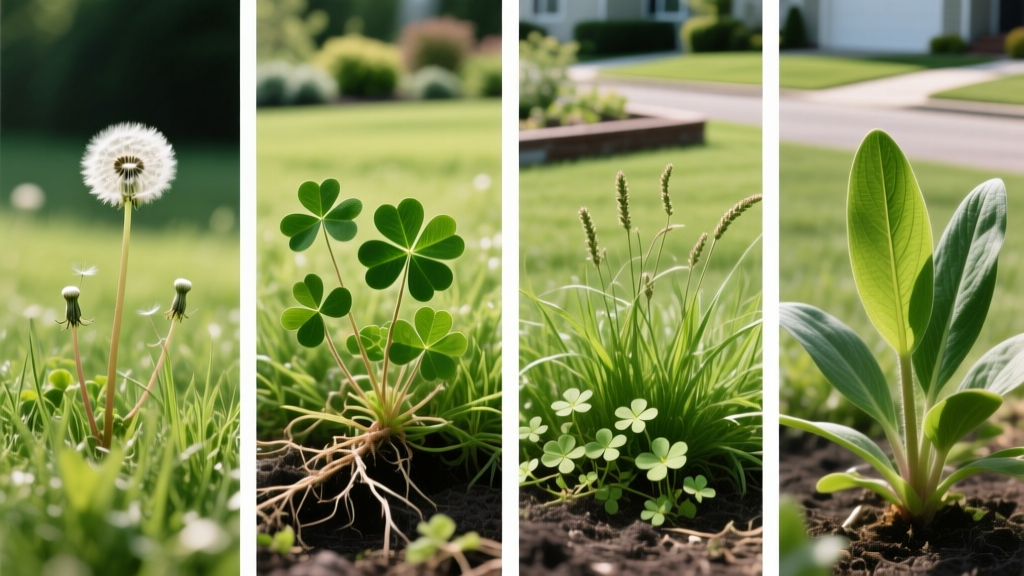
Pictures of Weeds in Grass: Visual ID and Spot-Treatment Guide
The Diagnostic Value of Visual Weed Identification
Blindly applying broad-spectrum herbicides wastes money, damages desirable turf, and accelerates chemical resistance. When browsing pictures of weeds in grass to diagnose your lawn, you must look beyond the obvious flowers and examine vegetative structures: leaf venation, stem cross-sections, and growth habits. Accurate visual identification dictates the exact active ingredient, application rate, and adjuvant required for effective spot-treatment. This guide provides a structural framework for identifying the four most disruptive lawn weeds and delivers precise, micro-dosed spot-treatment protocols.
Broadleaf vs. Grassy vs. Sedge: The Diagnostic Matrix
Before matching your lawn to specific pictures of weeds in grass, categorize the invader using this morphological matrix. Misidentifying a sedge as a grassy weed will result in total treatment failure, as standard grassy herbicides like Quinclorac do not affect sedges.
| Characteristic | Broadleaf Weeds | Grassy Weeds | Sedges |
|---|---|---|---|
| Leaf Width | Wide, variable shapes | Narrow, linear | Narrow, linear |
| Venation | Net-like (reticulate) | Parallel | Parallel (prominent midrib) |
| Stem Cross-Section | Round or square | Round, often hollow | Triangular (solid) |
| Growth Habit | Rosette, creeping, upright | Bunching or stoloniferous | Uright, tufted |
Visual ID & Spot-Treatment Protocols for Top 4 Invaders
1. Dandelion (Taraxacum officinale)
While most pictures of weeds in grass highlight the dandelion's bright yellow flower, early identification relies on the basal rosette. Leaves are deeply lobed, pointing backward toward the center, and exude a milky latex sap when broken. The taproot can extend 10 to 15 inches deep.
Spot-Treatment Protocol:
- Active Ingredient: 2,4-D + Dicamba + MCPP + Carfentrazone (e.g., SpeedZone Broadleaf Herbicide).
- Mix Rate: 1.5 fl oz per 1 gallon of water per 1,000 sq ft.
- Adjuvant: Non-ionic surfactant (NIS) at 0.25% v/v (approx. 1/2 tsp per gallon) to break leaf surface tension.
- Cost: ~$0.15 per spot treatment.
According to Penn State Extension, fall applications (when temperatures drop below 75°F) are most effective, as the plant actively translocates carbohydrates—and the herbicide—down into the taproot for winter storage.
2. Yellow Nutsedge (Cyperus esculentus)
Nutsedge grows twice as fast as surrounding turf during peak summer heat, creating distinct yellowish-green tufts. The definitive ID marker is the stem: roll it between your fingers. If it feels distinctly triangular, you have a sedge. The leaves feature a prominent, raised midrib and taper to a sharp point.
Expert Insight: Never pull mature nutsedge by hand. Pulling snaps the stem, leaving the nutlets (tubers) in the soil. Each nutlet can generate multiple new plants, effectively multiplying your infestation.
For precise chemical control, the UC Davis IPM program recommends targeting nutsedge before it reaches the 5-leaf stage. Use Halosulfuron-methyl (e.g., SedgeHammer) at a rate of one 13.5g packet per 1,000 sq ft, mixed with the included proprietary surfactant. Expect to spend around $25 per packet, but it provides systemic control that kills the underground nutlets.
3. Crabgrass (Digitaria sanguinalis)
Crabgrass is a prostrate, summer annual grassy weed. It forms a star-like pattern at the base, with leaves that are wider than typical turfgrass and covered in fine hairs. The seed heads resemble a crab's legs, extending outward from a central point.
Warning: Pre-emergent vs. Post-emergent Timing
If you see crabgrass in pictures of your lawn in July, pre-emergents (like Prodiamine) are useless. You must use a post-emergent graminicide. Quinclorac (e.g., Drive XLR8) is the industry standard. Apply at 0.54 fl oz per 1,000 sq ft. Crucial: Mix with Methylated Seed Oil (MSO) at 1% v/v, or the Quinclorac will fail to penetrate the waxy leaf cuticle of mature crabgrass.
Research from Michigan State University Extension emphasizes that mature crabgrass (tillering stage) requires a second Quinclorac application 14 to 21 days after the first to achieve complete necrosis.
4. Creeping Charlie (Glechoma hederacea)
This broadleaf perennial spreads aggressively via above-ground stolons. Leaves are round to kidney-shaped with scalloped edges, and crushing them releases a distinct minty odor. It thrives in shaded, moist areas where turfgrass is thin.
Spot-Treatment Protocol: Triclopyr is the most effective active ingredient against Creeping Charlie, often found in combination with 2,4-D (e.g., Ortho Weed B Gon Chickweed, Clover & Oxalis Killer). Apply at 2.0 fl oz per gallon. Because of its waxy stolon network, applications must be spaced 21 days apart to ensure the chemical reaches the root nodes.
Equipment Calibration for Micro-Dosing Spot Treatments
Spraying herbicide from a hose-end sprayer leads to massive over-application and turf phytotoxicity. For spot-treating based on visual ID, use a dedicated 1-gallon or 2-gallon pump sprayer (e.g., Chapin ProSeries) equipped with a flat-fan nozzle, not a cone nozzle.
The 1,000 Square Foot Calibration Test
- Fill your sprayer with exactly 1 gallon of plain water.
- Mark off a 10 ft x 10 ft area (100 sq ft) on your driveway.
- Spray the area at your normal walking pace (approx. 3 mph), maintaining consistent pumping pressure (40 PSI).
- Measure the water remaining. If you used 16 oz (0.125 gallons) to cover 100 sq ft, you will use 1.25 gallons to cover 1,000 sq ft.
- Adjust your herbicide concentrate math accordingly. If the label calls for 1.5 oz per 1,000 sq ft, and your sprayer outputs 1.25 gallons per 1,000 sq ft, mix 1.5 oz of herbicide into 1.25 gallons of water.
Pro Tip: Always add a liquid tracking dye (like Basagran Blue or Tracker Blue) at 1/4 tsp per gallon. This temporarily stains the grass blue, allowing you to see exactly which weeds you have spot-treated, preventing accidental double-dosing that will burn your desirable turf.
The Spot-Treatment Decision Tree
Not every weed identified in pictures of your grass requires immediate chemical intervention. Use this decision framework to determine the correct action:
- Is the weed an annual nearing the end of its lifecycle (e.g., mature crabgrass in October)?
- Action: Ignore. It will die at the first frost. Focus budget on spring pre-emergents.
- Is the infestation localized (less than 15% of total lawn area)?
- Action: Spot-treat with a pump sprayer using the specific active ingredient mapped above.
- Is the weed density greater than 40% of the lawn?
- Action: Abandon spot-treatment. The cost and labor of micro-dosing exceed the value of the remaining turf. Plan for a complete lawn renovation (glyphosate kill, aeration, and overseeding/sodding) during the next optimal planting window.
- Are environmental conditions extreme (Temps > 85°F or drought-stressed turf)?
- Action: Delay. Herbicides applied in high heat will volatilize (turn into gas) and drift, damaging nearby ornamental plants and causing severe turf burn. Wait for a cool front.
Post-Treatment Turf Recovery
Once the targeted weeds undergo necrosis (typically 7 to 14 days post-application), they leave bare soil exposed. Bare soil is an open invitation for new weed seeds to germinate. Immediately after pulling or confirming the death of the weed, apply a localized overseeding patch. Rake the bare spot, apply 10-15 seeds per square inch of a turf-type tall fescue or Kentucky bluegrass blend matching your existing lawn, and top-dress with 1/4 inch of compost. Keep the patch moist twice daily for 14 days to ensure rapid canopy closure, which naturally shades out future weed germination.

