
Lawn Care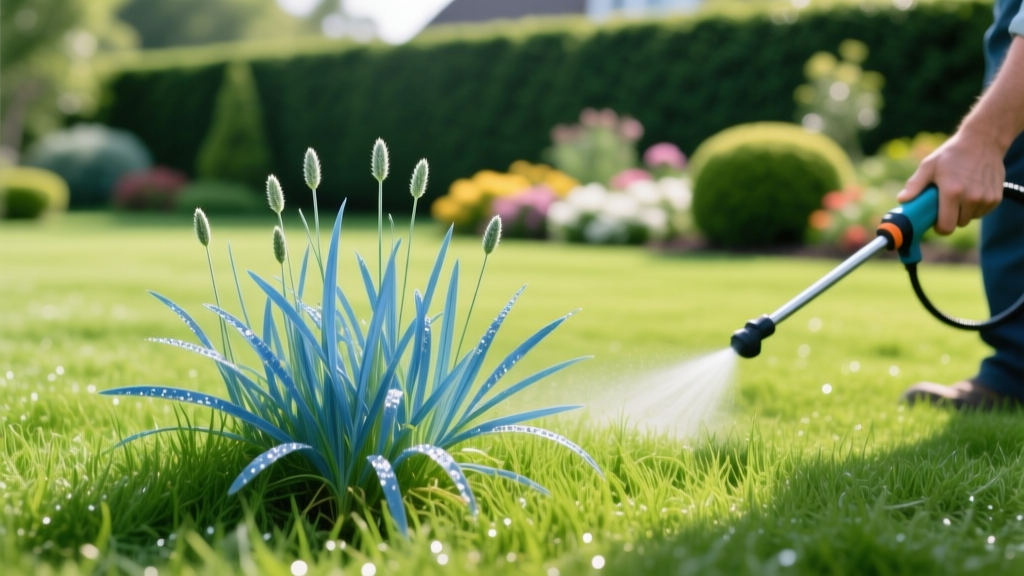
How to Spot-Treat Poa Weed: A Complete Control Guide
Poa annua, commonly known as annual bluegrass or simply poa weed, is one of the most frustrating invaders in residential turf. Unlike broadleaf weeds that stand out with distinct flowers and wide leaves, poa weed is a grassy weed. It mimics your desirable turf, making selective eradication incredibly difficult. A single poa plant can produce over 100 seeds in a single season, and those seeds can remain viable in your soil seedbank for up to five years. To reclaim your lawn, you need a targeted strategy that combines precise identification, timed pre-emergent barriers, and turf-specific post-emergent spot treatments.
Identifying Poa Weed vs. Desirable Turfgrass
Before applying any herbicide, you must confirm the invader is actually poa weed. Misidentifying it can lead to applying the wrong chemical, wasting money, and damaging your lawn. Poa annua is most easily identified by its distinct leaf tip and aggressive seed head production, even at very low mowing heights.
| Characteristic | Poa Weed (Poa annua) | Kentucky Bluegrass / Perennial Ryegrass |
|---|---|---|
| Leaf Tip Shape | Boat-shaped (canoe-like) | Pointed or tapered |
| Leaf Color | Apple green / bright light green | Dark green to emerald |
| Ligule | Long, membranous, and pointed | Short, truncate, or absent |
| Seed Heads | Produces white/panicle seed heads year-round | Only produces seed heads in late spring/early summer |
| Root System | Shallow, fibrous, easily pulled | Deep, extensive rhizomes or bunch-type roots |
Expert Insight: The "Morning Dew" Test
Poa annua leaves are highly hydrophobic compared to desirable turfgrasses. If you walk across your lawn early in the morning when dew is present, the poa weed patches will often remain visibly wet and shimmering, while the surrounding Kentucky Bluegrass or Fescue will have shed the moisture or absorbed it more evenly.
The Biology of Poa annua: Why Spot Treatment is Tricky
Understanding the lifecycle of poa weed is critical for timing your interventions. According to NC State University's TurfFiles, Poa annua is technically a winter annual in most of the United States. It germinates in late summer or early fall when soil temperatures drop below 70°F, thrives during the cool, moist months of spring, and dies off (or goes dormant) during the heat of summer, leaving behind thousands of seeds.
Because it germinates in the fall, applying standard spring pre-emergents (like those used for crabgrass) will do absolutely nothing to stop poa weed. You must shift your chemical defense to late summer.
Pre-Emergent Strategies: Stopping Poa Weed Before It Sprouts
The most effective way to manage poa weed is to prevent it from germinating. If you have a severe poa problem, a split-application pre-emergent program is the gold standard.
Timing and Soil Temperatures
Do not rely on calendar dates. Use a soil thermometer. Apply your pre-emergent when soil temperatures at a 2-inch depth consistently drop to 70°F and are trending downward. In the transition zone, this is typically late August to mid-September.
Top Pre-Emergent Herbicides for Poa Weed
- Prodiamine 65 WDG (Active ingredient: Prodiamine): The industry standard for long-lasting residual control. Apply at a rate of 0.5 to 0.83 oz per 1,000 sq ft. A 5 lb bag costs around $45 and covers up to 10,000 sq ft. It creates a chemical barrier in the top 1-2 inches of soil that halts root development in germinating seeds.
- Dimension 2EW (Active ingredient: Dithiopyr): This is a superior choice if you have missed the strict pre-emergent window. Dimension has early post-emergent activity, meaning it can kill poa weed seedlings up to the 1-tiller stage (roughly 2-3 weeks after germination). Apply at 0.4 to 0.5 fl oz per 1,000 sq ft. Expect to pay around $120 for a 2.5-gallon jug.
Warning: Overseeding Restrictions
Both Prodiamine and Dimension will prevent the germination of desirable grass seeds. If you plan to overseed your lawn with Tall Fescue or Kentucky Bluegrass in the fall, you cannot use these pre-emergents. You must choose between overseeding and poa prevention, or use a specialized, short-lived pre-emergent like Tenacity (mesotrione) which is safe for seedling turf, though it is less effective against heavy poa pressure.
Post-Emergent Spot Treatment: Killing Active Poa Weed
If the poa weed has already germinated and is visible in your lawn, pre-emergents will not help. You must use post-emergent herbicides. The product you choose depends entirely on your specific turfgrass type, as poa weed is closely related to many desirable cool-season grasses.
For Warm-Season Lawns (Bermuda, Zoysia, Centipede)
Spot treating poa in warm-season grasses is highly effective because the chemical differences between the weed and the turf are vast enough for selective herbicides to exploit.
- Revolver (Foramsulfuron): The premier choice for Bermuda and Zoysia. Apply at 0.06 to 0.14 fl oz per 1,000 sq ft. It causes the poa weed to yellow and die within 7 to 14 days without harming the warm-season turf. Note: Revolver is expensive, often retailing for $150+ for a small 27 oz bottle, but it is highly concentrated.
- Monument 75WG (Trifloxysulfuron): Excellent for nutsedge and poa annua in warm-season lawns. Apply at 0.018 to 0.03 oz per 1,000 sq ft. It requires the addition of a non-ionic surfactant (0.25% v/v) to penetrate the waxy cuticle of the poa leaves.
- Celsius WG: A great multi-purpose option for St. Augustine and Centipede grass that also suppresses poa annua, though it may require two applications spaced 3 weeks apart for complete control.
For Cool-Season Lawns (Fescue, Kentucky Bluegrass, Ryegrass)
This is where spot treatment becomes a massive challenge. Because poa weed and Kentucky Bluegrass are both in the Poa genus, herbicides that kill poa weed will often severely damage or kill your desirable bluegrass. According to Penn State Extension, selective chemical control in cool-season turf is limited and often unsatisfactory for homeowners.
- Ethofumesate (Prograss): One of the few selective options for cool-season lawns. It requires 2 to 3 applications spaced 3-4 weeks apart in the fall. It is highly expensive and difficult for homeowners to source in small quantities.
- Blindside A (Amicarbazone): Can be used on Tall Fescue and Kentucky Bluegrass, but it carries a high risk of phytotoxicity (turf yellowing) if temperatures exceed 85°F or if the lawn is drought-stressed.
- The Sponge Wiper Method (Non-Selective): For isolated patches of poa weed in a Kentucky Bluegrass lawn, the most practical and cost-effective spot treatment is using a 5% glyphosate solution applied via a sponge applicator or weed wiper. By physically wiping the sponge only on the taller poa weed seed heads, you kill the weed without spraying the surrounding desirable turf. This requires mowing your lawn slightly lower than the poa weed's seed head height to ensure selective contact.
Sprayer Calibration for Precision Spot Treatment
When spot-treating, guessing your application rate leads to herbicide failure or turf burn. Calibrate your backpack sprayer using the 1/128th acre method:
- Mark off a 20 ft x 20 ft area (400 sq ft) in your driveway.
- Fill your sprayer with plain water and spray the area at your normal walking pace and pressure.
- Measure how many ounces of water it took to cover that 400 sq ft area.
- Multiply that ounce measurement by 2.72 to find your total gallons per acre (GPA) output. Adjust your herbicide mixing ratio based on this exact output to ensure you are applying the correct active ingredient dose per 1,000 sq ft.
Cultural Controls: Outcompeting the Poa Seedbank
Chemical controls will fail if your lawn's environment favors poa weed. UC Agriculture and Natural Resources emphasizes that Poa annua thrives in specific, modifiable soil conditions.
- Alleviate Compaction: Poa weed has a shallow root system that thrives in heavily compacted soil where deeper-rooted turfgrasses struggle. Perform core aeration annually during your turf's peak growing season (fall for cool-season, late spring for warm-season).
- Adjust Irrigation: Poa requires frequent, shallow moisture. Transition your lawn to deep, infrequent watering (e.g., 1 inch of water applied once or twice a week rather than 15 minutes daily). This forces the desirable turf to root deeply while starving the shallow poa roots.
- Raise Mowing Heights: Poa annua can survive mowing heights as low as 0.125 inches (which is why it infests golf course greens). However, in a residential lawn, raising your mowing height to 3.5 or 4 inches shades the soil, preventing poa seeds from receiving the sunlight required to germinate, while allowing desirable turf to canopy and choke it out.
- Correct Soil pH: Poa weed tolerates acidic soils much better than Kentucky Bluegrass or Fescue. Test your soil and apply pelletized lime to raise the pH to the optimal 6.5 - 7.0 range.
Frequently Asked Questions
Will poa weed die on its own in the summer?
Yes, Poa annua is a winter annual and will naturally brown out and die when summer temperatures consistently exceed 85°F. However, before it dies, it drops thousands of seeds into the soil. Relying on summer heat to kill it guarantees a massive resurgence the following fall. You must manage the seedbank.
Can I use crabgrass preventer to stop poa weed?
Standard spring crabgrass preventers (like Halts or standard Scotts Weed & Feed) are applied in April or May. Poa weed germinates in August and September. Applying pre-emergents in the spring will offer zero residual control for fall-germinating poa weed. You must apply a dedicated pre-emergent in late summer.
Is poa weed the same as rough bluegrass?
No. Poa annua (annual bluegrass) completes its lifecycle in one year and has a shallow root system. Poa trivialis (rough bluegrass) is a perennial that spreads via stolons, thrives in heavy shade, and turns a severe purplish-red color in the winter. They require entirely different chemical management strategies.

