
Lawn Care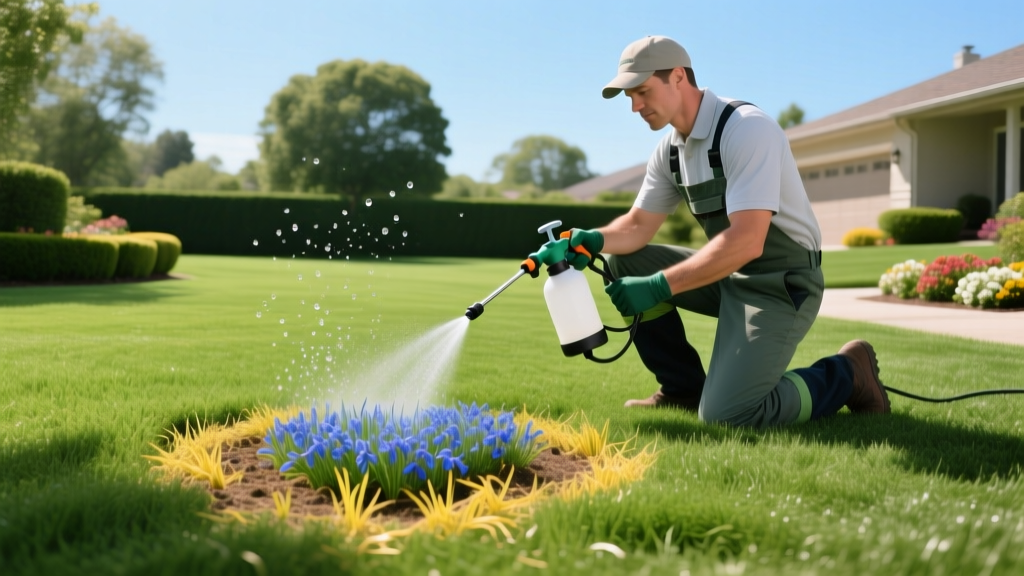
How to Choose the Right Poa Grass Killer for Spot-Treatment
Identifying Your Poa Invader: Annua vs. Trivialis
Before selecting a poa grass killer, you must accurately identify which species is invading your turf. Poa annua (annual bluegrass) and Poa trivialis (rough bluegrass) require fundamentally different management strategies. Poa annua is a winter annual that germinates in late summer, thrives in cool weather, and dies off in late spring, leaving bare patches. Poa trivialis is a perennial that spreads via stolons and thrives in damp, shaded areas. According to Penn State Extension, misidentifying these species is the leading cause of herbicide failure in residential lawns.
| Feature | Poa Annua (Annual) | Poa Trivialis (Perennial) | Desired Cool-Season Turf |
|---|---|---|---|
| Leaf Tip Shape | Boat-shaped (prow-like) | Pointed | Pointed or V-shaped |
| Vernation (Leaf Folding) | Folded | Folded | Rolled (Bluegrass) or Folded (Fescue) |
| Color | Light, apple green | Light, yellowish green | Dark to medium green |
| Seedhead Production | Prolific, even at low mowing heights | Rarely produces seedheads in lawns | Minimal during regular mowing |
| Root System | Shallow, fibrous | Shallow, stoloniferous | Deep, extensive |
Post-Emergent Poa Grass Killer Chemistry Breakdown
Selective post-emergent control of Poa in cool-season lawns is notoriously difficult because Poa is genetically very close to desirable turfgrasses like Kentucky bluegrass and perennial ryegrass. Broadcast spraying is rarely an option; precision spot-treatment is required. Here is a breakdown of the active ingredients available to homeowners and turf professionals.
Warning on Non-Selective Herbicides: Glyphosate (Roundup) will kill Poa, but it will also kill your desirable turf. Never use glyphosate as a broadcast spray or spot-spray during the active growing season of cool-season lawns. It is strictly reserved for the 'dormant window' technique detailed below.
Selective Options for Active Growth
- Ethofumesate (Prograss): This is the gold standard for selective post-emergent Poa annua control. It inhibits cell division in the weed. Dosage: 1.5 to 3.0 fl oz per 1,000 sq ft. Cost: High (approximately $180-$220 per gallon). Protocol: Requires two applications spaced 3 to 4 weeks apart for mature clumps. It is highly effective but cost-prohibitive for broadcast use, making it ideal for targeted spot-treatments.
- Mesotrione (Tenacity): An HPPD inhibitor that causes the Poa to bleach white and starve. Dosage: 1/2 teaspoon per gallon of water + 1 tsp non-ionic surfactant. Cost: Moderate ($60 for 4 oz). Limitation: Tenacity is excellent for preventing Poa seedlings and controlling young plants, but it often fails to kill mature, established Poa annua clumps. It also temporarily bleaches desirable Kentucky bluegrass, which can be visually jarring.
- Amicarbazone (Xonerate): Primarily used by professionals on golf courses, this photosystem II inhibitor is highly effective on Poa trivialis and Poa annua. It is rarely available in consumer-sized packaging and requires strict temperature adherence (apply only when daytime highs are below 70°F to avoid turf phytotoxicity).
The 'Dormant Window' Spot-Spraying Technique
The most cost-effective and aggressive poa grass killer strategy for cool-season lawns utilizes a biological loophole: the thermal dormancy gap. Poa annua remains actively photosynthesizing at temperatures as low as 20°F, while desirable turfgrasses like Tall Fescue and Kentucky Bluegrass enter physiological dormancy when soil temperatures drop below 40°F.
By applying a 1.5% to 2.0% solution of glyphosate (using a 41% concentrate like Roundup Pro) during late January or early February, you can spot-spray active Poa clumps. The desirable turf is dormant and will not absorb the herbicide systemically, but the Poa annua is actively growing and will translocate the glyphosate to its roots, resulting in a complete kill. According to NC State TurfFiles, this winter application drastically reduces the spring seedhead flush and subsequent summer bare spots.
Pro Tip: Add a blue dye indicator (like Blazon) to your dormant glyphosate mix. Because desirable turf is brown or dormant, it is easy to lose track of where you have sprayed. The dye ensures you do not accidentally double-apply and cause localized soil sterility issues.
Step-by-Step Spot-Treatment Protocol
Follow this precise framework when executing a spot-treatment for active Poa outbreaks during the fall or spring.
- Calibrate Your Spot Sprayer: Use a dedicated 1-gallon or 2-gallon pump sprayer (e.g., Chapin 20000). Spray a known volume of plain water over a 10x10 ft area (100 sq ft) on your driveway to determine your exact output rate. Adjust your walking speed and nozzle pressure to deliver exactly 1 gallon per 1,000 sq ft.
- Mix the Surfactant First: Fill the sprayer halfway with water. Add a Non-Ionic Surfactant (NIS) at a rate of 0.25% v/v (roughly 1 teaspoon per gallon). Poa leaves have a waxy cuticle; without a surfactant, the herbicide beads up and rolls off.
- Add the Herbicide: Add your chosen selective herbicide (e.g., Ethofumesate or Tenacity) based on your calibrated output. Agitate the tank thoroughly.
- Execute the Spot Spray: Approach the Poa clump from upwind. Hold the nozzle 12 to 18 inches above the turf. Apply a fine mist directly to the center of the Poa clump, stopping just before the liquid begins to run off the leaf tips. Do not spray to the point of puddling on the soil, as this wastes chemical and increases the risk of root uptake by desirable turf.
- Mark the Treated Area: Place a small landscaping flag or use the aforementioned blue dye to mark the treated clump. Poa annua requires a follow-up application 21 to 28 days later to catch any late-germinating seedlings hidden beneath the parent plant canopy.
Cultural Prevention Tactics
Chemical control is only a temporary fix if the underlying soil conditions favor Poa. The University of California IPM program emphasizes that Poa annua is an indicator species for specific soil deficiencies. Implement these cultural controls to prevent re-establishment:
- Alleviate Soil Compaction: Poa thrives in compacted soils where desirable turf roots cannot penetrate. Perform core aeration annually in the early fall. Remove 3-inch deep plugs at a density of 20-30 holes per square foot.
- Adjust Irrigation Frequency: Poa has a shallow root system (top 2 inches of soil). Transition your lawn to deep, infrequent watering (1 to 1.5 inches per week applied in a single session). This forces desirable turf roots deeper while starving the shallow Poa roots during dry intervals between waterings.
- Raise the Mowing Height: Poa annua can produce seedheads at a 1-inch mowing height. Raising your mower deck to 3.5 or 4.0 inches shades the soil surface, preventing Poa seeds from receiving the sunlight required for germination in late August.
- Correct Phosphorus Levels: High soil phosphorus levels heavily favor Poa annua establishment. Conduct a soil test and avoid using 'starter fertilizers' (high in phosphorus, like 10-18-10) on established lawns unless a soil test explicitly dictates a deficiency.
Frequently Asked Questions
Can I use pre-emergent herbicides to stop Poa annua?
Yes, pre-emergents are the most effective long-term strategy. Apply Prodiamine (Barricade) or Dithiopyr (Dimension) in late summer when soil temperatures at a 2-inch depth drop to 70°F. This creates a chemical barrier that prevents Poa seeds from germinating in the fall. However, pre-emergents will not kill existing Poa clumps, which is why post-emergent spot-treatment is necessary for current outbreaks.
Why does my Poa turn yellow and die in the summer?
Poa annua is a winter annual. It naturally completes its life cycle and dies when summer heat stress arrives and soil temperatures exceed 75°F. The goal of spring spot-treatment is not just to kill the visible plant, but to prevent it from dropping thousands of seeds into the soil seedbank before it naturally dies off.
Is Poa trivialis harder to kill than Poa annua?
Significantly harder. Because Poa trivialis is a perennial that spreads via above-ground stolons, spot-spraying a single clump often misses the connected runner network. Ethofumesate (Prograss) offers some suppression, but complete eradication of Poa trivialis often requires localized renovation: killing the affected patch with glyphosate, raking out the dead matter, and reseeding with a certified bluegrass or fescue blend.

