
Lawn Care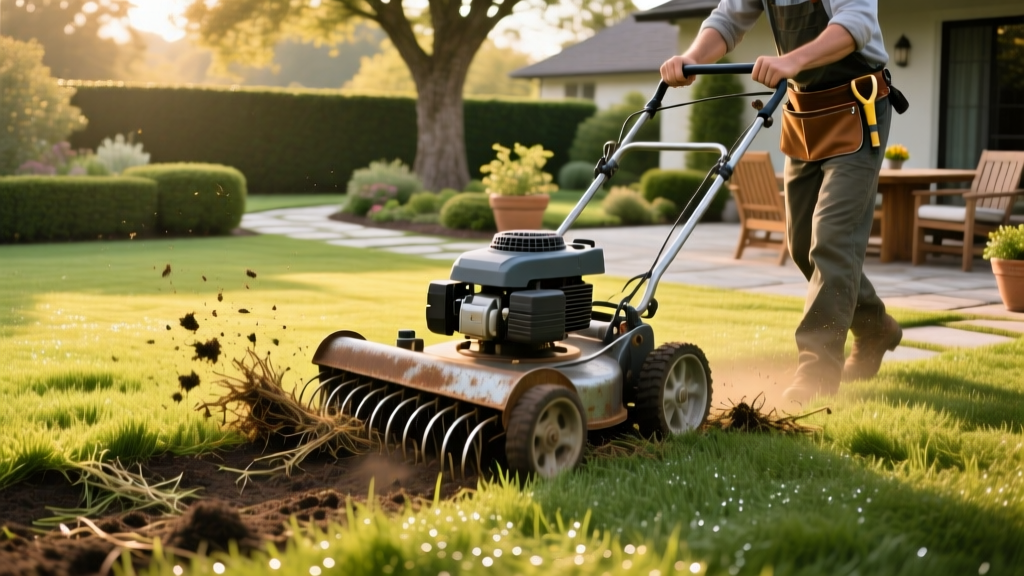
Power Rake Lawn Equipment: Selection, Setup, and Maintenance Guide
The Mechanics: Power Rake vs. Dethatcher vs. Verticutter
Before investing time or capital into equipment, it is critical to distinguish a true power rake from consumer-grade dethatchers. While often used interchangeably in big-box stores, these machines operate on fundamentally different mechanical principles and serve distinct agronomic purposes.
A power rake utilizes a rotating shaft equipped with free-swinging steel flails (or rigid tines on commercial models) that physically rip and lift thatch from the soil profile. The kinetic energy of the flails shatters the thatch layer, making it the most aggressive option for lawns with over 0.75 inches of thatch accumulation. According to University of Minnesota Extension, mechanical removal via power raking is necessary when microbial decomposition fails to keep pace with thatch production, particularly in heavily fertilized Kentucky Bluegrass lawns.
| Equipment Type | Cutting Mechanism | Aggressiveness | Best Use Case |
|---|---|---|---|
| Power Rake | Free-swinging steel flails / rigid tines | High | Severe thatch (>0.75"), pre-overseeding prep |
| Dethatcher | Flexible spring tines | Low to Medium | Annual maintenance, light thatch (<0.5") |
| Verticutter | Solid, fixed vertical blades | Medium (cuts deep) | Stolon severing, grooving soil for seed contact |
Equipment Selection: Rent, Buy, or Go Electric?
Choosing the right power rake lawn equipment depends entirely on your property size, grass type, and budget. Commercial-grade gas models deliver the torque necessary to penetrate compacted thatch layers, while electric models are strictly for superficial grooming.
Commercial Gas Models (For Properties > 10,000 sq. ft.)
If you are managing large estates or operating a lawn care business, buying a commercial unit is mandatory. The Billy Goat PR550H (powered by a Honda GX160 engine) remains the industry benchmark in 2026, retailing around $4,200 to $4,600. It features a 5-blade rotor with 40 free-swinging flails and an adjustable depth lever that locks securely over uneven terrain. A comparable alternative is the Classen PR-18H, which offers a slightly heavier chassis for better traction on sloped terrain, priced near $4,800.
Rental Units (For 2,000 – 10,000 sq. ft.)
For most homeowners, renting is the most economically sound choice. Expect to pay between $95 and $140 for a 4-hour rental from equipment yards like Sunbelt Rentals or local hardware cooperatives. Pro Tip: Always inspect the rental machine's flails before leaving the lot. If the steel flails are rounded off or worn down by more than 15%, request a different unit; worn flails will tear the grass crowns rather than slicing the thatch.
Consumer Electric Models (For < 5,000 sq. ft.)
Electric models, such as the Sun Joe AJ801E (12-amp, ~$160), are technically dethatchers that use spring tines, despite being marketed as power rakes. They lack the downward force and rotational mass to extract deep thatch but are adequate for lightly scarifying the surface before overseeding thin fescue lawns.
Warning: The Torque Deficit of Electric Models
Do not attempt to power rake a thick Bermuda or Zoysia lawn with a 12-amp electric unit. Warm-season grasses have dense, fibrous stolons that will wrap around the lightweight rotor shafts of electric models, causing immediate motor burnout and voiding the manufacturer warranty.
Calibrating Blade Depth (The Make-or-Break Step)
The most common mistake in power raking is setting the flails too deep, which scalp the lawn and destroy the crown tissue. Proper calibration requires testing on a concrete surface before engaging the turf.
The Concrete Test Procedure
- Lower the machine onto a flat concrete driveway or sidewalk.
- Adjust the depth lever so the tips of the flails just barely kiss the concrete surface (you should hear a light, metallic tapping sound).
- This represents the 'zero' point. When moved to the lawn, the flails will penetrate the soil exactly as deep as the thatch layer allows, preventing soil gouging.
Grass-Specific Depth Adjustments
According to turf management guidelines from Penn State Extension, the target depth varies strictly by grass species and rhizome structure:
- Cool-Season Grasses (Kentucky Bluegrass, Tall Fescue, Ryegrass): Set flails to penetrate 1/4 inch into the soil surface. This severs the thatch layer without damaging the deep crown.
- Warm-Season Grasses (Bermuda, Zoysia): Set flails to skim the surface (0 inch soil penetration). Warm-season grasses spread via shallow stolons; penetrating the soil will rip out the rhizomes and severely delay spring green-up.
- Centipede Grass: Avoid power raking entirely. Centipede lacks the vigor to recover from aggressive mechanical trauma; use a manual thatch rake or a light verticutter instead.
Post-Operation Machine Maintenance
Power rakes operate in high-dust, high-vibration environments. Neglecting post-operation maintenance leads to rotor seizure and drive belt failure. Implement this 5-step maintenance protocol immediately after cleaning the chassis:
- Rotor Bearing Lubrication: Locate the grease zerks on both ends of the rotor shaft. Pump exactly two strokes of lithium-complex grease (NLGI #2) into each zerk. Over-greasing will blow out the bearing seals, allowing dirt to infiltrate the housing.
- Drive Belt Tension Check: Press down on the center of the drive belt connecting the engine pulley to the rotor pulley. It should deflect exactly 1/2 inch under moderate thumb pressure. If it deflects more, loosen the engine mount bolts and slide the engine forward to tighten.
- Flail Inspection: Remove the rotor guard and inspect the flails. Replace any flail that is bent, cracked, or worn past the manufacturer's wear line. Always replace flails in complete sets to maintain rotor balance; replacing a single flail will cause violent chassis vibration at 3,000 RPM.
- Air Filter Service: The Honda GX engines used in most commercial units feature dual-element air filters. Tap the paper element to dislodge dust, and wash the foam pre-filter in warm soapy water, letting it dry completely before re-oiling.
- Chassis Washdown: Use a pressure washer on a wide-fan, low-pressure setting to blast caked mud from the underside. Never direct high-pressure water at the bearing housings or the engine carburetor intake.
Troubleshooting Common Power Rake Failures
'If the machine is vibrating so hard your hands go numb, you are either running on uneven terrain with the depth set too low, or your rotor is out of balance due to a missing flail or a buildup of hardened mud on one side of the shaft.' — Commercial Turf Equipment Service Manual
Diagnostic Matrix
| Symptom | Probable Cause | Corrective Action |
|---|---|---|
| Machine pulls heavily to the left or right | Uneven depth lever settings or worn drive tires | Recalibrate depth levers on both sides to identical notches; check tire pressure (usually 25-30 PSI). |
| Engine bogs down or stalls in thick turf | Flails set too deep, overloading the engine | Raise the depth lever one or two notches; make a second pass if necessary rather than forcing a deep single pass. |
| Thatch is torn, not cleanly extracted | Dull or rounded flail knives | Replace the entire set of flails; do not attempt to sharpen free-swinging flails as it alters their weight and balance. |
| Rotor spins slowly despite high engine RPM | Glazed or slipping drive belt | Adjust tension to 1/2 inch deflection; if the belt is shiny or cracked, replace it with an OEM matched Kevlar-reinforced belt. |
Mastering the power rake lawn technique requires respecting the mechanical limits of the equipment and the biological limits of the turf. By selecting the appropriate machine class, calibrating the depth to the exact millimeter, and adhering to strict bearing and belt maintenance, you will extract maximum thatch while preserving the structural integrity of both the lawn and the machine.

