
Lawn Care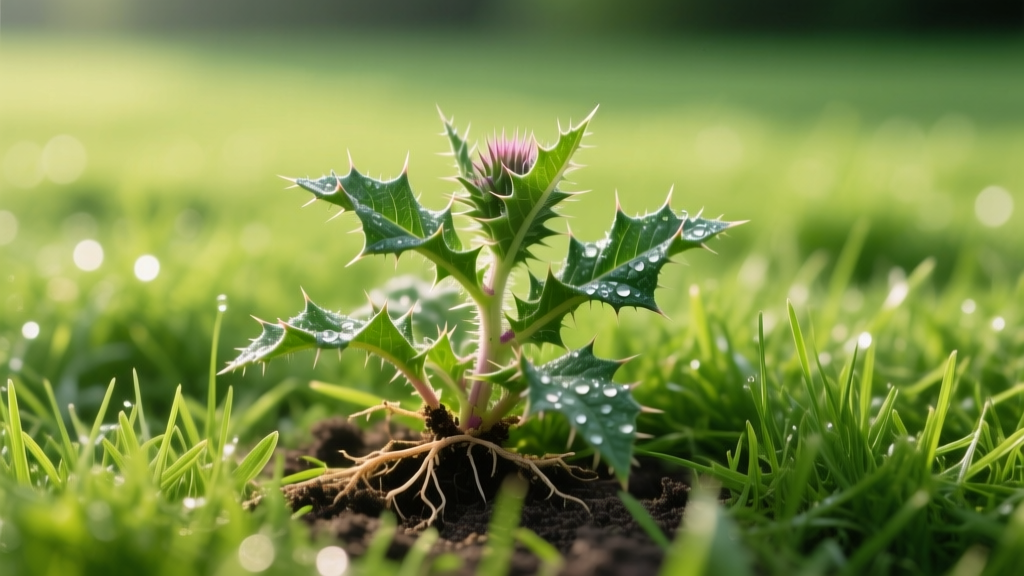
Prickly Weeds in Grass: Identification and Spot-Treatment Guide
Stepping on a lawn burweed or goathead barefoot is a quick way to ruin a weekend. Prickly weeds in grass are not just an aesthetic nuisance; they are a physical hazard to children, pets, and anyone enjoying the yard. Unlike broadleaf weeds like dandelions that simply disrupt turf uniformity, spiky weeds produce hardened, sharp burs or thorns that can puncture skin, bicycle tires, and even thick work boots.
Eradicating these weeds requires more than a generic 'weed and feed' application. Their unique life cycles, waxy leaf cuticles, and deep taproots demand targeted spot-treatment protocols. This guide breaks down the exact identification markers, chemical mixing rates, and cultural controls needed to eliminate the most common prickly weeds invading residential lawns.
The Big Four: Identifying Prickly Weeds in Grass
Before mixing any herbicide, you must correctly identify the invader. Misidentifying a winter annual as a perennial will lead to failed pre-emergent timing and wasted chemicals. Use the matrix below to diagnose the specific prickly weed in your turf.
| Weed Species | Leaf Structure | Burr / Seed Characteristics | Peak Season | Root System |
|---|---|---|---|---|
| Lawn Burweed (Soliva sessilis) | Feathery, finely dissected, low-growing rosette | Hard, sharp, spiky burs that cling to fur and skin | Winter Annual (Germinates fall, seeds spring) | Shallow taproot |
| Sandbur (Cenchrus echinatus) | Flat, rough, pale green blades with a prominent midrib | Spherical, heavily spiked 'sandburs' | Summer Annual | Fibrous, shallow |
| Goathead (Tribulus terrestris) | Compound, hairy, opposite leaflets on reddish stems | Woody, triangular caltrops with 1-inch piercing spikes | Summer Annual (Thrives in heat/drought) | Deep, woody taproot |
| Prickly Thistles (Cirsium spp.) | Large, lobed, deeply spined leaves with woolly undersides | Fluffy seed heads (no sharp burrs, but leaves are highly spined) | Biennial or Perennial | Extensive, deep taproot and rhizomes |
Targeted Spot-Treatment Protocols
Generic herbicides often fail against prickly weeds due to their specialized defenses. Goathead leaves are covered in trichomes (hairs) that repel water-based sprays, while thistles have thick, waxy cuticles. Below are the precise chemical protocols for each species.
1. Lawn Burweed and Sandbur (The Annual Spikers)
Lawn burweed is notoriously difficult to kill once it forms burs in early spring. The most effective strategy is a two-pronged approach: a fall pre-emergent and a late-winter post-emergent.
- Pre-Emergent (Fall): Apply Isoxaben (e.g., Gallery 75 DF) when soil temperatures at a 2-inch depth drop below 70°F, typically in early September to October. The exact rate is 0.38 to 0.5 lbs of product per 1,000 square feet. This creates a chemical barrier that stops burweed seeds from germinating.
- Post-Emergent (Winter/Early Spring): If rosettes appear, use a multi-active-ingredient ester formulation like SpeedZone (carfentrazone, 2,4-D, MCPP, and dicamba). Mix at a rate of 1.5 to 2.0 fluid ounces per gallon of water to cover 1,000 square feet. Critical: You must add a non-ionic surfactant (NIS) at 0.25% v/v (roughly 1 teaspoon per gallon) to break the surface tension and allow the herbicide to penetrate the feathery leaves.
2. Eradicating Goathead (Puncturevine)
According to the University of California Integrated Pest Management program, puncturevine is highly adapted to dry, compacted soils and produces seeds that remain viable for up to five years. Because of its hairy leaves, standard amine-based 2,4-D will bead up and roll off.
- Chemical Control: Use an ester-based herbicide containing Triclopyr or a specialized Fluroxypyr blend. Esters penetrate the waxy, hairy cuticle far better than amines, especially when daytime temperatures are between 65°F and 80°F. Spot-treat individual plants rather than broadcasting, as goathead usually invades in localized patches.
- Mechanical Extraction: If the plant has already dropped its woody caltrops, herbicides will not destroy the existing spikes. You must manually pull the plant, ensuring you extract the entire taproot. Use a stand-up weeder with a deep V-notch claw to lever the root out without snapping it.
3. Defeating Prickly Thistles (Canada and Bull Thistle)
Thistles are biennials or perennials that spend their first year as a low-growing, spiny rosette before shooting up a tall, prickly flower stalk in year two. The University of Minnesota Extension emphasizes that treating thistles in the rosette stage is critical for long-term control.
- Rosette Stage Treatment: Spot-treat with Aminopyralid (e.g., Milestone) or a high-concentration 2,4-D ester. Aminopyralid is highly effective on thistles because it translocates down into the deep taproot, killing the root system rather than just burning off the top growth. Apply at 5 to 7 fluid ounces per acre (roughly 0.15 fl oz per 1,000 sq ft) mixed with a methylated seed oil (MSO) surfactant.
- Timing Restriction: Never apply volatile ester herbicides when temperatures exceed 85°F. The chemicals will vaporize and drift, causing severe phytotoxicity (leaf cupping and twisting) to your desirable turfgrass and nearby ornamental plants.
Cultural Controls: Fixing the Underlying Soil Issues
Chemical spot-treatments are only a temporary fix if your lawn's environment is perfectly calibrated for prickly weeds. The Texas A&M AgriLife Extension notes that lawn burweed is a primary indicator weed for severely compacted soil and low nitrogen levels.
Warning: The Compaction Connection
If your lawn is overrun with burweed or goathead, your soil is likely compacted to a bulk density above 1.5 g/cm³. These weeds thrive where turfgrass roots suffocate. Applying herbicide without addressing compaction guarantees the weeds will return next season.
- Core Aeration: Perform core aeration in the active growing season of your specific turfgrass (late spring for warm-season grasses like Bermuda and Zoysia; early fall for cool-season grasses like Fescue and Kentucky Bluegrass). Pull plugs that are at least 3 inches deep and 0.5 inches wide.
- Topdressing: Immediately after aeration, topdress the lawn with a 1/4-inch layer of screened compost. This introduces organic matter into the aeration holes, improving soil structure and water infiltration.
- Nitrogen Loading: Prickly weeds are poor competitors against dense, vigorously growing turf. Shift your fertilizer program to deliver 3 to 4 pounds of actual nitrogen per 1,000 square feet annually, split across 3 to 4 applications, to force the turfgrass to choke out weed seedlings.
2026 Herbicide Cost & Coverage Matrix
Budgeting for a full-season prickly weed eradication program requires understanding the cost-per-thousand-square-foot metrics of professional-grade chemicals versus consumer-grade retail products.
| Product Category | Active Ingredient(s) | Approx. Cost (2026) | Coverage per Container | Cost per 1,000 sq ft |
|---|---|---|---|---|
| Pre-Emergent (Pro) | Isoxaben (Gallery 75 DF) | $110 - $130 (2 lb jug) | ~4,000 - 5,200 sq ft | $0.02 - $0.03 |
| Post-Emergent (Pro) | Carfentrazone + 2,4-D (SpeedZone) | $65 - $80 (1 pint) | ~10,000 - 14,000 sq ft | $0.005 - $0.008 |
| Systemic Thistle (Pro) | Aminopyralid (Milestone) | $140 - $160 (1 pint) | ~14,000 - 20,000 sq ft | $0.007 - $0.01 |
| Retail 'Weed & Feed' | Low-dose 2,4-D + Mecoprop | $25 - $35 (10 lb bag) | ~5,000 sq ft | $0.005 - $0.007 |
Pro-Tip: While retail 'Weed & Feed' products appear cheap upfront, their low active-ingredient concentrations rarely penetrate the cuticles of mature goathead or thistle plants, resulting in wasted money and chemical runoff. Investing in a concentrated professional ester formulation yields a higher first-kill success rate.
Frequently Asked Questions
Will mowing my lawn shorter kill prickly weeds?
No. In fact, scalping your lawn (mowing below 1.5 inches) removes the turfgrass canopy, allowing sunlight to hit the soil surface. This triggers the germination of buried burweed and sandbur seeds. Maintain your turf at the highest recommended height for your specific grass species (e.g., 2.5 to 3 inches for Tall Fescue) to shade out weed seedlings.
Can I use vinegar to kill goathead and thistles?
Horticultural vinegar (20% to 30% acetic acid) is a non-selective contact desiccant. It will burn the top growth of a prickly weed, but it will not translocate to the taproot. The weed will simply resprout from the root within two weeks. Furthermore, high-concentration acetic acid is highly corrosive, dangerous to handle without PPE, and will permanently alter your soil pH if repeatedly applied.
How do I safely dispose of pulled goathead plants?
Do not put pulled goathead or burweed plants in your municipal compost bin or standard yard waste bags if they have already formed seeds. Most municipal composting facilities do not reach the sustained 140°F+ temperatures required to destroy the hard seed coats of these weeds. Bag them in heavy-duty contractor trash bags and send them to the landfill to prevent spreading the seeds to other neighborhoods.

