
Lawn Care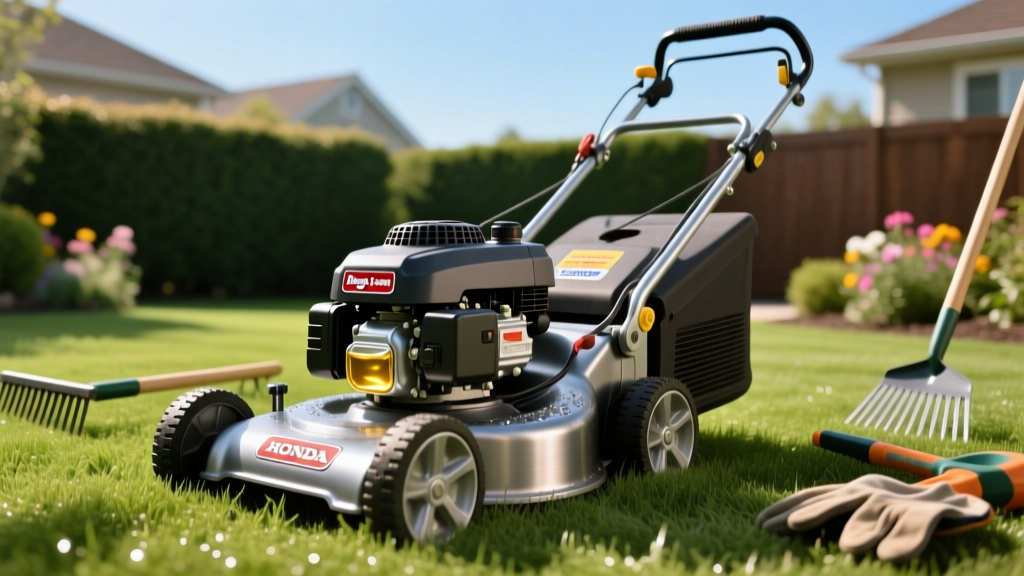
The Right Push Mower Oil Type for Briggs, Honda, and Toro Engines
Selecting the correct push mower oil type is the single most critical maintenance decision you make for your lawn equipment. Unlike liquid-cooled automobile engines that operate at a steady 195°F to 220°F, the air-cooled small engines found in push mowers routinely see cylinder head temperatures exceeding 300°F. This extreme thermal load causes inferior or incorrect oils to oxidize, sludge, and lose viscosity, leading directly to piston scoring and catastrophic engine seizure.
This guide details the exact viscosity grades, API service classifications, and manufacturer-specific requirements for the most common residential push mower engines on the market.
The Critical Role of Viscosity in Air-Cooled Engines
Viscosity defines an oil's resistance to flow. Small engine manufacturers engineer their bearing clearances and oil splash lubrication systems around specific viscosity thresholds. Using an oil that is too thin (like 5W-20 automotive oil) will result in the oil film tearing under the high heat of an air-cooled cylinder. Using an oil that is too thick (like 20W-50) in cold weather will starve the splash lubricator, causing immediate dry-start wear on the connecting rod and crankshaft.
Warning: 4-Cycle vs. 2-Cycle Engines
The vast majority of modern push mowers (including all current Briggs, Honda, and Toro models) utilize 4-cycle engines requiring separate oil and gas. If you are operating an older or specialized 2-cycle push mower, you must not use standard crankcase oil; instead, you must mix TC-W3 or JASO FD certified 2-stroke oil directly into the gasoline at a 50:1 ratio. Adding 4-cycle oil to a 2-cycle gas mix will destroy the engine.
The vast majority of modern push mowers (including all current Briggs, Honda, and Toro models) utilize 4-cycle engines requiring separate oil and gas. If you are operating an older or specialized 2-cycle push mower, you must not use standard crankcase oil; instead, you must mix TC-W3 or JASO FD certified 2-stroke oil directly into the gasoline at a 50:1 ratio. Adding 4-cycle oil to a 2-cycle gas mix will destroy the engine.
Decoding the Push Mower Oil Type: SAE 30 vs. 10W-30 vs. Synthetic
When browsing the small engine aisle, you will primarily encounter three oil formulations. Here is how they perform under real-world mowing conditions.
| Oil Type | Optimal Temp Range | Best Application | Avg. Cost (Quart) |
|---|---|---|---|
| SAE 30 (Conventional) | 40°F to 100°F+ | Standard summer mowing; consistent warm climates. | $5.00 - $7.00 |
| 10W-30 (Conventional) | 0°F to 100°F | Variable seasons; early spring/fall mowing with cold starts. | $6.00 - $8.00 |
| 5W-30 / 10W-30 (Full Synthetic) | -20°F to 120°F+ | Extreme heat, heavy wet grass, commercial use, maximum protection. | $10.00 - $14.00 |
Manufacturer-Specific Oil Requirements
While the physics of air-cooled engines remain constant, original equipment manufacturers (OEMs) have distinct baseline recommendations based on the specific bearing tolerances of their engine blocks.
Briggs & Stratton Engines
Briggs & Stratton, the most common engine found on push mowers, officially recommends SAE 30 for operating temperatures above 40°F (4°C). If you are starting your mower in temperatures below 40°F, they mandate switching to 10W-30 to ensure the oil reaches the camshaft and lifters before metal-on-metal wear occurs. For maximum protection against the thermal breakdown common in late-summer mowing, Briggs produces a proprietary Small Engine Full Synthetic 5W-30, which resists oxidation significantly better than standard automotive synthetics.
Honda GCV Series (GCV160 / GCV190)
Honda's legendary GCV series engines (found on the Honda HRX and HRR push mowers) feature a slightly different internal oil gallery design. Honda's official maintenance manual lists 10W-30 as the primary, year-round recommendation, regardless of ambient temperature. SAE 30 is listed only as an acceptable alternative if 10W-30 is unavailable. Honda engines are particularly sensitive to overfilling; the GCV160 holds exactly 18.6 oz (0.55 Liters). Exceeding this by even 2 ounces will cause the crankshaft to whip the oil into a foam, leading to immediate lubrication starvation.
Toro Recycler and Super Recycler Models
Toro push mowers are typically powered by either Briggs & Stratton engines or Toro's own branded engines (manufactured by Loncin or Kawasaki). For Toro-branded 4-cycle engines, the factory fill and primary recommendation is 10W-30. Toro specifically warns against using automotive oils labeled with friction modifiers, as these can interfere with the internal governor mechanisms and cause erratic RPM surging.
API Service Classifications: The 'Resource Conserving' Trap
The American Petroleum Institute (API) classifies motor oils based on their detergent packages and anti-wear additives. For small air-cooled engines, you must look for the API 'Donut' symbol on the back of the bottle. Acceptable current and legacy classifications for push mowers include API SJ, SL, SM, SN, and SP.
Critical Selection Rule: Never use an oil where the API Donut explicitly states 'Resource Conserving' or 'Energy Conserving' in the lower half of the circle. These automotive oils contain friction modifiers (like molybdenum) designed to improve car fuel economy. In a small mower engine, these modifiers can cause carbon deposits to bake onto the piston rings and cylinder walls, leading to blow-by, excessive oil consumption, and eventual engine failure.
According to the American Petroleum Institute's engine oil guidelines, the shift to API SP (the newest standard) offers improved timing chain protection and sludge control, making it an excellent, backward-compatible choice for your push mower if a dedicated small-engine oil is unavailable.
Step-by-Step: Checking and Changing Your Mower Oil
Proper maintenance requires exact procedures. According to University of Minnesota Extension small engine maintenance protocols, oil should be changed after the first 5 hours of use on a new mower, and every 50 hours or annually thereafter.
- Warm the Engine: Run the mower for 3 minutes. Warm oil suspends carbon particles and drains completely, whereas cold oil leaves sludge in the crankcase.
- Disconnect the Spark Plug: Pull the rubber boot off the spark plug wire to prevent accidental ignition while tilting the mower.
- Drain the Oil: Place a catch pan beneath the drain plug. Use a 3/8-inch or 1/2-inch socket to remove the plug. If your mower lacks a drain plug, carefully tilt the mower on its side (always tilt with the carburetor and air filter facing UP to prevent oil from flooding the intake).
- Reinstall the Drain Plug: Clean the threads and reinstall. For Briggs & Stratton engines, torque the drain plug to exactly 14 ft-lbs. Overtightening will strip the soft aluminum crankcase threads, requiring a costly helicoil repair.
- Fill to the Exact Capacity: Use a funnel. Pour slowly. Most 140cc-190cc push mower engines hold between 15 oz and 20 oz. Do not dump in a full 32 oz quart.
- Read the Dipstick Correctly: Insert the dipstick but do not thread it in. Rest it on top of the threads to get the accurate reading. The oil level must sit exactly at the top crosshatch mark.
Common Failure Mode: Overfilling is responsible for nearly 40% of small engine smoking complaints. When the oil level is too high, the spinning crankshaft aerates the oil. This foam is compressible and cannot maintain the hydrodynamic wedge required to protect the bearings, resulting in a spun connecting rod.
Frequently Asked Questions
Can I use regular automotive 10W-30 in my push mower?
Yes, but with a major caveat. You can use standard automotive 10W-30 only if it does not carry the 'Resource Conserving' label on the API donut. Many modern 5W-20 and 5W-30 automotive oils contain friction modifiers that harm small engines. Always opt for oils explicitly labeled for 'Small Engines' or 'Lawn & Garden' to ensure the correct detergent package.
My mower is burning oil and smoking blue. Will thicker oil fix it?
Switching from SAE 30 to a heavier oil like 15W-40 or 20W-50 is a temporary band-aid for worn piston rings or a scored cylinder wall. While a heavier oil might reduce blue smoke for a few mows due to its higher resistance to slipping past the rings, it will not fix the mechanical wear. The correct solution is a cylinder hone and new piston rings, or an engine replacement if the bore is out of specification.
How do I dispose of old push mower oil?
Never pour small engine oil into storm drains, soil, or household trash. Pour the used oil into the empty plastic bottle from the new oil, seal it tightly, and take it to any local auto parts store (such as AutoZone, Advance Auto Parts, or O'Reilly), which are legally mandated to accept used motor oil for recycling free of charge.

