
Lawn Care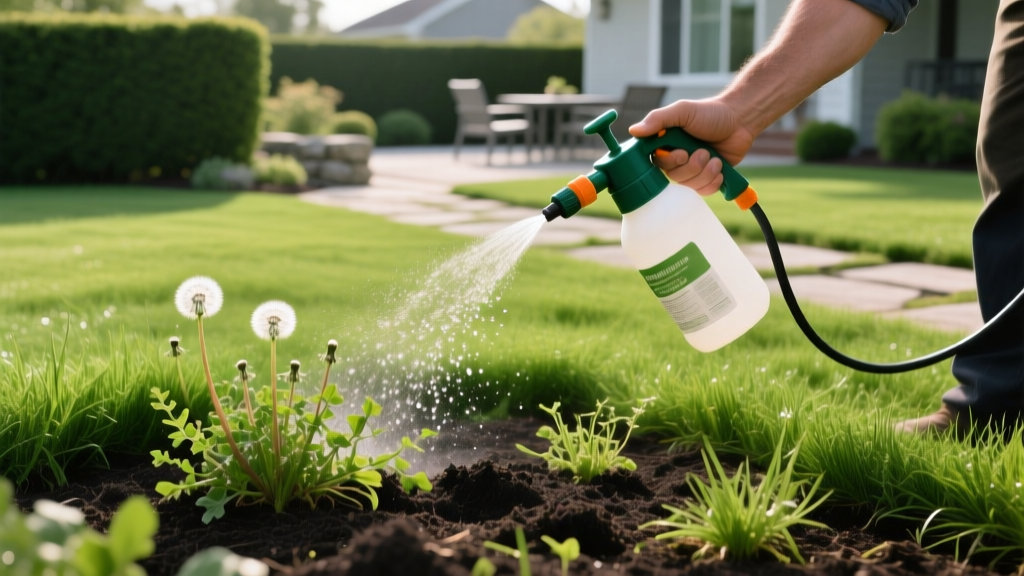
DIY Recipe for Weed Control: Spot-Treatment Formulas for Stubborn Weeds
The Economics and Ecology of Precision Spot-Treatment
Blanket spraying your entire lawn with broad-spectrum herbicides is an outdated practice that degrades soil microbiology, wastes capital, and accelerates herbicide resistance. A targeted recipe for weed control relies on spot-treating specific weed species with customized chemical or organic profiles. In 2026, with retail ready-to-use (RTU) herbicides averaging $18 to $25 per gallon, formulating your own spot-treatment concentrates yields a cost-per-application drop from $0.15 per square foot to roughly $0.004 per square foot. More importantly, precision targeting preserves the beneficial mycorrhizal fungi in your turf's root zone.
The Chemistry of Spot-Treatment: Overcoming Hard Water Antagonism
The most common reason a DIY weed control recipe fails is water chemistry. Municipal and well water often contain high levels of calcium (Ca2+), magnesium (Mg2+), and iron (Fe3+). These cations bind to the active ingredients in weak-acid herbicides (like 2,4-D and Glyphosate), forming unabsorbable salts. This phenomenon, known as hard water tie-up, can reduce herbicide efficacy by up to 40%.
Pro Formulation Tip: Always include Ammonium Sulfate (AMS) in your mixing recipe. Adding 1 teaspoon of AMS per gallon of spray solution conditions the water, tying up the antagonistic cations and freeing the herbicide molecules to penetrate the weed cuticle. According to turf researchers at University of Minnesota Extension, water conditioning is non-negotiable for consistent broadleaf control.
Base Ingredients for Your Recipe for Weed Control
Building an effective spot-treatment requires selecting the right active ingredient (AI) for the specific weed's biology. Below is a comparison of the most reliable concentrates available to homeowners and independent turf managers.
| Active Ingredient | Target Species | Mode of Action | Avg. Retail Cost (2026) |
|---|---|---|---|
| 2,4-D + Dicamba + MCPP | Dandelion, Plantain, Clover | Synthetic Auxin (Group 4) | $45 / 16 oz bottle |
| Quinclorac | Crabgrass, Foxtail | Synthetic Auxin (Group 4) | $65 / 16 oz bottle |
| Sulfentrazone | Yellow Nutsedge, Henbit | PPO Inhibitor (Group 14) | $80 / 8 oz bottle |
| Pelargonic Acid (Organic) | Young annuals, seedlings | Cell Membrane Disruptor | $35 / 32 oz bottle |
Species-Specific Spot-Treatment Recipes
Mix these formulas in a dedicated 1-gallon or 2-gallon pump sprayer. Never use a sprayer that has previously held glyphosate or non-selective killers, as residual trace amounts will severely damage your desirable turf.
Recipe 1: The Deep-Root Broadleaf Eradicator (Dandelions & Thistles)
Dandelions possess a deep taproot that stores carbohydrates. Contact-only herbicides will burn the leaves but leave the root intact, resulting in regrowth within 14 days. This systemic recipe translocates down to the root tip.
- Base: 1 Gallon of water
- Conditioner: 1 tsp Ammonium Sulfate (AMS)
- Active: 1.5 fl oz Trimec Classic (or generic 3-way ester blend)
- Surfactant: 0.5 tsp Non-Ionic Surfactant (NIS)
Application Rate: Spray until the weed leaves are uniformly wet but not dripping. Approximately 1 gallon covers 1,000 sq ft of spot-treatment area.
Recipe 2: The Grass-Selective Sedge Killer (Yellow Nutsedge)
Nutsedge is technically a sedge, not a grass or broadleaf. It has a thick, waxy cuticle and reproduces via underground nutlets. Standard broadleaf herbicides are entirely ineffective against it.
- Base: 1 Gallon of water
- Active 1: 0.5 fl oz Quinclorac (suppresses competition)
- Active 2: 0.15 fl oz Sulfentrazone (primary sedge killer)
- Surfactant: 1 tsp Methylated Seed Oil (MSO) - MSO is required here to penetrate the waxy sedge cuticle; NIS will fail.
The W-A-L-E-S Mixing Protocol
Combining multiple chemicals can cause them to precipitate out of solution, forming a solid sludge that clogs sprayer nozzles and ruins the chemical efficacy. According to agronomic guidelines published by NC State TurfFiles, always follow the W-A-L-E-S mixing order:
- Water: Fill the tank halfway with water and begin agitation.
- Ammonium Sulfate / Water Conditioners: Add AMS to neutralize hard water.
- Liquid Flowables / Suspensions: Add liquid concentrates (like Sulfentrazone).
- Emulsifiable Concentrates: Add oil-based liquids (like MSO or ester-based 2,4-D).
- Soluble Liquids / Surfactants: Add NIS and fill the tank with the remaining water.
Temperature Warning: Never apply ester-based 2,4-D or Dicamba recipes when ambient temperatures exceed 85°F. At high heat, these chemicals undergo volatilization, turning into a gas that drifts onto neighboring gardens, causing severe cupping and damage to sensitive plants like tomatoes and grapes.
Application Decision Matrix: When to Spray
Timing your recipe for weed control based on soil temperature and weed growth stage dictates success or failure.
| Weed Species | Ideal Soil Temp | Optimal Growth Stage | Action Required |
|---|---|---|---|
| Dandelion | 55°F - 75°F | Pre-bloom (rosette stage) | Apply Recipe 1; translocation to root is highest before flowering. |
| Yellow Nutsedge | > 70°F | 3 to 5 leaf stage | Apply Recipe 2; treat before nutlets form underground. |
| Crabgrass | 60°F - 80°F | 1 to 3 tiller stage | Apply Quinclorac recipe; mature crabgrass requires multiple applications. |
Common Failure Modes and Troubleshooting
If your spot-treatment resulted in burnt leaf tips but the weed returned three weeks later, diagnose the failure using these parameters:
- Mowing Too Soon: Herbicides require 48 to 72 hours to translocate through the plant's phloem. Mowing 12 hours after application physically removes the chemical before it reaches the root crown.
- Rainfastness Ignorance: Sulfentrazone is rainfast in 2 hours, but 2,4-D and Dicamba require 6 to 8 hours of dry weather. Check localized micro-climate forecasts, not just regional radar.
- Incorrect pH: Most broadleaf herbicides perform best in slightly acidic solutions (pH 4.5 to 6.0). If your water pH is above 7.5, alkaline hydrolysis will break down the active ingredients in the tank before you even spray.
Frequently Asked Questions
Can I use 20% horticultural vinegar as a recipe for weed control?
Acetic acid at 20% concentration is a non-selective contact burn-down. It will destroy the top growth of any plant it touches, including your turfgrass, but it does not translocate to the roots. It is only effective on very young annual weed seedlings, not established perennials like dandelions or nutsedge.
How long should I wait to water my lawn after spot-treating?
Wait a minimum of 24 hours. While the chemical may be rainfast in a few hours, delaying irrigation ensures maximum foliar absorption and prevents the herbicide from being washed into the soil profile where it could affect turf roots or leach into groundwater.

