
Lawn Care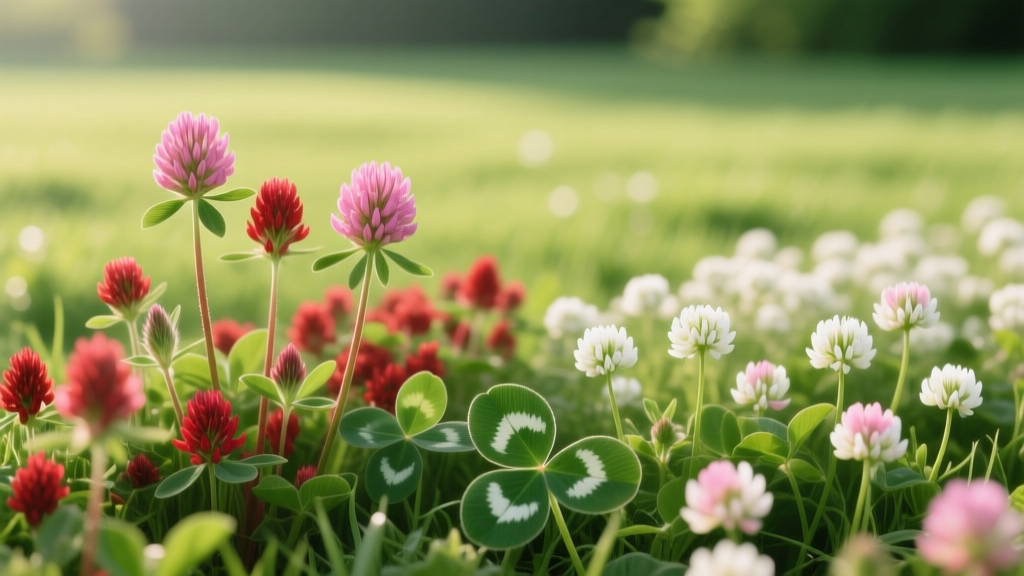
Red Clover vs White Clover: Identification and Spot Treatment
The Botanical Breakdown: Trifolium Pratense vs. Trifolium Repens
Before mixing any herbicides, accurate identification is mandatory. While both species belong to the legume family and fix atmospheric nitrogen, their growth habits and root structures dictate entirely different eradication strategies. Misidentifying the species often leads to herbicide failure, as the waxy cuticle thickness and stolon networks vary significantly between the two.
According to turfgrass research from the University of Minnesota Extension, white clover (Trifolium repens) relies heavily on above-ground creeping stems called stolons to spread laterally. Red clover (Trifolium pratense), conversely, grows more upright and relies on a deep, resilient taproot to survive drought and mowing stress.
| Feature | White Clover (Trifolium repens) | Red Clover (Trifolium pratense) |
|---|---|---|
| Growth Habit | Prostrate, creeping stolons | Upright, bunch-type growth |
| Mature Height | 4 to 8 inches | 18 to 24 inches (if unmowed) |
| Leaf Characteristics | Smooth, smaller leaflets, prominent white 'V' watermark | Hairy stems and leaves, larger leaflets, faint watermark |
| Flower Color | White to pale pink | Magenta to deep purplish-red |
| Root System | Shallow, fibrous roots at stolon nodes | Deep, aggressive taproot |
Why Clovers Invade: The Soil Health Indicator
Clover is rarely a random occurrence; it is a biological indicator of specific soil deficiencies. Both red and white clover thrive in lawns where soil nitrogen is depleted. Because they possess rhizobia bacteria in their root nodules, they synthesize their own nitrogen from the air, giving them a massive competitive advantage over nitrogen-starved turfgrass.
Diagnostic Action Step: Before spending money on herbicides, pull a core sample. If the soil is heavily compacted (penetration resistance > 300 psi) and your turf is pale green, the clover is merely a symptom. Apply a high-nitrogen fertilizer (like Lesco 32-0-10) at a rate of 1 lb of nitrogen per 1,000 sq ft immediately after the clover dies to prevent reinvasion.
Spot-Treatment Protocols: Chemical Herbicides
Broadcast spraying an entire lawn for isolated clover patches is an inefficient use of chemicals and money. Spot-treatment using a 1-gallon or 2-gallon pump sprayer targets the weeds while preserving soil biology and minimizing turf stress.
Selective Broadleaf Herbicides and Active Ingredients
Clover leaves are notoriously difficult to penetrate due to a thick, waxy cuticle. Standard 2,4-D formulations often bead up and roll off the leaf surface. To achieve a complete kill, you need a multi-active-ingredient formulation that includes carfentrazone-ethyl or triclopyr.
- Consumer Grade: Ortho WeedClear Lawn Weed Killer (contains 2,4-D, quinclorac, and dicamba). Priced around $15 for a 32 oz ready-to-use bottle. Effective on young white clover, but struggles with mature red clover taproots.
- Prosumer Grade: SpeedZone Broadleaf Herbicide for Turf (contains 2,4-D, MCPP, dicamba, and carfentrazone-ethyl). Priced around $120 for a 20 oz concentrate. The carfentrazone acts as a rapid contact burner, destroying the waxy cuticle and allowing the systemic herbicides to translocate down to the taproot.
Mixing Rates, Surfactants, and Application Timing
The most common failure mode in clover spot-treatment is omitting a surfactant. You must add a Non-Ionic Surfactant (NIS) to your tank mix. Products like Hi-Yield Spreader Sticker or Southern Ag Surfactant (approximately $12 for 16 oz) reduce the surface tension of the water, forcing the herbicide to spread evenly across the clover leaf and enter the stomata.
Exact Spot-Treatment Mix (per 1 Gallon of Water):
- Add 1.5 fluid ounces of SpeedZone concentrate (or 3 fl oz of standard Trimec 992).
- Add 0.25 fluid ounces (1/2 tablespoon) of Non-Ionic Surfactant.
- Fill the rest with clean water and agitate gently.
Timing Constraints: Apply only when soil temperatures are between 55°F and 80°F. If ambient air temperatures exceed 85°F, volatile herbicides like dicamba can vaporize and drift, causing severe cupping and damage to nearby ornamental shrubs and garden beds. Furthermore, do not mow the lawn for 48 hours before or 48 hours after application. The clover needs maximum leaf surface area to absorb the chemical, and the plant needs time to translocate the poison down to the root crown.
Organic and Iron-Based Spot Treatments
For homeowners managing organic lawns, or those with pets and children who frequently use the turf, synthetic auxin herbicides (2,4-D/dicamba) may be undesirable. The most scientifically validated organic alternative for clover is FeHEDTA (Iron HEDTA), a chelated iron compound.
As detailed by NC State Extension, broadleaf weeds like clover absorb large quantities of iron, which triggers fatal oxidative stress and cellular necrosis. Cool-season turfgrasses, however, possess an internal regulatory mechanism that prevents iron toxicity, allowing them to survive and even green up from the treatment.
FeHEDTA Application Protocol
The leading product in this category is Fiesta Turf Weed Killer (retailing around $35 for a 16 oz bottle of concentrate). Because it is a contact herbicide rather than a systemic one, it will burn the top growth of the clover but may not kill a deep red clover taproot on the first pass.
- Mixing Rate: 1.5 to 2.5 fluid ounces of Fiesta per 1,000 square feet, diluted in 2 to 3 gallons of water to ensure thorough coverage.
- Application Schedule: Apply the first treatment, wait exactly 21 days, and apply a second treatment to any regrowth. The second pass is non-negotiable for mature red clover.
- Temperature Warning: FeHEDTA efficacy drops significantly in cold weather. Apply only when daytime highs are consistently above 65°F.
Post-Eradication Lawn Recovery
Once the clover turns black and desiccates (usually 7 to 14 days post-application), rake out the dead organic matter. The resulting bare soil patches are prime real estate for new weed seeds. To close the canopy, immediately overseed the bare spots with a turf-type tall fescue or Kentucky bluegrass blend that matches your existing lawn.
For optimal germination, top-dress the seeded areas with 1/4 inch of screened compost and keep the soil consistently moist for 14 days. According to Purdue University Turfgrass Science, maintaining a dense turf canopy through proper mowing heights (3 to 3.5 inches for cool-season grasses) shades the soil surface, depriving any surviving clover seeds of the sunlight required for germination. By combining precise chemical spot-treatments with aggressive cultural recovery, you permanently eliminate the clover advantage.

