
Lawn Care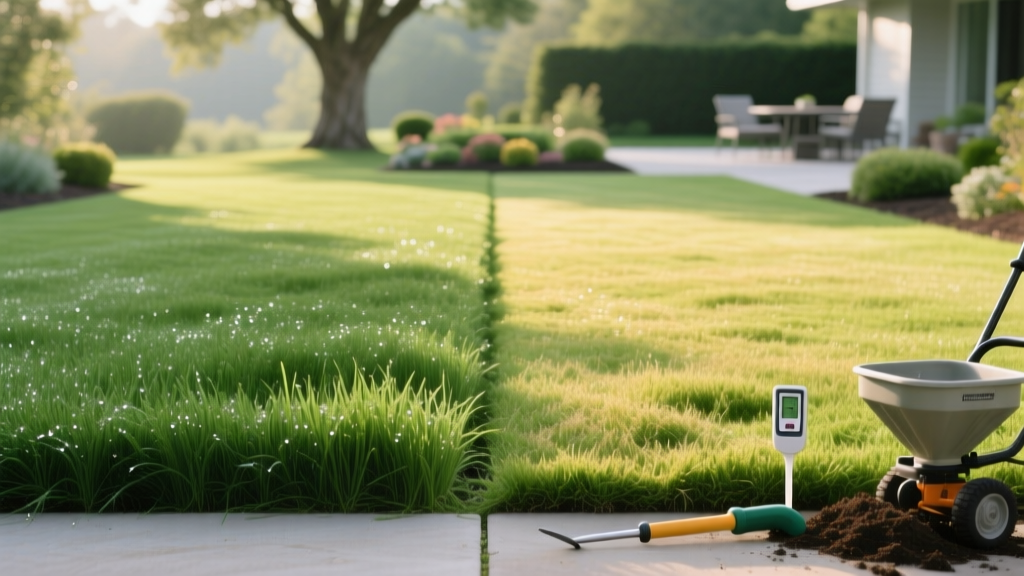
Regional Fertilize Lawn Schedule: Cool vs Warm Grasses
Most homeowners rely on arbitrary holidays like Memorial Day or Labor Day to time their turf applications. This calendar-based approach leads to nutrient runoff, fertilizer burn, and shallow root systems. A scientifically accurate fertilize lawn schedule relies on soil thermodynamics and regional grass physiology, not the Gregorian calendar. Applying nitrogen when the soil is too cold feeds winter annual weeds like Poa annua, while applying it during peak summer heat stresses cool-season grasses and invites fungal pathogens.
The Science of Timing: Soil Temperature vs. Calendar Dates
Turfgrass roots absorb nutrients based on soil temperature at a 2-inch depth. Cool-season grasses (Kentucky Bluegrass, Tall Fescue, Perennial Ryegrass) require soil temperatures between 50°F and 65°F for optimal root uptake and growth. Warm-season grasses (Bermudagrass, Zoysia, St. Augustine) remain largely dormant until soil temperatures consistently reach 65°F to 70°F.
Equipment Requirement: Stop guessing the soil temperature. Invest in a REOTEMP digital soil thermometer or a standard analog soil probe (typically $15 to $25). Measure at 8:00 AM in a shaded area of your lawn to get a baseline reading before the afternoon sun artificially inflates the topsoil temperature.
According to the University of Minnesota Extension, applying fast-release nitrogen to cool-season lawns when soil temperatures exceed 75°F forces top-growth at the expense of root development, making the turf highly susceptible to drought stress and Brown Patch disease.
Cool-Season Grass Fertilize Lawn Schedule (Northern & Transition Zones)
Cool-season lawns thrive in the northern third of the country and the transition zone. The heaviest feeding should occur in the fall when the grass is actively storing carbohydrates in its root system for winter survival and spring green-up.
| Application Window | Soil Temp Target | Nitrogen Rate (per 1k sq ft) | Recommended Product & N-P-K | Est. Cost |
|---|---|---|---|---|
| Late Spring (May) | 55°F - 65°F | 0.5 - 0.75 lb N | Scotts Turf Builder Lawn Food (32-0-3) | $4.50 |
| Early Fall (Sept) | 70°F dropping to 60°F | 1.0 lb N | The Andersons PGF Balanced (10-10-10) | $6.50 |
| Late Fall (Nov) | 50°F dropping to 40°F | 1.0 lb N | Scotts WinterGuard Fall Weed & Feed (32-0-10) | $5.00 |
Transition Zone Caveat: If you live in the transition zone (e.g., Southern Pennsylvania to Northern Georgia), Tall Fescue is your primary turf. Avoid all heavy nitrogen applications in July and August. Summer fertilization in this region promotes Pythium blight and severe fungal outbreaks due to high humidity and warm nights.
Warm-Season Grass Fertilize Lawn Schedule (Southern Zones)
Warm-season grasses follow a completely different metabolic pathway (C4 photosynthesis). They demand heavy feeding during the peak heat of summer and must be put to bed early to prevent winterkill. The North Carolina State Extension emphasizes that late-fall fertilization of warm-season grasses delays dormancy, leaving the turf highly vulnerable to freezing temperatures.
Bermudagrass and Zoysia (High Feeders)
- Early Summer (May/June): Apply 1.0 lb of Nitrogen per 1,000 sq ft once the grass has fully greened up and you have mowed it twice. Use a slow-release product like Milorganite (6-4-0) to prevent rapid flush growth that requires mowing every three days.
- Peak Summer (July/August): Apply 1.0 lb of Nitrogen per 1,000 sq ft. Switch to a synthetic, fast-acting product like Lesco Professional Turf Fertilizer (24-2-11) to support heavy foot traffic and rapid recovery.
- Early Fall (September): Apply a low-nitrogen, high-potassium winterizer (e.g., 5-10-30) to harden the cell walls against frost.
Centipedegrass and St. Augustine (Sensitive Feeders)
Warning - Centipede Decline: Centipedegrass is notoriously sensitive to over-fertilization. Never exceed 1.5 lbs of total Nitrogen per 1,000 sq ft per year. Excess nitrogen causes iron chlorosis (yellowing) and accelerates thatch buildup, leading to a condition known as Centipede Decline. Use a specialized 15-0-15 fertilizer with added iron.
St. Augustine requires 2 to 4 lbs of Nitrogen annually, but avoid fast-release synthetics during the humid months of July and August. High nitrogen combined with moisture triggers Gray Leaf Spot, a devastating fungal disease that melts the turf canopy within 48 hours.
Product Selection Matrix: Synthetic vs. Organic Timelines
Your fertilize lawn schedule must also account for the release mechanism of the product you choose. Organic fertilizers rely on soil microbes to break down nutrients, meaning they are entirely dependent on soil moisture and temperature.
| Feature | Synthetic (e.g., Andersons PGF) | Organic (e.g., Espoma Organic Lawn Food) |
|---|---|---|
| Nutrient Release | Immediate to 30 days (coated) | 30 to 90 days (microbial breakdown) |
| Soil Temp Requirement | Can apply at 45°F+ | Requires 55°F+ for microbial activity |
| Watering Needs | Must water in immediately (0.25 inch) | Forgiving; natural rain is usually sufficient |
| Cost per 1,000 sq ft | $4.00 - $6.50 | $8.00 - $11.00 |
Frequently Asked Questions
Can I fertilize newly laid sod immediately?
No. Wait until the sod has rooted firmly into the soil below—typically 3 to 4 weeks after installation. Applying high-nitrogen fertilizer to unrooted sod will burn the shallow, stressed roots and delay establishment. Use a starter fertilizer high in phosphorus (e.g., 10-18-10) only at the exact time of laying the sod, then wait 30 days for your first standard application.
What happens if a heavy rainstorm hits right after I apply synthetic fertilizer?
If you applied a synthetic, fast-release product and receive more than 1 inch of rain within 12 hours, the nitrogen will likely leach past the root zone or run off into storm drains. Do not immediately reapply, as you risk burning the lawn if the soil is already saturated. Wait 14 days, assess the turf color, and apply a half-rate (0.5 lb N / 1,000 sq ft) of a slow-release organic product like Milorganite to recover lost nutrients safely.
How do I calculate the exact amount of product needed for 1 lb of Nitrogen?
Look at the first number on the N-P-K bag (the percentage of Nitrogen). Divide 100 by that number to find out how many pounds of product you need per 1,000 sq ft. For example, if using a 20-0-5 fertilizer: 100 ÷ 20 = 5. You need exactly 5 lbs of that specific product per 1,000 sq ft to deliver 1 lb of actual Nitrogen.

