
Lawn Care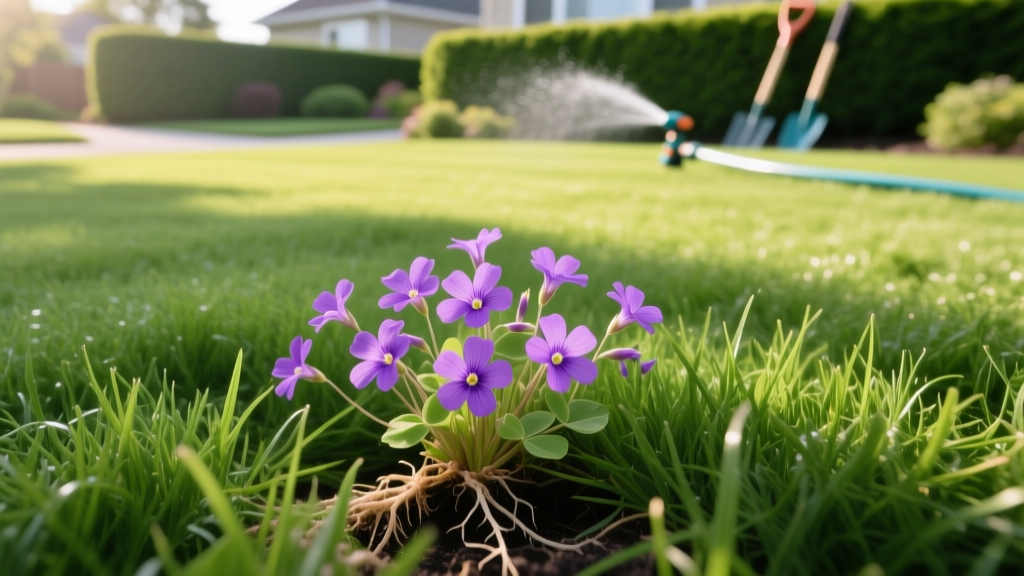
How to Identify and Remove Little Purple Flowers in Lawn
The Culprits: Identifying Little Purple Flowers in Lawn
When little purple flowers in lawn turf emerge each spring, they are rarely a welcome addition to the landscape. These blooms are the reproductive structures of aggressive broadleaf weeds that exploit thin turf, compacted soil, and excessive shade. Eradicating them requires precise identification, as the biological differences between these species dictate entirely different chemical and cultural control strategies.
According to NC State Extension, misidentifying these weeds often leads homeowners to apply ineffective herbicides, wasting money and allowing the root systems to strengthen. The three most common purple-flowering lawn invaders are Creeping Charlie, Henbit, and Wild Violet.
1. Creeping Charlie (Ground Ivy)
Glechoma hederacea is a perennial broadleaf weed in the mint family. It features small, funnel-shaped purple flowers and round, creeping stems (stolons) that root at the nodes. Crushing the scalloped, coin-shaped leaves releases a distinct minty odor. It thrives in moist, shaded areas but will invade full sun if the turf is thin.
2. Henbit
Lamium amplexicaule is a winter annual. It germinates in early fall, overwinters as a small rosette, and bursts into tubular purple flowers in early spring. Unlike Creeping Charlie, Henbit has square stems and leaves that clasp directly around the stem without petioles. Because it is a winter annual, its life cycle ends naturally in late spring, but it drops thousands of seeds before dying.
3. Wild Violet
Viola sororia is a resilient perennial with distinct heart-shaped leaves and five-petaled purple or white flowers. Penn State Extension notes that Wild Violets possess a thick, waxy cuticle on their leaves, making them notoriously difficult to control with standard off-the-shelf herbicides. They spread aggressively via both seeds and underground rhizomes.
| Weed Species | Life Cycle | Stem & Leaf Traits | Primary Vulnerability |
|---|---|---|---|
| Creeping Charlie | Perennial | Round stems, scalloped leaves, mint odor | Triclopyr-based herbicides in fall |
| Henbit | Winter Annual | Square stems, clasping leaves | Pre-emergent in late summer; 2,4-D in spring |
| Wild Violet | Perennial | Heart-shaped leaves, waxy surface | Requires surfactant + Triclopyr/Quinclorac mix |
Step-by-Step Eradication and Maintenance Protocol
Eliminating these weeds requires a phased approach. Hand-pulling is largely ineffective for perennials like Creeping Charlie and Wild Violet, as any fragmented node or rhizome left in the soil will regenerate within weeks.
Step 1: Time the Application to Soil Temperature
Do not apply herbicides based on the calendar; apply them based on soil temperature. Use a digital soil probe thermometer. Post-emergent herbicides are most effective when soil temperatures are consistently between 55°F and 65°F. At this range, the weeds are actively translocating nutrients (and herbicides) down to their root systems. Applying when temperatures exceed 85°F risks volatilization, which can damage desirable turf and ornamental shrubs.
WARNING: If you are maintaining a warm-season grass like St. Augustine or Centipede, avoid applying 2,4-D or Dicamba during spring green-up. These chemicals can severely stunt or kill warm-season turf as it breaks dormancy. Opt for Atrazine-based products specifically labeled for warm-season grasses.
Step 2: Select the Correct Chemical Formulation
Standard consumer-grade 'Weed and Feed' products typically rely on low concentrations of 2,4-D, which will burn the tops off Wild Violets but fail to kill the rhizomes. For professional-grade results, source a liquid concentrate containing Triclopyr. Triclopyr is highly effective against mint-family weeds (Creeping Charlie) and tough perennials (Violets).
- For Cool-Season Lawns (Fescue, Kentucky Bluegrass, Ryegrass): Use a three-way herbicide containing 2,4-D, MCPP, and Dicamba, fortified with Triclopyr. Products like SpeedZone Broadleaf Herbicide or Trimec 992 (approx. $110-$130 per 2.5-gallon jug in 2026) offer commercial-level control.
- For Warm-Season Lawns (Bermuda, Zoysia): Use products containing Quinclorac or specific formulations of 2,4-D labeled safe for your specific grass cultivar.
Step 3: Add a Surfactant (The Non-Negotiable Step)
If you are fighting Wild Violets, the herbicide will bead up and roll off the waxy leaf cuticle. You must add a Non-Ionic Surfactant (NIS) or Methylated Seed Oil (MSO) to your tank mix. Add 0.25% v/v (roughly 1/3 ounce per gallon of water). This breaks the surface tension, allowing the active ingredients to penetrate the leaf tissue and reach the rhizomes.
Step 4: Execute the Application
- Mow First: Mow the lawn 24 hours before application. This removes excess leaf surface area from the grass, ensuring the herbicide targets the broadleaf weeds directly.
- Spray Technique: Use a pump sprayer with a fan-nozzle tip. Apply a fine mist until the weed leaves are uniformly wet, but not to the point of runoff. Dripping herbicide wastes chemical and increases soil contamination.
- Wait to Water: Do not irrigate or allow rainfall for at least 24 hours post-application. The plant needs this time to absorb and translocate the chemical to the roots.
- Follow-Up: Perennials like Creeping Charlie require a second application 21 to 28 days after the first to catch any late-germinating nodes or surviving rhizomes.
Long-Term Prevention: Fixing the Underlying Soil Issues
Herbicides only treat the symptom. Little purple flowers in lawn turf are biological indicators of environmental stress. If you do not alter the lawn's environment, the weeds will return the following spring.
Alleviate Soil Compaction
Both Henbit and Creeping Charlie thrive in compacted, poorly drained soils where turfgrass roots struggle to penetrate. Perform core aeration in the early fall (for cool-season grasses) or late spring (for warm-season grasses). Rent a walk-behind or stand-on core aerator that pulls 3-inch deep plugs, removing physical soil barriers and allowing oxygen to reach the turf's root zone.
Adjust Mowing Heights and Canopy Shade
Weeds require sunlight to germinate. If your mower is set below 3.0 inches, you are actively inviting weed invasion. Raise your mower deck to 3.5 or 4.0 inches. Taller grass develops deeper root systems and creates a dense canopy that shades out weed seeds. Additionally, if the affected area receives less than 4 hours of direct sunlight, hire an arborist to perform canopy elevation pruning on surrounding trees to increase light penetration.
Frequently Asked Questions
Will boiling water or horticultural vinegar kill these purple flowers?
Horticultural vinegar (20% acetic acid) is a non-selective contact burn-down. It will scorch the purple flowers and leaves, but it will not kill the underground rhizomes of Wild Violets or the stolons of Creeping Charlie. It will also kill your surrounding grass and severely lower the soil pH, creating long-term nutrient lockout issues.
Can I use a pre-emergent to stop them?
Pre-emergents like Prodiamine are highly effective at stopping Henbit (which germinates from seed in the fall). However, pre-emergents do absolutely nothing to stop Creeping Charlie or Wild Violets, as these perennials spread primarily via underground root networks and stolons, bypassing the seed-germination barrier entirely.
Is Creeping Charlie toxic to pets?
While Glechoma hederacea is not considered highly toxic to dogs or cats in small amounts, ingestion of large quantities can cause gastrointestinal upset. Furthermore, if you treat the lawn with liquid herbicides, keep pets off the turf until the application has completely dried (usually 2 to 4 hours).

