
Lawn Care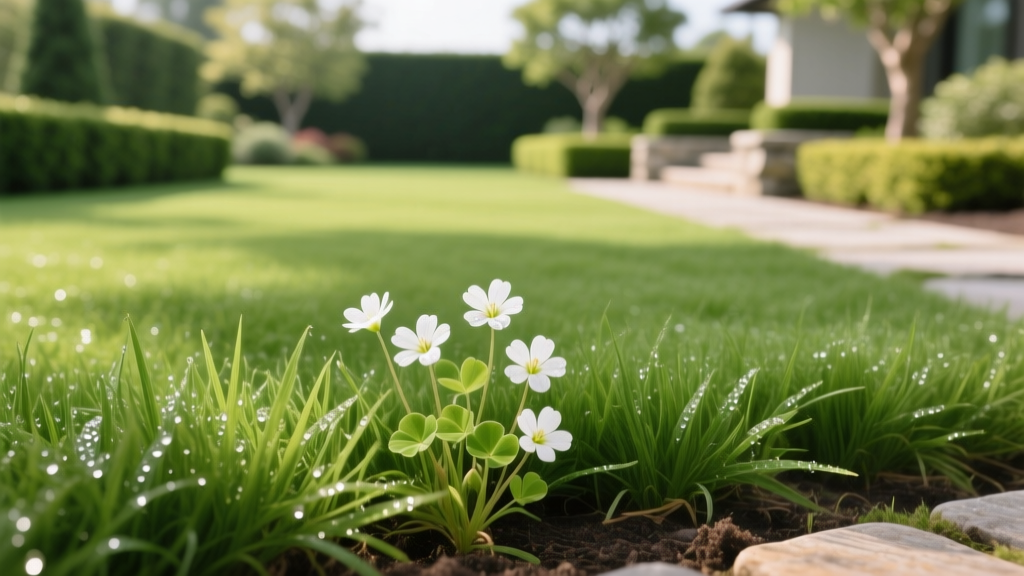
How to Eliminate Little White Flowers in Grass: Step-by-Step
Identifying the Culprit: Clover, Chickweed, or Pearlwort?
When homeowners spot little white flowers in grass, they are almost always dealing with one of three broadleaf weeds. Accurate identification is the critical first step in your eradication protocol, as the root structures and life cycles of these weeds dictate your chemical and cultural control strategies.
| Weed Species | Scientific Name | Leaf Structure | Flower Appearance | Growth Habit & Roots |
|---|---|---|---|---|
| White Clover | Trifolium repens | Three-lobed (trifoliate), often with a white 'V' chevron marking. | Spherical, 0.5-inch white or pinkish ball-shaped clusters. | Perennial. Spreads aggressively via above-ground creeping stems (stolons) that root at nodes. |
| Common Chickweed | Stellaria media | Small, oval, opposite leaves with a single line of hairs on the stem. | Tiny, star-like white flowers with five deeply notched petals (looks like 10). | Winter annual. Shallow, fibrous root system. Thrives in cool, moist, shaded areas. |
| Pearlwort | Sagina procumbens | Very narrow, awl-shaped, bright green leaves forming dense mats. | Minuscule, solitary white flowers with four or five tiny petals. | Perennial. Forms low, dense, moss-like mats with a shallow taproot. |
According to the University of California Statewide IPM Program, white clover is the most persistent of the three due to its stoloniferous growth habit, allowing it to quickly bypass localized herbicide treatments and recolonize bare turf areas.
Why Are Little White Flowers Invading Your Lawn?
Little white flowers are not just a cosmetic nuisance; they are bio-indicators of underlying soil and maintenance deficiencies. White clover, in particular, is a legume. It possesses a symbiotic relationship with Rhizobium bacteria, allowing it to fix atmospheric nitrogen into the soil. If your lawn lacks sufficient soil nitrogen, clover will rapidly outcompete your turfgrass.
Diagnostic Callout: The Nitrogen Deficiency Test
Look closely at the grass immediately surrounding the white flowers. If the turfgrass blades are pale green or yellowing while the clover remains dark, vibrant green, your soil is nitrogen-deficient. Clover is thriving precisely because your grass is starving.
Additionally, soil compaction and a pH below 6.0 heavily favor chickweed and clover over desirable cool-season grasses like Kentucky Bluegrass and Tall Fescue. Before applying any herbicides, you must address these cultural triggers, or the weeds will return within a single growing season.
Step-by-Step Eradication Protocol
Eliminating established white flowers requires a phased approach combining mechanical disruption and targeted chemical application. Follow this exact sequence for optimal results.
Step 1: Mechanical Disruption (For Infestations Under 15% Coverage)
If the white flowers are localized in small patches, manual removal is highly effective, provided you extract the entire stolon network. Use a specialized stand-up weeding tool with a clawed tip (such as the Fiskars 3-Claw Weeder). Insert the claws 3 inches deep at a 45-degree angle beneath the weed's central crown, and lever the handle back. For white clover, failing to remove the nodes along the creeping stems will result in regrowth within 14 days.
Step 2: Targeted Post-Emergent Herbicide Application
For widespread infestations, manual removal is impractical. You must deploy a selective, systemic broadleaf herbicide. Standard 2,4-D formulations often fail against mature white clover. Instead, utilize a multi-active-ingredient ester-based herbicide.
- Professional Grade: SpeedZone Broadleaf Herbicide for Turf (contains 2,4-D, MCPP, Dicamba, and Carfentrazone). The addition of carfentrazone provides a rapid 'burn-down' effect, showing visible wilting within 24 hours.
- Consumer Grade: Ortho WeedClear Lawn Weed Killer Plus Crabgrass Preventer (ready-to-spray hose-end, though tank-mixed concentrates offer better dosage control).
Exact Mixing and Application Rates:
Mix 1.5 fluid ounces of SpeedZone concentrate per 1 gallon of water to treat 1,000 square feet. Crucially, you must add a non-ionic surfactant (such as Southern Ag Surfactant) at a rate of 0.25% v/v (roughly 1 teaspoon per gallon). The waxy cuticle on clover leaves repels water; the surfactant breaks surface tension, allowing the herbicide to penetrate the leaf tissue. Apply using a pump sprayer when ambient temperatures are between 65°F and 80°F. Do not mow for 48 hours before or after application.
Step 3: Pre-Emergent Defense Timing
Post-emergents kill existing flowers, but pre-emergents stop the seeds from germinating. White clover seeds can remain viable in the soil seedbank for up to 30 years. Apply a pre-emergent containing prodiamine (e.g., Prodiamine 65 WDG) in early spring when soil temperatures at a 2-inch depth consistently reach 50°F to 55°F. Use a rate of 0.83 ounces per 1,000 square feet, watered in immediately with 0.25 inches of irrigation.
Corrective Lawn Maintenance to Prevent Regrowth
Herbicides only buy time. Permanent eradication requires altering the lawn's microenvironment to favor turfgrass over broadleaf weeds. Implement these specific maintenance parameters:
- Canopy Shading via Mowing Height: Raise your mower deck to 3.5 or 4.0 inches for cool-season grasses. Research from Penn State Extension confirms that taller grass blades shade the soil surface, depriving low-growing clover stolons and chickweed seedlings of the photosynthetically active radiation (PAR) required to establish.
- Aggressive Nitrogen Loading: Apply 3.0 to 4.0 pounds of actual nitrogen per 1,000 square feet annually. Use a slow-release, methylene-urea based fertilizer (like 32-0-4) applied at 1.0 lb N/1,000 sq ft in late spring, and 1.5 lbs N/1,000 sq ft in early fall. This forces rapid turfgrass lateral spread, physically choking out the weeds.
- Core Aeration: If your soil is compacted (verify by attempting to push a 6-inch screwdriver into the lawn; if it won't penetrate easily, you have compaction). Core aerate in the fall to relieve soil bulk density, allowing oxygen to reach turfgrass roots while disrupting the shallow mat of pearlwort.
Cost Breakdown: DIY vs. Professional Treatment (2026 Estimates)
Deciding whether to tackle the little white flowers yourself or hire a licensed lawn care operator (LCO) depends on your lawn size and equipment access. Below is a cost matrix for a standard 5,000 square foot lawn.
| Treatment Approach | Materials & Equipment Needed | Estimated Cost (5k sq ft) | Efficacy & Time Investment |
|---|---|---|---|
| DIY Consumer Herbicide | Ortho WeedClear hose-end, basic PPE (gloves) | $25 - $35 | Moderate. Requires multiple applications. 1 hour labor. |
| DIY Pro-Grade Chemical | SpeedZone (partial bottle), Surfactant, 2-gallon pump sprayer ($40 one-time) | $60 - $85 (initial) $20 (refills) |
High. Professional results. 1.5 hours mixing and spraying. |
| Professional LCO Service | None (included in service) | $55 - $85 per visit | Very High. Commercial-grade nozzles and surfactants. Zero labor. |
Frequently Asked Questions
Will little white flowers eventually kill my grass?
White clover and pearlwort will not chemically kill your grass through allelopathy, but they will outcompete it for space, water, and light. Over 2 to 3 seasons, a severe clover infestation will result in a lawn that is 80% weed and 20% thin, patchy turfgrass.
Should I leave white clover for the bees?
While white clover is an excellent nectar source for pollinators, maintaining it in a primary recreational lawn creates slip hazards when wet and attracts stinging insects (wasps and bees) to areas where children and pets play. If pollinator support is your goal, consider converting a back corner of your property into a dedicated micro-clover or native wildflower meadow, rather than integrating it into your primary turf.
How long does it take for the herbicide to work on white flowers?
When using a multi-active-ingredient ester herbicide with a surfactant, you will notice the white flowers curling and wilting (epinasty) within 24 to 48 hours. Complete browning and necrosis of the stolon network typically takes 14 to 21 days. Do not reapply herbicide if the weeds look 'dead' on top but still have green stems at the soil line; allow the systemic chemicals time to translocate to the roots.

