
Lawn Care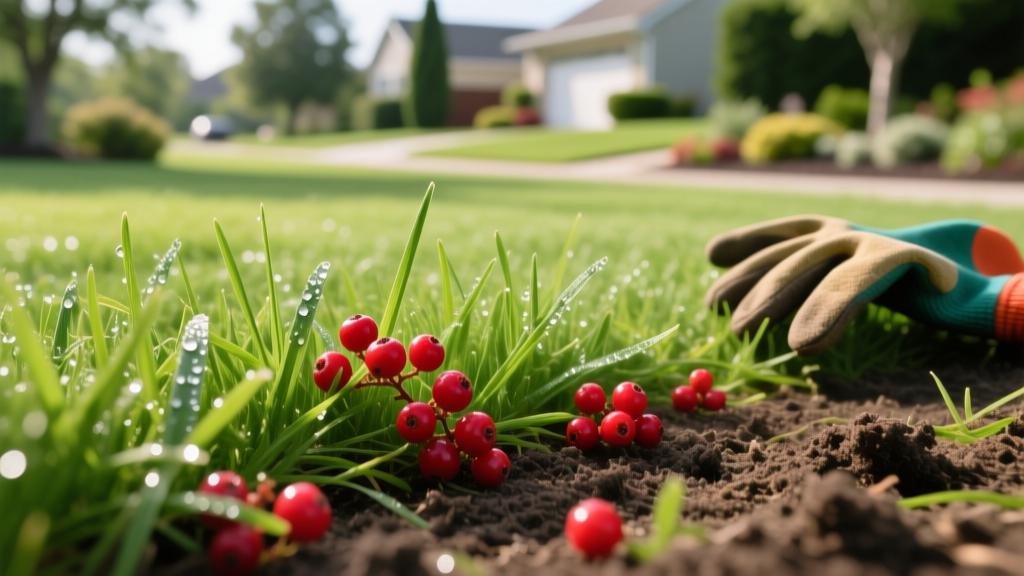
Identifying and Removing Red Berries in Grass: A Step-by-Step Guide
Spotting red berries in grass is a common source of confusion for homeowners. While they might look like harmless wild strawberries, these low-growing, berry-producing plants are most often Potentilla indica (commonly known as mock strawberry or false strawberry), an aggressive perennial broadleaf weed. Unlike true wild strawberries, mock strawberry offers no culinary value, spreads rapidly via above-ground stolons, and chokes out desirable turfgrass by monopolizing sunlight, water, and soil nutrients.
Eradicating this weed requires more than a casual pull. Because mock strawberry roots at every stolon node, incomplete removal guarantees rapid regrowth. This guide outlines a precise, step-by-step lawn maintenance protocol to identify, eliminate, and prevent red berry weeds from compromising your turf.
Identifying the Culprit: Mock Strawberry vs. True Strawberry vs. Toxic Drop
Before initiating any chemical or mechanical control, accurate identification is critical. Misidentifying the plant can lead to ineffective herbicide selection or, worse, overlooked safety hazards. According to the USDA Plants Database, Potentilla indica is distinguished by specific floral and structural traits that separate it from beneficial or harmless plants.
| Feature | Mock Strawberry (P. indica) | Wild Strawberry (Fragaria virginiana) | Yew/Holly Berry Drop (Toxic) |
|---|---|---|---|
| Flower Color | Yellow (5 petals) | White (5 petals) | N/A (Berries dropped from trees/shrubs) |
| Berry Posture | Points upward | Droops downward | Scattered randomly on turf surface |
| Fruit Taste/Texture | Dry, tasteless, spongy | Sweet, juicy, aromatic | Fleshy, highly toxic to pets/livestock |
| Leaf Structure | Trifoliate, prominent veining | Trifoliate, slightly serrated edges | N/A |
⚠️ CRITICAL SAFETY WARNING: If the red berries in your grass lack leaves, feature a fleshy red cup (aril) with a green or black seed inside, and are found near ornamental shrubs, they are likely dropped Yew (Taxus) berries. Yew is highly toxic to dogs, cats, and horses. Do not let pets ingest them, and remove them immediately using gloves. For more on toxic landscape plants, consult your local university extension office.
Step-by-Step Eradication Protocol
Once you have confirmed the presence of mock strawberry, implement this three-phase maintenance procedure. The University of Maryland Extension notes that combining cultural shifts with targeted chemical or mechanical control yields the highest long-term eradication rates.
Phase 1: Soil Testing and Amendment
Mock strawberry thrives in compacted, poorly drained soils with low fertility. Before applying herbicides or overseeding, test your soil. Aim for a pH between 6.2 and 6.8 for cool-season grasses (Kentucky Bluegrass, Tall Fescue) and 5.8 to 6.5 for warm-season grasses (Bermuda, Zoysia).
- Aeration: Perform core aeration using a gas-powered aerator, pulling 3-inch deep plugs at 2-inch spacing. This breaks up the thatch layer where mock strawberry stolons anchor.
- Amendment: Apply pelletized lime if pH is below 6.0, or elemental sulfur if above 7.0, based strictly on your soil test results.
Phase 2: Manual Extraction for Spot Treatments
For infestations covering less than 5% of your lawn, manual removal is viable, provided you extract the entire stolon network.
- Hydrate the Soil: Water the target area deeply 24 hours prior. Applying 0.5 inches of water softens the soil, allowing the shallow fibrous roots to release without snapping.
- Trace the Stolon: Locate the main crown and follow the above-ground runner (stolon). Mock strawberry roots at every node (the small bump on the runner).
- Extract Nodes: Use a specialized weeding tool, such as a Fiskars Stand-Up Weeder or a soil knife (hori-hori), to sever the soil directly beneath each node. Pull upward at a 45-degree angle.
- Dispose Properly: Bag the extracted weeds in heavy-duty contractor bags. Do not compost mock strawberry, as the seeds can survive standard composting temperatures and reintroduce the weed to your garden.
Phase 3: Targeted Post-Emergent Herbicide Application
For widespread infestations, selective broadleaf herbicides are mandatory. Mock strawberry is resistant to single-active-ingredient herbicides like basic 2,4-D. You must use a three-way or four-way herbicide formulation.
Recommended Active Ingredients:
- Triclopyr (primary driver for tough broadleaf weeds)
- 2,4-D (systemic growth regulator)
- Dicamba (rapid contact and systemic action)
- Quinclorac (optional, aids in grassy weed control simultaneously)
Application Parameters:
- Product Selection: Prosumer products like SpeedZone Southern or Surge Broadleaf Herbicide contain the necessary Triclopyr/2,4-D/Dicamba ratios.
- Temperature Constraints: Apply only when daytime air temperatures are between 65°F and 85°F. Applications above 85°F risk volatilization, which can drift and damage nearby ornamental shrubs or trees.
- Surfactant: Mock strawberry leaves have a slightly hairy texture that repels water. Mix a Non-Ionic Surfactant (NIS) at a rate of 0.25% v/v (roughly 1 teaspoon per gallon of mixed solution) to break the surface tension and ensure the herbicide coats the leaf.
- Mowing Restriction: Do not mow 48 hours before or 48 hours after application to allow maximum foliar absorption and translocation to the roots.
Cultural Prevention and Turf Thickening
Herbicides kill the existing weed, but they do not prevent new seeds from germinating. The ultimate defense against red berries in grass is a dense, aggressive turf canopy that blocks sunlight from reaching the soil surface.
Optimize Mowing Heights
Raising your mower deck is the single most effective cultural control against stoloniferous weeds.
- Cool-Season Grasses (Fescue, Bluegrass): Maintain a minimum cutting height of 3.0 to 3.5 inches.
- Warm-Season Grasses (Bermuda, Zoysia): Maintain a height of 1.5 to 2.5 inches, depending on the specific cultivar.
Taller grass shades the soil, inhibiting the photosynthesis required for mock strawberry seeds to germinate and stolons to establish new nodes.
Strategic Overseeding
After herbicide application (wait 14 to 21 days post-spray), overseed bare patches. For cool-season lawns, apply a blend of Turf-Type Tall Fescue at a rate of 6 to 8 lbs per 1,000 sq ft. Keep the seedbed consistently moist with light, daily irrigation for 14 days until germination occurs.
Seasonal Maintenance Calendar for Weed Suppression
To ensure mock strawberry does not return, align your lawn care schedule with the weed's biological growth cycles. According to turfgrass management guidelines from NC State Extension, timing your interventions is just as important as the intervention itself.
| Season | Target Action | Biological Rationale |
|---|---|---|
| Early Spring | Pre-emergent application (e.g., Prodiamine) and manual spot-pulling. | Targets seeds before germination; removes overwintered crowns before they produce spring stolons. |
| Late Spring | Post-emergent herbicide application. | Weeds are actively growing and translocating nutrients (and herbicides) to their root systems. |
| Summer | Raise mowing height; deep, infrequent watering (1 inch per week). | Stresses shallow-rooted weeds while sustaining deep-rooted turfgrass during heat stress. |
| Early Fall | Core aeration, overseeding, and fall fertilization (high nitrogen). | Thickens turf canopy to block autumn-germinating weed seeds and outcompetes late-season stolon growth. |
By adhering to this step-by-step protocol, you shift the ecological advantage back to your desirable turfgrass. Consistent monitoring, precise herbicide chemistry, and strict mowing heights will permanently eliminate red berries in grass and restore a uniform, healthy lawn.

