
Lawn Care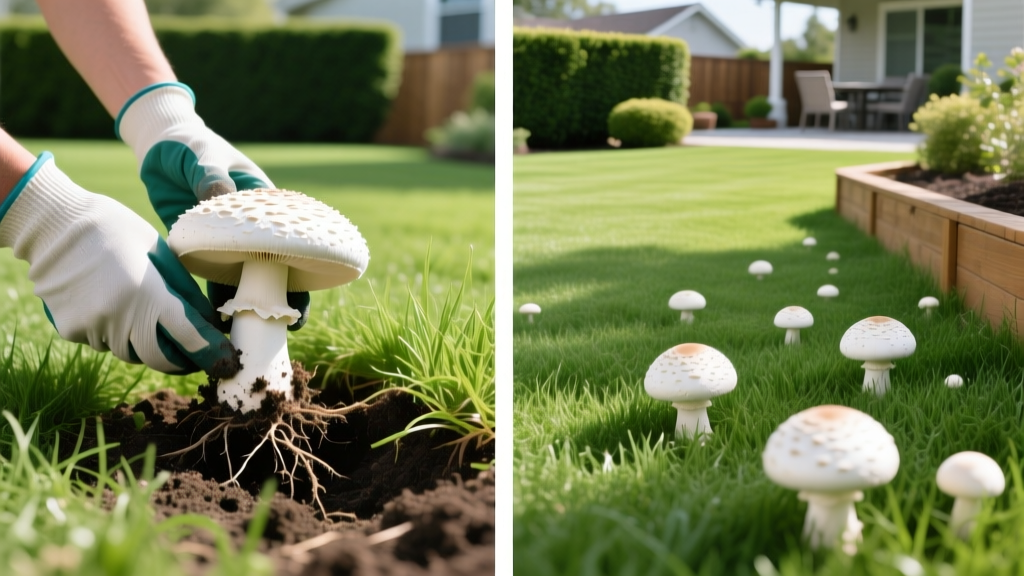
Step-by-Step Guide to Removing Big White Mushrooms in Lawn
Identify the Fungi: What Are Big White Mushrooms in Lawn?
Spotting large, white fruiting bodies emerging from your turf is a clear indicator of active subsurface fungal networks. While many homeowners view them as an aesthetic nuisance, these mushrooms are actually the reproductive structures of saprophytic fungi breaking down organic matter. According to the University of California IPM, these fungi do not attack living grass blades; instead, they consume dead wood, buried construction debris, and excessive thatch.
⚠️ Toxicity Warning: Never allow children or pets to ingest wild lawn mushrooms. Species like Chlorophyllum molybdenites (the False Parasol) closely resemble edible varieties but cause severe gastrointestinal distress. Always wear gardening gloves during physical removal.
Common Large White Lawn Mushrooms
| Species | Cap Diameter | Distinguishing Features | Primary Food Source |
|---|---|---|---|
| Chlorophyllum molybdenites | 4 to 10 inches | Large white cap with brown scales, prominent stem ring | Rich organic matter, mulch beds |
| Lycoperdon pyriforme (Puffball) | 1 to 4 inches | Spherical, no stem, releases brown spore dust when crushed | Buried wood, decaying tree roots |
| Agaricus campestris (Meadow) | 2 to 5 inches | White cap, pink-to-brown gills beneath, distinct almond odor | Thatch layers, manure-rich soil |
The Root Cause: Why Are They Growing?
Mushrooms are merely the symptom; the mycelium network is the underlying issue. The University of Minnesota Extension notes that fungal fruiting requires three specific environmental conditions: high moisture, low light, and an abundant carbon food source.
- Buried Debris: Newer homes often have buried tree stumps, backfill wood, or construction debris left behind by developers. Fungi will colonize this wood for years.
- Excessive Thatch: A thatch layer exceeding 0.5 inches creates a hydrophobic barrier that traps moisture against the soil surface, providing an ideal breeding ground for mycelium.
- Compacted Soil & Overwatering: Clay-heavy soils with poor drainage force homeowners to overwater, keeping the top 2 inches of soil perpetually saturated.
Step-by-Step Procedure to Remove and Prevent Them
Eliminating big white mushrooms in lawn requires a multi-phase cultural approach targeting the mycelium's food source and environment. Fungicides are largely ineffective for saprophytic mushrooms because the active ingredients cannot penetrate deep enough to reach the buried wood or dense thatch feeding the network.
Step 1: Physical Removal and Spore Containment
Do not mow over the mushrooms. Mowing shreds the caps and acts as a mechanical spreader, blasting millions of spores across your turf. Instead, put on nitrile or leather gloves, grasp the mushroom at the very base of the stem, and twist gently while pulling upward. Place them immediately into a sealed plastic trash bag. This removes the immediate eyesore and prevents local spore dispersal, though it does not kill the underground mycelium.
Step 2: Deep Core Aeration and Thatch Management
If your thatch layer is thicker than 0.5 inches, rent a power dethatcher. For compacted soils, rent a walk-behind core aerator (such as a Ryan Lawnaire IV, typically $80–$100 per day from equipment rental centers).
Execution Specs: Make two passes over the lawn in perpendicular directions. Aim for core spacing of 2 to 3 inches apart, pulling plugs that are 3 inches deep. Leave the soil cores on the lawn; as they dry and shatter during your next mowing, the introduced soil microbes will help break down the thatch layer.
Step 3: Recalibrate Irrigation Schedules
Fungi thrive on frequent, shallow watering. Transition your irrigation controller from daily 10-minute cycles to deep, infrequent soaks. Apply 0.5 to 0.75 inches of water per session, no more than twice a week. Use a standard 6-ounce tuna can placed on the lawn to measure exactly when your sprinkler zones hit the 0.5-inch mark. This forces grass roots to grow deeper while allowing the top 1 inch of soil to dry out completely between waterings, starving the surface mycelium.
Step 4: Accelerate Decay with Nitrogen
Counterintuitively, applying high-nitrogen fertilizer speeds up the elimination of mushrooms feeding on buried wood. Nitrogen stimulates the bacteria that decompose carbon-rich wood, essentially outcompeting the fungi and accelerating the decay of their food source.
The Math: Apply 1 lb of actual Nitrogen per 1,000 square feet. If you are using a professional-grade 32-0-4 fertilizer (like Lesco Professional Turf Fertilizer, approx. $65 per 50-lb bag), you need 3.1 lbs of product per 1,000 sq ft to deliver exactly 1 lb of Nitrogen. For a 5,000 sq ft lawn, set your rotary spreader to deliver 15.5 lbs of product total.
Cultural Controls vs. Chemical Fungicides
Many homeowners waste money on broad-spectrum fungicides. Below is a decision matrix to help you allocate your lawn care budget effectively.
| Treatment Method | Efficacy on Saprophytic Mushrooms | Estimated Cost (per 5k sq ft) | Long-Term Prevention Value |
|---|---|---|---|
| Core Aeration + Thatch Removal | High (Removes habitat) | $90 (Rental) + $0 | Excellent |
| Nitrogen Fertilization | Medium (Accelerates wood decay) | $15 - $25 | Good |
| Systemic Fungicides (e.g., Azoxystrobin) | Low (Fails to reach deep wood) | $120 - $180 | Poor |
| Excavation of Buried Wood | 100% (Eliminates food source) | $150+ (Manual labor/shovels) | Permanent |
Frequently Asked Questions
Will adjusting my soil pH kill the mushrooms?
No. While extreme pH levels can inhibit some fungal growth, altering your soil pH to kill mushrooms will likely lock out essential nutrients for your turfgrass. Most lawn grasses thrive at a pH of 6.0 to 7.0. Keep your pH in this optimal range for the grass, and manage the mushrooms via moisture and thatth control instead.
Are big white mushrooms a sign of a healthy lawn?
They are a sign of high biological activity and abundant organic matter, which is generally good for soil ecology. However, their presence indicates that your thatch layer may be too thick or your soil drainage is inadequate, which can eventually lead to turf diseases like brown patch or Pythium blight if left unaddressed.
How long does it take for the mycelium to die off?
If the mushrooms are feeding on a buried tree stump or construction lumber, the fungal network will persist until the wood is entirely decomposed. By aggressively aerating, dethatching, and applying nitrogen, you can accelerate this process from a decade down to 2 or 3 seasons. If you need immediate results, physically digging out the buried wood with a mattock and shovel is the only instant cure.

