
Lawn Care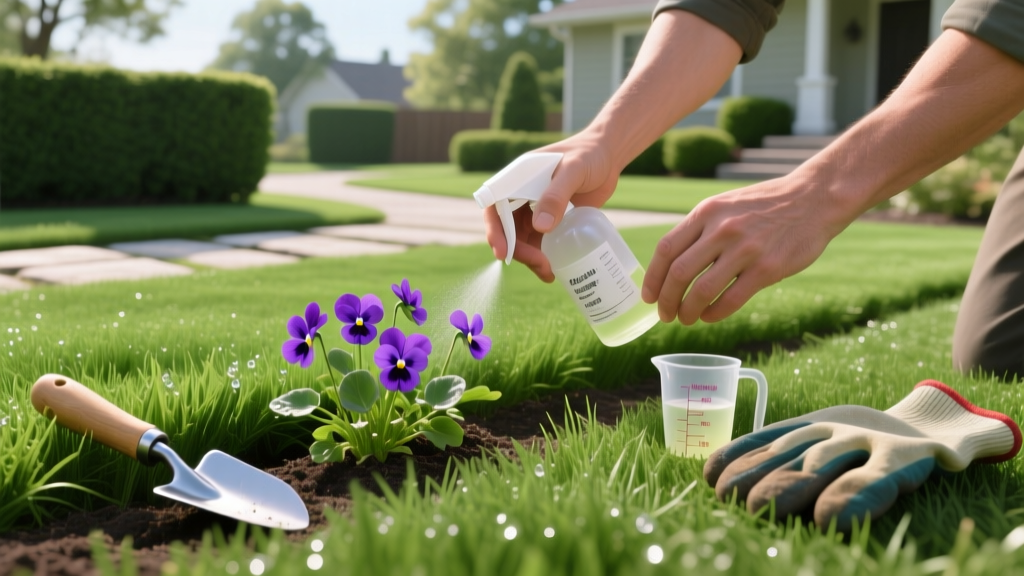
Eradicating Wild Violets in Grass: Step-by-Step Control Guide
The Challenge of Wild Violets in Turfgrass
Wild violets (Viola sororia and Viola papilionacea) are notoriously resilient perennial broadleaf weeds. While their delicate purple and white flowers may look charming in the spring, their aggressive underground rhizome networks and thick, waxy leaf cuticles make them one of the most frustrating weeds for homeowners to manage. Standard 'weed and feed' granular applications routinely fail against them because the herbicide simply beads up and rolls off the leaves, or the active ingredient lacks the systemic strength to kill the deep root system.
⚠️ Critical Warning: Do not rely on generic 2,4-D amine formulations sold in cheap hose-end sprayers. Wild violets require specific active ingredients—primarily Triclopyr—combined with a high-quality surfactant to penetrate the waxy leaf barrier. Applying the wrong chemical will only stress the plant, causing it to retreat into its rhizomes and resprout more densely the following spring.
Step 1: Timing the Application for Maximum Kill
The single most common mistake in violet control is applying herbicide in the spring. While the flowers are highly visible in May, the plant's physiology is working against you. In spring, energy and water are moving upward from the roots to support blooming and leaf growth. Herbicides applied during this time will burn the top growth but fail to reach the deep rhizomes.
The Fall Advantage
The optimal window for treating wild violets in grass is mid-September through late October, when daytime temperatures are consistently between 55°F and 75°F. During autumn, the plant shifts into survival mode, actively pulling carbohydrates and nutrients down into its root system to store for winter. When you apply a systemic herbicide during this window, the plant unwittingly transports the chemical directly into its rhizomes, ensuring a complete kill rather than a superficial burn.
Step 2: Mechanical Preparation
Proper turf preparation ensures the chemical reaches the target foliage and stays there long enough to be absorbed.
- Mowing: Mow your lawn 48 hours before application. This removes the upper canopy of the turfgrass, exposing the lower-growing violet leaves to the spray. Waiting 48 hours allows the cut grass blades to heal, preventing the herbicide from entering the desirable turf and causing phytotoxicity.
- Hydration: Water the lawn deeply 3 days prior to spraying. Drought-stressed weeds develop an extra-thick waxy cuticle to retain moisture, which repels herbicides. Ensure the violets are actively growing and hydrated before treatment.
- Withholding Water: Do not irrigate or water the lawn for 24 hours immediately before application. You want the violet leaves to be completely dry so the herbicide mixture is not diluted upon contact.
Step 3: Chemical Selection and Surfactant Mixing
To effectively eradicate wild violets in grass, you need a systemic broadleaf herbicide containing Triclopyr. Triclopyr is highly effective against tough, woody, and waxy perennial weeds that resist standard 2,4-D. Professional-grade products like Gordon's Triclopyr or consumer formulations like Ortho WeedClear Lawn Weed Killer (which combines Triclopyr with 2,4-D and Dicamba) are the industry standards.
The Surfactant Imperative
If you are mixing a liquid concentrate, a surfactant (surface-active agent) is non-negotiable. Surfactants break the surface tension of the water, allowing the herbicide to spread evenly across the waxy violet leaf and penetrate the cuticle. Use a Non-Ionic Surfactant (NIS) or Methylated Seed Oil (MSO) at a rate of 1/2 teaspoon per gallon of water. If using a consumer 'Ready-To-Spray' (RTS) hose-end bottle, the manufacturer has already included a surfactant in the emulsion.
Step 4: Application Technique and Calibration
Use a 1-gallon or 2-gallon pump tank sprayer for precise spot treatment, or a 4-gallon backpack sprayer for larger infestations. Calibrate your sprayer to deliver 1.5 to 2.0 gallons of mixed solution per 1,000 square feet.
- Mix the Solution: Add half the required water to the tank, add the herbicide concentrate, add the surfactant, and then fill the rest of the water. Agitate gently.
- Spray to Wet: Apply a fine mist directly to the violet foliage. The leaves should be uniformly wet and glistening, but not dripping. Spraying to the point of runoff wastes chemical and increases soil contamination.
- Wait and Observe: Do not mow for 48 hours after application. Do not water for 24 hours. You should see the violets begin to curl, yellow, and necrotize within 7 to 14 days.
- Follow-Up: Because of the deep rhizome network, a single application rarely achieves 100% control. Plan for a second application 21 to 28 days after the first to catch any late-emerging shoots.
Herbicide Active Ingredients Comparison
| Active Ingredient | Efficacy on Violets | Avg. Cost per 1,000 sq ft | Rainfast Period |
|---|---|---|---|
| Triclopyr (e.g., Gordon's, Ortho) | Excellent (Systemic) | $0.85 - $1.20 | 2 Hours |
| 2,4-D + Dicamba + MCPP (3-Way) | Moderate (Requires 2-3 apps) | $0.40 - $0.60 | 4-6 Hours |
| Carfentrazone-ethyl (e.g., SpeedZone) | Good (Fast burn, needs Triclopyr mix) | $1.50 - $2.00 | 1 Hour |
Note: Always read and follow the manufacturer's label instructions. The label is the law. For more information on safe pesticide handling, consult the Environmental Protection Agency (EPA) guidelines on pesticide safety.
Post-Treatment Lawn Recovery
Eradicating wild violets in grass will inevitably leave behind bare patches in your turf, especially in the shady, moist areas where violets thrive. To prevent crabgrass and other noxious weeds from colonizing these bare spots, you must actively repair the lawn.
"Violets are an indicator species for compacted soil, low mowing heights, and heavy shade. If you kill the violets but don't address the shade canopy or aerate the soil, the turf will still fail to thrive, and a new wave of weeds will take their place." — Turfgrass Management Best Practices, University of Minnesota Extension
Overseeding Protocol
Wait at least 14 to 21 days after your final herbicide application before overseeding. Many broadleaf herbicides have a residual soil activity that can inhibit the germination of new grass seed. Once the waiting period has passed, core aerate the bare patches to relieve compaction, apply a starter fertilizer (such as a 10-18-10 NPK ratio), and overseed with a shade-tolerant grass blend like Fine Fescue or a turf-type Tall Fescue. Keep the seed consistently moist until germination occurs.
Frequently Asked Questions
Will horticultural vinegar kill wild violets?
No. While 20% or 30% horticultural acetic acid will rapidly burn the top foliage of the violet, it is strictly a contact herbicide. It has zero systemic activity and will not penetrate the soil to kill the fleshy rhizomes. The violet will simply resprout from the roots within two weeks, making vinegar an ineffective and costly solution for perennial violet control.
Can I just pull wild violets by hand?
Hand-pulling is only viable for very small, isolated infestations (fewer than 10 plants). You must use a weeding tool, such as a dandelion digger, to extract the entire rhizome network. If even a half-inch of the white, fleshy root is left behind in the soil, the violet will regenerate. For lawns with widespread infestations, chemical control is the only practical step-by-step solution.

