
Lawn Care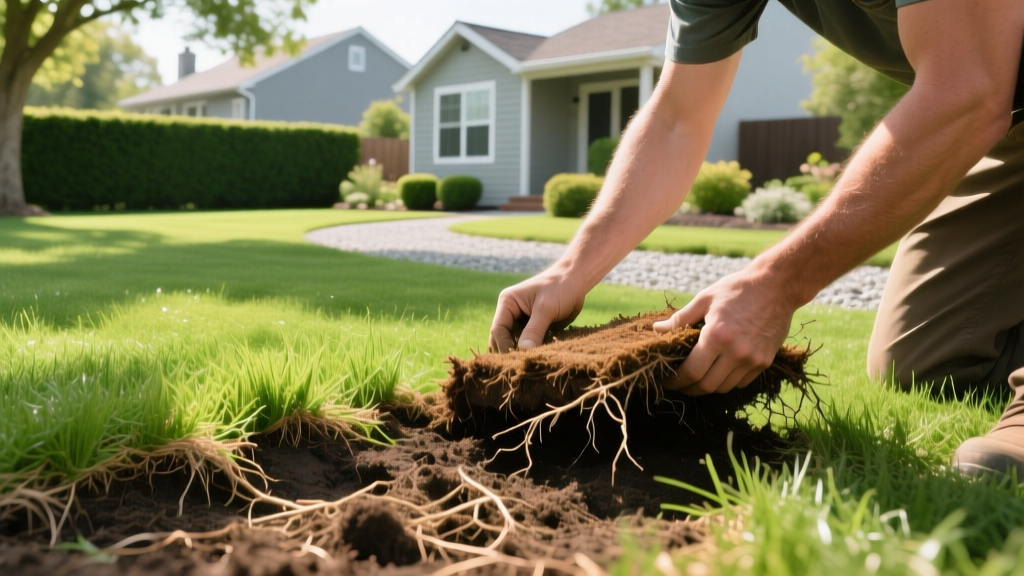
How to Repair Dead Grass Patches: A Diagnostic Rescue Guide
Blindly throwing grass seed over dead patches is a waste of time and money. If the underlying pathogen, pest, or soil issue remains active, new grass will simply die and repeat the cycle. Successfully executing a rescue fix requires accurate symptom diagnosis before any soil is turned. Below is a clinical, symptom-driven framework to identify the exact cause of your turf loss and apply the correct chemical or cultural intervention.
Rapid Diagnostic Decision Tree
- Pulls up like a carpet + C-shaped white larvae? ➔ White Grub Infestation
- Irregular brown rings with a dark 'smoke ring' border? ➔ Brown Patch Fungus
- Brown center with a bright green, lush outer halo? ➔ Dog Urine Nitrogen Burn
- Footprints stay visible for hours + thinning turf? ➔ Soil Compaction & Drought Stress
Symptom 1: Irregular Rings with a 'Smoke Ring' (Brown Patch Fungus)
Brown patch, caused by the pathogen Rhizoctonia solani, thrives in cool-season grasses (especially Tall Fescue and Perennial Ryegrass) when night temperatures stay above 68°F and humidity exceeds 85%. According to NC State Extension Turfgrass Pathology, the hallmark sign is a dark, purplish-brown 'smoke ring' at the outer edge of the patch during early morning dew.
The Rescue Fix
- Halt Disease Spread: Apply a systemic fungicide containing Azoxystrobin (0.31%), such as Scotts DiseaseEx. Apply at a curative rate of 2.87 lbs per 1,000 sq ft. Do not water immediately; allow the granules to sit on the foliage for 24 hours before watering in.
- Adjust Irrigation: Switch from evening watering to early morning (4:00 AM - 6:00 AM). Fungal spores require 10-12 hours of continuous leaf wetness to infect; morning watering allows the canopy to dry by midday.
- Reseed: Wait 14 days after the final fungicide application before overseeding. Some fungicides inhibit seed germination. Use a disease-resistant cultivar like Jonathan Green Black Beauty Ultra, which includes endophyte-enhanced ryegrass that naturally resists fungal attacks.
Symptom 2: Green Halo with a Burnt Center (Dog Urine Burn)
Canine urine contains high concentrations of urea (nitrogen) and soluble salts. When deposited in a concentrated volume, it creates a localized fertilizer overdose, burning the roots in the center while the diluted outer edges receive a growth boost, creating a distinct green halo. The University of Minnesota Extension notes that soil pH imbalances from repeated urination can also lock out essential micronutrients.
The Rescue Fix
Do not attempt to seed directly over urine-scorched soil; the residual salts will desiccate new seedlings.
- Flush the Zone: Saturate the affected 2-foot radius with 2 to 3 gallons of water to leach soluble salts below the root zone (past 6 inches deep).
- Apply Gypsum: Broadcast Calcium Sulfate (Gypsum) at a rate of 12 lbs per 1,000 sq ft. The calcium displaces the sodium in the soil matrix, restoring soil structure and permeability.
- Topdress and Seed: Rake out the dead thatch, lay down a 1/4-inch layer of sphagnum peat moss, and seed with a urine-tolerant mix. Tall Fescue is significantly more tolerant to nitrogen spikes than Kentucky Bluegrass.
Symptom 3: Spongy Turf That Peels Back (White Grubs)
If you grab a handful of dead grass and it rolls back like a newly laid carpet, the roots have been severed. This is the definitive sign of white grubs (the larval stage of Japanese, June, or Masked Chafer beetles). Grubs feed 1 to 3 inches below the surface. Penn State Extension indicates that a threshold of 8 to 10 grubs per square foot is required to cause visible turf death.
The Rescue Fix
| Treatment Type | Active Ingredient | Speed & Efficacy | Best Application Window |
|---|---|---|---|
| Curative (Rescue) | Trichlorfon (Dylox) | Kills in 24-48 hrs; degrades in soil within 7 days. | Late August to October (when grubs are actively feeding near surface). |
| Preventative | Chlorantraniliprole (GrubEx) | Takes 60-90 days to activate; provides season-long control. | April to early June (targets eggs before they hatch). |
Action Step: For an active, destructive infestation, apply Dylox immediately. Water it in with exactly 0.5 inches of irrigation to move the chemical into the top 2 inches of soil where the grubs are feeding. Rake out the dead turf, loosen the soil, and reseed once the grubs are eradicated.
Symptom 4: Lingering Footprints & Thinning (Compaction)
When soil bulk density exceeds 1.4 g/cm³, pore spaces collapse. Oxygen and water cannot reach the roots, leading to shallow root systems, drought stress, and eventual localized death, particularly in high-traffic zones (e.g., between the driveway and the front door).
The Rescue Fix
Standard aeration is insufficient for severely compacted, dead zones. You must perform deep-tine core aeration pulling 3-inch to 4-inch plugs, followed immediately by topdressing.
- Rent a walk-behind core aerator (e.g., a Ryan Lawnaire IV) and make two passes over the dead zone in perpendicular directions.
- Leave the soil cores on the lawn to break down naturally.
- Topdress the area with a 50/50 mix of coarse sand and compost (apply at a depth of 1/4 inch). The sand keeps the aeration holes open, while the compost introduces microbial life to break down the compacted clay matrix.
- Overseed heavily into the aeration holes, which provide perfect seed-to-soil contact and moisture retention.
Repair Matrix: Seed vs. Sod vs. Plugs
Once the underlying issue is neutralized, choose your repair medium based on your grass type and timeline.
| Method | Best For Grass Type | Cost (per 100 sq ft) | Time to Usable Lawn |
|---|---|---|---|
| Overseeding | Cool-season (Fescue, KBG, Ryegrass) | $3 - $8 | 45 - 60 days |
| Sodding | Both (Instant fix for visible areas) | $15 - $30 | 14 - 21 days (root establishment) |
| Plugs/Sprigs | Warm-season (Bermuda, Zoysia, Centipede) | $10 - $20 | 60 - 90 days (spreads via stolons) |
Pro-Tip for Warm-Season Grasses
Do not attempt to seed Bermudagrass or Zoysia patches in late summer. These grasses require soil temperatures above 70°F for germination and will not establish before the first frost. Instead, purchase trays of live plugs (3-inch diameter) and plant them 12 inches apart in a grid pattern within the dead zone. Apply a high-phosphorus starter fertilizer (e.g., 18-24-12) to accelerate stolon spread.
Warning: Herbicide Residuals
If you applied a pre-emergent herbicide (like Prodiamine or Dithiopyr) within the last 4 to 5 months, grass seed will not germinate in that zone. You must either wait out the residual window, use activated charcoal to neutralize the soil (products like SeedSafe), or opt for sod/plugs, which have mature root systems unaffected by pre-emergents.