
Lawn Care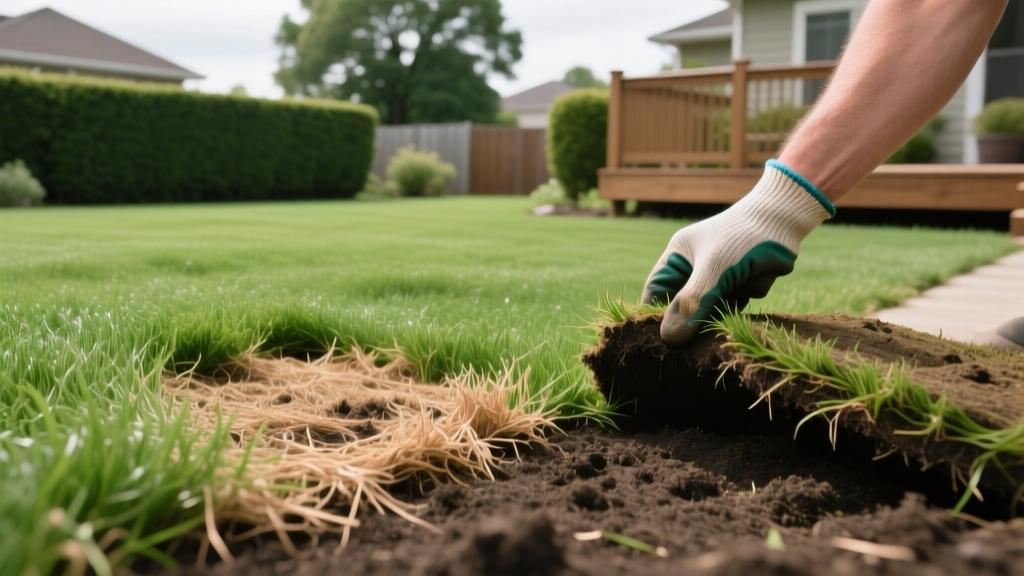
How to Repair Dead Grass Spots: Diagnosis & Rescue Fixes
Discovering brown, lifeless patches in your yard is frustrating, but blindly throwing grass seed at the problem rarely works. Understanding how to repair dead grass spots requires moving beyond generic reseeding and addressing the underlying pathology. A dead spot caused by fungal mycelium requires a completely different intervention than one caused by subsurface grub feeding or localized nitrogen burn. This guide provides a clinical, symptom-based diagnostic framework and exact rescue protocols to restore your turf.
The Symptom Diagnosis Matrix
Before purchasing any amendments, perform a visual and physical inspection of the damaged turf. Use the matrix below to identify the primary culprit based on field symptoms.
| Visual Symptom | Physical Clue | Likely Root Cause | Verification Test |
|---|---|---|---|
| Perfectly circular rings with dark green borders | Grass pulls up easily with no root attachment | Fairy Ring (Fungal) | Soil profile shows white, thread-like mycelium and hydrophobic (dry) soil. |
| Irregular brown patches, 1-5 feet wide | Lesions on individual grass blades with distinct borders | Brown Patch or Dollar Spot | Check for cobweb-like mycelium in early morning dew. |
| Yellowing/brown spots near walkways or patios | Soil smells faintly of ammonia; center of spot is dead, edges dark green | Dog Urine Nitrogen Burn | Flush with water; if it doesn't green up in 7 days, roots are dead. |
| Large, ragged dead zones in late summer/early fall | Turf rolls back like loose carpet | White Grub Infestation | Dig a 12x12 inch square; >5 grubs per sq ft confirms infestation. |
Rescue Fix 1: Dog Urine Burn (Nitrogen Overload)
Canine urine contains high concentrations of urea and salts. When concentrated in a small area, it acts as a fertilizer overdose, burning the crown and roots. Do not attempt to reseed immediately; the residual salts will kill new germination.
The Neutralization Protocol
- Flush the Zone: Saturate the spot with 2 to 3 gallons of water to leach salts below the root zone (6-8 inches deep).
- Apply Gypsum: Broadcast calcium sulfate (gypsum) at a rate of 2 lbs per 100 square feet. Gypsum displaces sodium ions in the soil, restoring soil structure and permeability. Products like Jonathan Green Love Your Soil ($28 for 30 lbs) are highly effective for this.
- Wait and Test: Wait 14 days. Pull lightly on the dead grass. If it releases with no white root tips, the crown is dead and physical repair (detailed below) is required.
Rescue Fix 2: Grub & Chinch Bug Devastation
If your dead spots are caused by root-severing insects, reseeding is a waste of money until the population is eradicated. According to Penn State Extension, curative treatment requires fast-acting contact insecticides, not slow-release preventatives.
Curative Insecticide Application
- Active Ingredient: Trichlorfon (Consumer brand: Bayer Advanced 24-Hour Grub Killer Plus). Cost: ~$25 for a 28 lb bag covering 5,000 sq ft.
- Application Timing: Apply when grubs are actively feeding near the surface (late August to early October for most cool-season zones).
- Watering Requirement: Trichlorfon degrades rapidly in sunlight and high pH soils. You must water the lawn with 1/4 inch of irrigation immediately after application to move the chemical into the thatch layer where grubs feed.
Warning: Do not use Imidacloprid (Merit) for active, visible grub damage. Imidacloprid is a slow-acting preventative that takes 60-90 days to reach peak efficacy. It will not stop the current generation of grubs from destroying your remaining turf.
Rescue Fix 3: Fungal Brown Patch & Dollar Spot
Fungal pathogens thrive in high humidity and prolonged leaf wetness. If your dead spots feature distinct foliar lesions, you must halt the pathogen before introducing new seed. Purdue University Turfgrass Science recommends rotating fungicide modes of action (FRAC codes) to prevent resistance.
Targeted Fungicide Strategy
For immediate rescue of fungal brown patch, use a systemic strobilurin fungicide. Scotts DiseaseEX (Active ingredient: Azoxystrobin, FRAC Code 11) provides 28 days of control and costs approximately $22 for a 10 lb bag covering 5,000 sq ft. Apply at the first sign of mycelium or blade lesions. Water deeply but infrequently (e.g., 1 inch per week in a single morning session) to reduce overnight leaf wetness, which starves the fungus of the moisture it needs to sporulate.
The 5-Step Physical Repair Protocol
Once the underlying biological or chemical issue is neutralized, execute this physical repair sequence for spots smaller than 3 feet in diameter.
Step 1: Aggressive Raking
Use a steel thatch rake to remove all dead organic matter. You must scratch the soil surface to a depth of 1/4 inch. Seed-to-soil contact is the single most critical factor in germination success; seed resting on top of dead thatch will desiccate and die within 48 hours.
Step 2: Soil Amendment
Mix a 50/50 blend of screened topsoil and coarse compost. Spread a 1/2 inch layer over the scratched soil. This introduces beneficial microbes and improves moisture retention. Avoid using pure peat moss, which becomes hydrophobic when dry.
Step 3: Precision Seeding
Apply seed at a rate of 6 to 8 lbs per 1,000 square feet for patch repair (this is double the rate used for full lawn overseeding to ensure dense coverage). Press the seed into the amended soil using the back of a landscaping rake or by walking over it with flat-soled shoes.
Step 4: Hydro-Mulch Topdressing
Cover the seeded area with 1/8 inch of a biodegradable hydro-mulch or weed-free straw. Products like Scotts EZ Seed Patch & Repair ($25 for 10 lbs) include a built-in mulch matrix and starter fertilizer, eliminating the need for separate topdressing and feeding steps.
Step 5: The Germination Watering Schedule
Water the repaired spot for 10 to 15 minutes, two to three times daily, keeping the top 1 inch of soil consistently moist but not waterlogged. Once the new grass reaches 2 inches in height, transition to deep, infrequent watering (1 inch per week) to force root development downward.
Seed Selection by Grass Type
Using the wrong seed cultivar guarantees failure. Match your repair seed to your existing turf's genetic profile, not just the general species.
| Grass Category | Recommended Cultivar | Key Trait for Repair | Estimated Cost (5 lbs) |
|---|---|---|---|
| Cool-Season (Bluegrass) | Midnight Kentucky Bluegrass | Deep rhizome spread; knits into existing turf seamlessly. | $35 - $45 |
| Cool-Season (Fescue) | Titan Ultra Tall Fescue | Deep taproots; highly resistant to drought and brown patch. | $25 - $35 |
| Warm-Season (Bermuda) | Arden 15 Bermudagrass | Aggressive stolon growth; rapid coverage in full sun. | $40 - $55 |
| Warm-Season (Zoysia) | Zenith Zoysia Seed | Improved cold tolerance; slower establishment but dense. | $50 - $65 |
For localized shade issues where dead spots recur annually due to lack of photosynthetically active radiation (PAR), consider switching the specific repair zone to a fine fescue blend (like Creeping Red Fescue), which requires 40% less sunlight than Kentucky Bluegrass to maintain viability. For more detailed environmental thresholds, consult the University of California IPM Turfgrass Guidelines.
Post-Repair Maintenance & Cost Breakdown
Repairing a standard 100-square-foot dead spot using the premium protocol outlined above costs approximately $18 to $32 in materials (seed, compost, and targeted curative treatments). The primary investment is time: 21 to 28 days of consistent micro-irrigation and monitoring. Do not apply broadleaf herbicides (like 2,4-D or Dicamba) to the repaired zone until the new grass has been mowed at least three times, as young seedlings are highly susceptible to chemical burn. By diagnosing the exact failure mode first, you ensure the physical repair is a permanent solution rather than a seasonal band-aid.

