
Lawn Care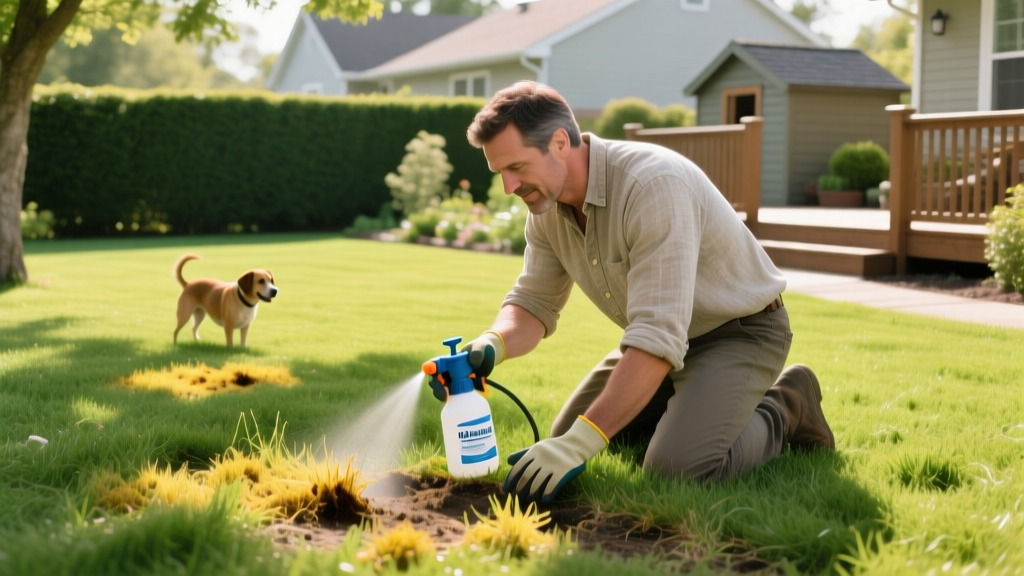
How to Fix Dog Pee Killing Lawn: Step-by-Step Recovery Guide
The Chemistry of Canine Urine Burns
When homeowners notice dog pee killing lawn grass, the immediate assumption is often that the urine is too acidic. This is a pervasive myth. Canine urine typically has a pH between 6.0 and 7.5, which is well within the acceptable range for most turfgrasses. The actual culprit is nitrogen overload.
Dog urine contains high concentrations of urea, a nitrogen-rich compound. A single urination event from a medium-sized dog (40-50 lbs) can deposit the equivalent of 15 to 30 grams of nitrogen into a 4-inch diameter circle. For context, standard lawn fertilization recommendations call for roughly 1 pound of nitrogen per 1,000 square feet per application. A localized dog urine spot receives a massive, unbuffered dose of nitrogen, resulting in severe osmotic stress, root desiccation, and rapid tissue necrosis. The result is a brown, dead center surrounded by a dark green 'halo' where the diluted edges of the urine act as a mild fertilizer.
Turfgrass Science Fact: According to Colorado State University Extension, altering a dog's diet to change urine pH will not prevent nitrogen burns. The damage is strictly a function of urea concentration and soil saturation, not acidity.
Step-by-Step Recovery Protocol for Necrotic Patches
Simply throwing grass seed over a dead urine patch will result in germination failure. The soil matrix remains saturated with toxic levels of soluble salts and ammonium. Follow this precise remediation sequence to restore the turf.
Step 1: Immediate Dilution (The 8-Hour Window)
If you witness the urination event, you have an 8-hour window to prevent the burn. Use a watering can or hose to apply exactly 1.5 to 2.0 gallons of water directly to the spot. This volume is required to push the urea past the root zone (typically 4 to 6 inches deep) and into the subsoil where it can be safely denitrified. Sprinkling a few drops of water is ineffective and can actually accelerate urea hydrolysis, worsening the burn.
Step 2: Core Extraction for Dead Zones
For patches that have already turned brown and necrotic, the soil must be physically removed. Using a 4-inch bulb planter or a heavy-duty soil knife, excavate the top 3 inches of soil from the center of the burn. Remove the dead thatch and root mass entirely. Do not simply till the dead soil back into the ground, as this redistributes the concentrated salts into the surrounding healthy root zones.
Step 3: Rebuild the Soil Matrix with Biochar
Refill the excavated holes with a custom remediation mix. Standard topsoil is insufficient because it lacks the buffering capacity to handle future nitrogen spikes. Mix the following:
- 2 Parts Premium Topsoil: Screened, loam-based, free of heavy clay.
- 1 Part Finished Compost: Introduces microbial life to break down residual urea.
- 1 Part Horticultural Biochar: This is the critical ingredient. Biochar possesses an exceptionally high Cation Exchange Capacity (CEC). It acts like a microscopic sponge, binding excess ammonium ions and releasing them slowly to the grass roots over time, preventing future burns. Expect to pay $15 to $25 per cubic foot for high-quality, inoculated horticultural biochar.
Step 4: Reseed with Tolerant Cultivars
Sow the repaired patch with a urine-tolerant seed blend (detailed in the matrix below). Apply seed at a rate of 6 to 8 pounds per 1,000 square feet. Top-dress lightly with 1/4 inch of peat moss to retain moisture, and water twice daily for 10 minutes until germination occurs (typically 5-7 days for ryegrass, 10-14 days for fescue).
Urine-Tolerant Grass Species Matrix
Not all grasses react to nitrogen spikes equally. If dog urine is a persistent issue, transition your lawn to species with higher urea tolerance and aggressive lateral recovery rates. Data compiled from University of Minnesota Turfgrass Science and regional extension trials highlight the following performance metrics.
| Grass Species | Urine Tolerance | Recovery Mechanism | Recommended Cultivars (2026) |
|---|---|---|---|
| Perennial Ryegrass | High | Rapid germination and bunch-type growth quickly fills small gaps. | 'Manhattan V', 'Sunset II' |
| Tall Fescue | Medium-High | Deep root system (up to 3 feet) dilutes surface nitrogen exposure. | 'Titan Ultra', 'Firewall' |
| Kentucky Bluegrass | Low | Relies on rhizomes; easily overwhelmed by salt desiccation. | N/A (Avoid in high-traffic dog zones) |
| Bermudagrass | Medium | Aggressive stolons and rhizomes allow rapid lateral creep over dead spots. | 'TifTuf', 'Latitude 36' |
| White Clover | Very High | Fixes its own nitrogen; broad leaves resist urea burn better than grass blades. | 'Microclover', 'Pipolina' |
Preventative Landscape and Dietary Strategies
Repairing burns is labor-intensive. Implementing structural and behavioral changes is the most effective long-term strategy for maintaining a pristine lawn.
The 'Pee Post' Substrate Method
Dogs naturally prefer to urinate on vertical objects or distinct substrate changes. Capitalize on this by building a designated 'pee post' in a discreet corner of the yard. Drive a 3-foot wooden post or large landscape boulder into the ground. Excavate a 3x3 foot square around it, 4 inches deep, and fill it with pea gravel or cedar mulch. Train your dog to use this spot by placing a few of their previous urine-soaked soil clumps or a commercial pheromone attractant on the post. The gravel allows the urine to percolate deep into the soil profile without damaging surface vegetation.
Hydration vs. Supplements: A Critical Warning
Many pet owners attempt to solve the problem by altering their dog's diet. This approach is fraught with veterinary risks.
⚠️ Veterinary Warning on 'Lawn Saver' Supplements:
Products marketed to stop dog pee killing lawn often contain DL-Methionine, ascorbic acid, or Yucca schidigera. DL-Methionine attempts to acidify the urine, which does not reduce nitrogen content and can cause severe urinary tract issues, including calcium oxalate bladder stones. Yucca schidigera claims to bind nitrogen in the gut, but clinical efficacy is negligible. The only safe, vet-approved method to reduce urine concentration is increasing the dog's water intake. Switch to wet food, add low-sodium bone broth to their kibble, or use a pet water fountain to encourage hydration.
Products marketed to stop dog pee killing lawn often contain DL-Methionine, ascorbic acid, or Yucca schidigera. DL-Methionine attempts to acidify the urine, which does not reduce nitrogen content and can cause severe urinary tract issues, including calcium oxalate bladder stones. Yucca schidigera claims to bind nitrogen in the gut, but clinical efficacy is negligible. The only safe, vet-approved method to reduce urine concentration is increasing the dog's water intake. Switch to wet food, add low-sodium bone broth to their kibble, or use a pet water fountain to encourage hydration.
Seasonal Maintenance Timeline for Dog-Heavy Lawns
Maintaining a lawn subject to heavy canine traffic requires a modified seasonal schedule focused on soil buffering and aggressive overseeding.
- Early Spring (March-April): Perform liquid core aeration or mechanical aeration to relieve soil compaction caused by dog traffic. Apply a thin (1/4 inch) top-dressing of compost to boost microbial activity, which accelerates the breakdown of winter urea accumulation.
- Late Spring (May): Apply a slow-release, polymer-coated nitrogen fertilizer (e.g., 30-0-0 with 50% SCU). Fast-release synthetic fertilizers combined with dog urine will guarantee severe burning. Slow-release formulas provide a steady baseline of nutrients without spiking soil salinity.
- Late Summer (August): Inspect the lawn for dormant brown spots. Differentiate between urine burns and fungal diseases (like Summer Patch or Brown Patch) by performing a 'tug test'. Urine-burned grass pulls up easily with no root resistance, while fungal grass breaks off at the crown.
- Early Fall (September-October): This is the optimal window for heavy overseeding. Slit-seed the entire lawn with a Perennial Ryegrass and Tall Fescue mix at a rate of 8 pounds per 1,000 square feet. The cooler temperatures and increased rainfall help flush residual salts from the root zone while establishing a dense, urine-resistant turf canopy before winter.

