
Lawn Care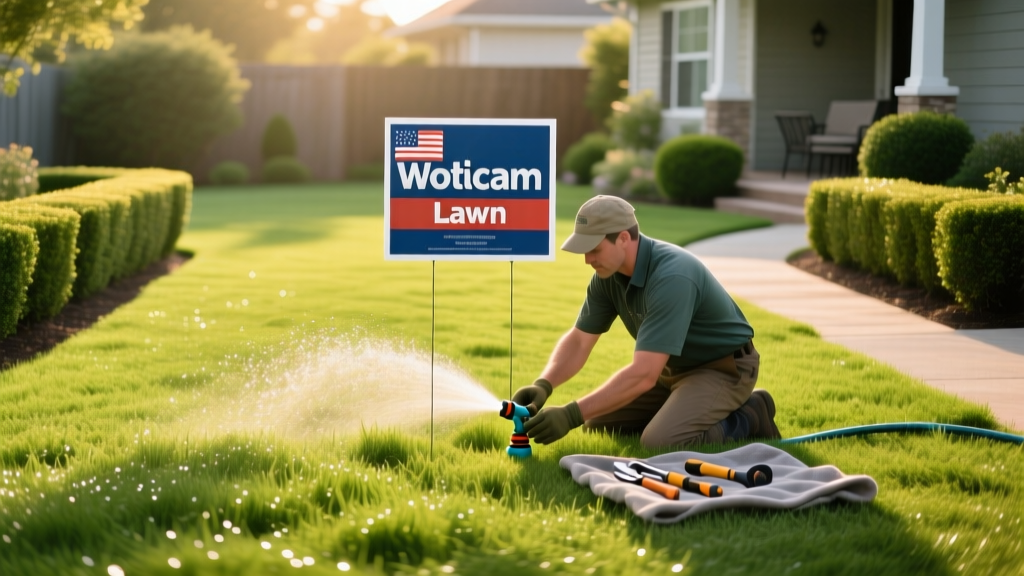
Maintaining Turf Around Political Lawn Signs: A Step-by-Step Guide
The Hidden Turf Toll of Election Season
Election cycles introduce a unique, often overlooked challenge to meticulous lawn care programs: the proliferation of political lawn signs. These signs, typically constructed from fluted polypropylene (Coroplast) and supported by galvanized steel H-stakes, disrupt mowing patterns, shade out underlying turf, and cause severe localized soil compaction. When volunteers repeatedly trample the same 3x3 foot area to install or adjust signage, soil bulk density can exceed 1.6 g/cm³, suffocating grassroots and halting nutrient uptake. This guide provides a step-by-step maintenance and renovation protocol to preserve your turf during election season and seamlessly repair the inevitable damage once the signs come down.
Phase 1: Mowing and Trimming Around Active Signs
Maintaining a clean cut around a cluster of yard signs requires adjusting your standard mowing protocol to prevent both turf scalping and sign degradation.
- Adjust Deck Height: Raise your mower deck to 3.5 or 4 inches around sign perimeters. This prevents the mower blades from catching the bottom edge of the Coroplast, which can tear the sign and violently throw plastic shrapnel.
- Establish a Perimeter Pass: Make your first mowing pass in a wide circle around the signs, discharging clippings away from the sign base to prevent wet grass from clinging to the plastic and promoting mold growth on the stakes.
- String Trimmer Technique: When edging, keep the string trimmer guard fully intact. Use a 0.080-inch or 0.095-inch nylon line rather than heavier 0.155-inch lines, which can easily slice through the 4mm corrugated plastic, shedding microplastics directly into your soil ecosystem.
Warning: Microplastic Shedding
Striking political signs with a high-RPM string trimmer shaves microscopic polypropylene particles into your lawn. According to environmental studies on turf contamination, these plastics do not biodegrade and can alter soil water retention properties. Always maintain a 2-inch buffer between your trimmer line and the sign stakes.
Phase 2: Assessing Soil Compaction from Foot Traffic
The area immediately surrounding political signs suffers from repetitive foot traffic. Before removing the signs, assess the soil compaction. Push a standard 6-inch soil probe or a long flathead screwdriver into the ground. If you cannot penetrate the soil past 2 inches without excessive force, the root zone is critically compacted.
For localized compaction around sign clusters, renting a walk-behind core aerator (typically $80 to $120 per day from local equipment rental yards) is overkill. Instead, utilize a manual stand-on coring tool, such as the Yard Butler Lawn Coring Aerator (approx. $45). This tool extracts 3.5-inch soil cores, instantly relieving pressure and allowing oxygen to reach the stressed rhizomes beneath the compacted footprint.
Phase 3: Safe Sign and H-Stake Extraction
Yanking political signs out of dry, compacted soil is the primary cause of severe turf tearing. The standard 10x15 inch H-stakes are made of 3mm to 4mm galvanized wire; when pulled forcefully, they act like a subterranean blade, slicing through lateral stolons and rhizomes.
Step-by-Step Extraction Protocol
- Pre-Soak the Zone (24 Hours Prior): Apply 0.5 inches of water directly to the base of the stakes using a watering can or targeted hose spray. This softens the soil matrix without turning it into mud.
- Sever the Suction Seal: Insert a 12-inch landscaping knife or a narrow trenching shovel 4 inches away from the stake, angling slightly toward the wire. Push down to break the soil's suction seal.
- Rock and Lift: Grip the sign at the base of the plastic board (not the top, which will snap in the wind). Gently rock the sign side-to-side while applying upward pressure. The 4mm wires will slide out, leaving clean, narrow 1/8-inch holes rather than tearing up chunks of sod.
Phase 4: Repairing Stake Holes and Compacted Ruts
Once the signs are removed, you are left with two distinct issues: deep, narrow stake holes and broad, shallow compaction ruts. The repair strategy depends heavily on your specific turfgrass species and its natural recuperative capacity.
| Grass Type | Stake Hole Repair | Rut & Compaction Repair | Expected Recovery Time |
|---|---|---|---|
| Bermudagrass (Warm) | Leave holes open; lateral stolons will fill them naturally. | Manual core aeration + light topdressing. | 14–21 days (in summer) |
| Kentucky Bluegrass (Cool) | Fill with 70/30 sand-compost mix to prevent settling. | Core aeration + overseeding with matching KBG cultivar. | 21–30 days (spring/fall) |
| Tall Fescue (Cool) | Inject loose topsoil; fescue lacks lateral spread. | Heavy overseeding required; fescue will not spread to fill ruts. | 14–21 days for germination |
| Zoysia (Warm) | Topdress with fine masonry sand to level. | Aerate and apply high-nitrogen fertilizer to stimulate rhizomes. | 30–45 days (slow spreader) |
For cool-season grasses like Tall Fescue, which grow in bunches and lack aggressive lateral runners, simply leaving stake holes unfilled will result in permanent divots that collect water and invite fungal pathogens like Pythium blight. Always fill fescue stake holes with a dry, screened topsoil, tamping it down flush with the surrounding grade.
Phase 5: Post-Removal Soil Amendment and Overseeding
After addressing the physical damage, the soil biology beneath the sign needs rehabilitation. The plastic board blocks UV light and restricts airflow for weeks or months, often leaving the underlying soil pale, anaerobic, and devoid of microbial activity.
Pro-Tip: The Compost Tea Flush
Before dropping seed, apply a liquid compost extract or humic acid solution (such as Simple Lawn Solutions Liquid Aerating Soil Loosener, approx. $25 per 32oz bottle) to the shaded area. This reintroduces beneficial microbes and breaks down the anaerobic crust formed under the plastic sign, drastically improving seed-to-soil contact and germination rates.
Once the soil is prepped, overseed the bare patches using a high-quality, weed-free seed blend. For cool-season lawns, apply seed at a rate of 6 to 8 pounds per 1,000 square feet for renovation patches. Cover the seed with a thin layer of peat moss or straw mulch to retain moisture, and water lightly twice a day for 14 days until the cotyledon leaves emerge. Follow up with a starter fertilizer high in phosphorus (e.g., a 18-24-12 NPK ratio) to accelerate root establishment in the previously compacted zones.
Frequently Asked Questions
Can I leave the metal H-stakes in the ground after the election?
No. Leaving 4mm galvanized stakes in the ground poses a severe hazard to mower blades, aerator tines, and pets. Furthermore, as the zinc coating eventually degrades, the exposed steel will rust, creating localized iron toxicity in the immediate soil profile, which can manifest as dark, necrotic spots in the turf.
Do HOAs have the right to restrict where I place political signs?
While the First Amendment generally protects political speech, Homeowner Associations can enforce reasonable, content-neutral 'time, place, and manner' restrictions. According to the Federal Communications Commission and various state supreme court rulings, HOAs can dictate sign size and placement (e.g., requiring signs to be set back 5 feet from the sidewalk) to maintain neighborhood aesthetics, provided they do not ban them outright or restrict them based on the candidate supported.
How do I fix a sign that was placed on a steep slope and caused erosion?
If a sign was staked on a slope and the surrounding foot traffic caused a runoff trench, you must regrade the area. Fill the trench with a 50/50 mix of topsoil and compost, then lay a piece of biodegradable jute erosion control netting over the patch before overseeding. The jute will hold the seed and soil in place during heavy rains while the new grass roots establish.
For more comprehensive guidance on relieving soil compaction and restoring root health, consult the University of Minnesota Extension's aeration guidelines. If your lawn requires complete renovation after severe election-season damage, the NC State Turfgrass renovation resources offer excellent species-specific recovery matrices.

