
Lawn Care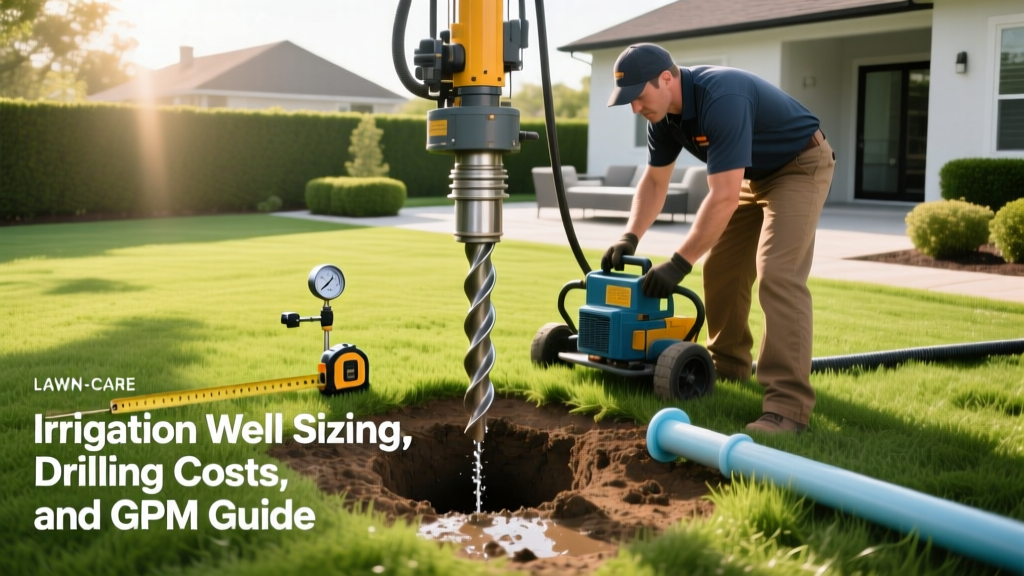
Irrigation Well Sizing, Drilling Costs, and GPM Guide
Municipal water restrictions and surging utility rates are pushing homeowners toward independent water sources. Installing an irrigation well dedicated solely to landscape hydration bypasses tiered municipal pricing and ensures your turf receives optimal moisture even during drought-stage bans. However, a poorly sized well or mismatched pump will lead to dry zones, burnt-out submersible motors, and destroyed sprinkler valves. This guide breaks down the exact hydrology math, 2026 drilling costs, and mechanical specifications required to build a reliable irrigation well system.
Calculating Your Lawn's True GPM Requirement
The most common mistake in well planning is sizing the pump based on the number of sprinkler heads rather than the agronomic water requirement of the turf. To size your well yield, you must calculate the Gallons Per Minute (GPM) your lawn actually consumes.
One inch of water applied to one square foot of lawn equals roughly 0.623 gallons. A standard 1/2 acre lawn (21,780 sq ft) requires approximately 13,568 gallons per week to maintain deep root growth in warm-season grasses like Bermuda or Zoysia. According to the EPA WaterSense program, watering deeply two to three times a week is superior to daily light watering. If you apply 6,784 gallons over a 4-hour (240-minute) watering window, your system demands a continuous flow of 28.2 GPM.
Turf Water Requirements by Grass Type
| Grass Type | Weekly Water Need (Inches) | Gallons/Week (1/2 Acre) | Required GPM (4 hr/day, 2x/week) |
|---|---|---|---|
| Bermuda (Warm) | 1.0 - 1.25 | 13,500 - 16,900 | 28 - 35 GPM |
| Kentucky Bluegrass (Cool) | 1.5 - 2.0 | 20,300 - 27,100 | 42 - 56 GPM |
| Centipede (Warm) | 0.5 - 0.75 | 6,700 - 10,100 | 14 - 21 GPM |
Designing Zones Around Well Recovery Rates
Most residential aquifers yield between 5 and 15 GPM. If your lawn requires 28 GPM but your well only produces 10 GPM, you have a deficit. You do not necessarily need to drill a second well; instead, you must design your sprinkler zones to match the well's recovery rate.
Hydrology Warning: Never configure a sprinkler zone that draws more GPM than your well's tested recovery rate. Pulling water faster than the aquifer replenishes it will cause the water level to drop below the pump intake, leading to cavitation, motor overheating, and eventual pump failure.
If your well yields 10 GPM, limit each irrigation zone to 9 GPM. This means running smaller rotors (like the Hunter I-20 at 2.5 GPM each) and limiting zones to 3 or 4 heads. You will need to water sequentially over a longer period, allowing the well to recover between zone changes.
The Drilling Process and 2026 Cost Realities
According to the USGS Groundwater Use data, domestic and irrigation groundwater extraction is heavily regulated in many states. Before drilling, secure a permit from your local water management district. In 2026, the national average cost for residential water well drilling ranges from $25 to $45 per foot, depending on geological formations.
- Surface Casing (First 20-40 ft): Requires 6-inch steel casing to prevent surface runoff and shallow aquifer contamination.
- Inner Casing: 4-inch Schedule 40 or 80 PVC is standard for the remainder of the borehole, slotted at the aquifer depth to allow water ingress while blocking gravel.
- Gravel Pack & Bentonite Seal: A silica gravel pack surrounds the slotted screen to filter sediment, while a bentonite clay seal at the surface prevents surface water from migrating down the outside of the casing.
For a 150-foot well in standard sedimentary rock, expect to pay between $4,500 and $6,500 for the drilling and casing alone. Add $2,500 to $3,500 for the pump, trenching, and electrical wiring, bringing the total turnkey investment to roughly $8,500.
Pump Sizing and Pressure Tank Selection
For irrigation wells deeper than 25 feet, a 4-inch submersible pump is mandatory. The National Ground Water Association's Well Owner guide recommends sizing the pump horsepower (HP) based on total dynamic head (TDH), which includes the depth to water, elevation changes, and friction loss in the piping.
For a 150-foot well delivering 15 GPM at 50 PSI, a 1.5 HP Franklin Electric submersible motor paired with a Goulds J-Series end-suction pump is the industry benchmark. However, standard residential pressure tanks (like the Amtrol WX-202) are too small for irrigation. Irrigation systems run continuously for hours; a small tank will cause the pressure switch to rapid-cycle, destroying the switch contacts. Install an 80-gallon bladder tank (e.g., Amtrol WX-350) or utilize a Variable Frequency Drive (VFD) constant pressure system to maintain steady 50 PSI without tank drawdown.
Filtration: Protecting Your Solenoid Valves
Groundwater is rarely pristine. Even trace amounts of fine sand or iron bacteria will score the rubber diaphragms inside your irrigation solenoid valves (such as the Hunter PGV or Rain Bird DV series), causing them to stick open and flood your lawn. You must install a multi-stage filtration manifold at the wellhead.
- Centrifugal Sand Separator: If your well pumps visible grit, install a Lakos centrifugal separator before the pressure tank. It uses vortex action to drop heavy sand into a purge valve without restricting flow.
- Spin-Down Filter: A 100-mesh Rusco spin-down filter is the absolute minimum requirement for any irrigation well. It catches fine particulate and can be flushed via a ball valve without removing the screen.
- Iron Filtration: If water tests show high dissolved iron (which stains concrete driveways orange), you will need an inline manganese greensand filter or a dedicated aeration system before the water enters the sprinkler mains.
10-Year ROI: Municipal Water vs. Irrigation Well
Is the upfront capital expenditure justified? Below is a 10-year cost projection comparing municipal water (averaging $5.50 per 1,000 gallons including sewer fees, though sewer caps may apply) versus a dedicated well system operating at $0.14/kWh for electricity.
| Expense Category | Municipal Water (1/2 Acre) | Dedicated Irrigation Well |
|---|---|---|
| Upfront Installation | $0 (Tap fees excluded) | $8,500 |
| Annual Water/Energy Cost | $1,485 (270k gal/season) | $165 (Pump electricity) |
| 10-Year Maintenance | $0 | $800 (Filter screens, switch) |
| Total 10-Year Cost | $14,850 | $9,465 |
Assuming municipal rates increase by a conservative 4% annually, the well system achieves break-even in approximately 5.5 years, yielding pure savings thereafter while insulating the homeowner from drought-stage watering bans.
Common Failure Modes and Maintenance
To ensure your irrigation well operates for its 20-year expected lifespan, monitor these specific failure points:
- Pressure Switch Pitting: If the pump short-cycles due to a waterlogged bladder tank, the 30/50 PSI square pressure switch contacts will arc and weld together. Test the tank's air charge annually with a tire gauge (it should be 2 PSI below the cut-in pressure).
- Aquifer Depletion: If your sprinklers suddenly lose pressure mid-cycle, the water table may have dropped below the pump intake during peak summer draw. Lowering the pump drop pipe by 20 feet usually resolves this.
- Lightning Strikes: Submersible pumps are highly susceptible to power surges. Install a dedicated 240V surge protector (like the Intermatic IG2240) at the well control box to protect the $1,200 motor from grid fluctuations.
By accurately calculating your turf's GPM requirements, matching your zone design to the aquifer's recovery rate, and installing proper sediment filtration, an irrigation well transforms from a risky excavation project into a highly predictable, cost-saving landscape asset.

