
Lawn Care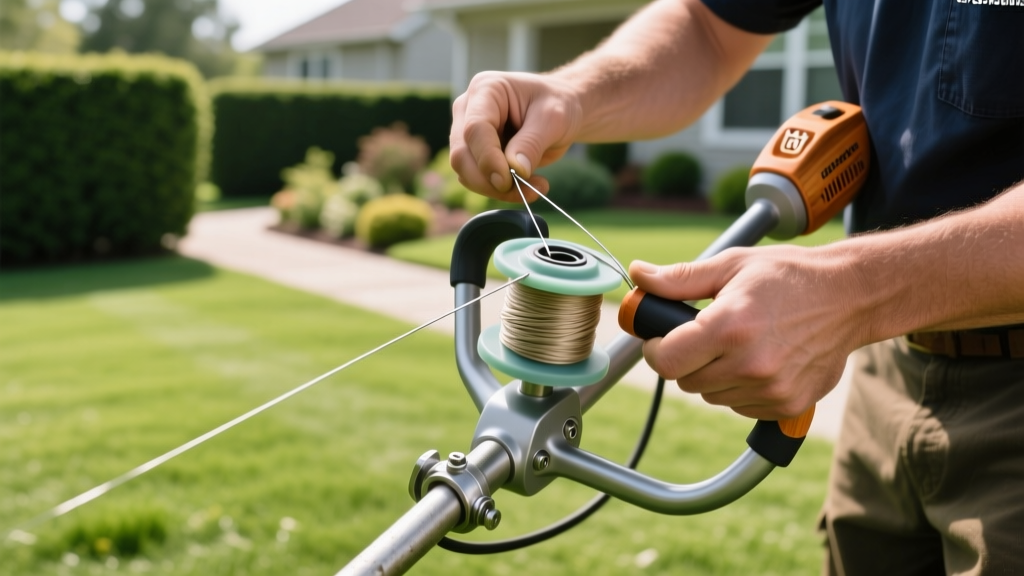
How to Restring a Husqvarna Weed Eater for Precision Weed Control
Why String Selection Matters for Weed Spot-Treatment
Spot-treating invasive species like yellow nutsedge, mature crabgrass, or dallisgrass requires more than just selective chemical herbicides. Mechanical removal and precise edging are critical to preventing seed spread and disrupting rhizome networks. Knowing exactly how to restring a Husqvarna weed eater ensures your trimmer slices cleanly through tough weed stems rather than tearing them. Tearing the crown of a weed like dallisgrass often triggers aggressive regrowth, while a clean mechanical cut at the soil line starves the root system over time.
Furthermore, using the wrong line diameter or shape for a specific weed species leads to rapid line degradation, excessive trimmer vibration, and unintended damage to the surrounding desirable turf. A properly strung Husqvarna trimmer head maintains optimal rotational balance, allowing you to maneuver tightly around ornamental beds and spot-treat individual weed clusters without scalping the lawn.
Matching Line Diameter and Shape to Weed Species
Not all trimmer lines are created equal. The structural integrity of a weed's stem dictates the required line geometry. According to weed management guidelines from the University of Minnesota Extension, yellow nutsedge features a tough, triangular stem that easily deflects standard round nylon lines. To achieve a clean cut, you must upgrade your line profile.
| Weed Species | Stem Characteristics | Recommended Line Diameter | Optimal Line Shape |
|---|---|---|---|
| Annual Bluegrass (Poa annua) | Soft, hollow, low-tensile | .080 inch | Round |
| Crabgrass (Mature) | Fibrous, sprawling, tough nodes | .095 inch | Twisted or Multi-sided |
| Yellow Nutsedge | Triangular, rigid, waxy coating | .095 inch or .105 inch | Twisted (bites into flat edges) |
| Dallisgrass | Thick rhizomes, dense basal crowns | .105 inch | Serrated or Square |
Identifying Your Husqvarna Trimmer Head
Before initiating the restringing process, you must identify which Husqvarna trimmer head is mounted on your shaft. The restringing mechanism and maximum line capacity vary significantly between models.
- Husqvarna T25 (Tap-N-Go): Standard on residential models like the 128LD. Accepts .080" and .095" line. Features a simple two-piece spool and cover design.
- Husqvarna T35 (Tap-N-Go): Found on commercial and heavy-duty models like the 130L or 320iL. Accepts .095" and .105" line. Features a heavy-duty aluminum-reinforced hub and a larger spool capacity for extended runtime.
- Husqvarna T45: Designed for brushcutters. Accepts up to .130" line or steel blades. Uses a reverse-thread retention bolt (lefty-tighty) compared to the standard right-hand threads on the T25 and T35.
Step-by-Step: How to Restring a Husqvarna Weed Eater (T25/T35)
Follow this precise procedure to restring standard Husqvarna Tap-N-Go heads. This method minimizes spool overlap, which is the primary cause of line feed failure during spot-treatment operations.
- Remove the Spool: Align the arrow on the trimmer head cover with the notch on the hub. Push down on the spool and turn it counter-clockwise to unlock the retention tabs. Lift the cover and spool straight up.
- Clean the Hub: Use a wire brush or compressed air to clear out compacted grass clippings, dirt, and melted nylon residue from the aluminum hub. Debris here causes the spool to bind, preventing the line from advancing when you tap the head on the ground.
- Cut and Anchor the Line: Cut exactly 15 feet of your selected nylon line. Fold it in half to find the center. Insert the center loop into the anchor hole located in the inner chamber of the spool.
- Wind the Spool: Wind the line tightly and evenly in the direction indicated by the arrow on the spool (almost always clockwise for Husqvarna T-series). Keep the two strands separated in their respective channels. Overlapping strands will fuse together under centrifugal force.
- Secure the Tails: Leave approximately 6 inches of line extending from the spool. Snap these tails into the temporary holding notches on the spool's outer rim.
- Thread the Eyelets: Feed the left and right tails through the metal or reinforced plastic exit eyelets on the trimmer head cover.
- Reassemble: Place the spool back into the cover, ensuring the tails remain threaded through the eyelets. Pull the tails tight to release them from the temporary notches. Align the cover arrows and twist clockwise until it clicks securely into place.
Warning: Never wind line counter-clockwise on standard Husqvarna T-series heads. Reversing the winding direction defeats the internal ratcheting mechanism, causing the line to retract into the spool and permanently jam the hub during high-RPM operation.
Troubleshooting Common Restringing Failures
Even with proper technique, mechanical spot-treatment of dense weed patches can expose equipment vulnerabilities. Here is how to diagnose and fix the most common restringing failures.
Line Fusing and Welding
If your line advances once but then refuses to feed out further, the nylon has likely fused inside the spool. This occurs when the trimmer head strikes concrete curbs or rocks while edging around weed-infested hardscapes. The friction generates enough heat to melt the nylon strands together. The Fix: Switch to a co-polymer or reinforced titanium-nylon blend line, which has a higher melting point. Additionally, avoid holding the throttle at maximum RPM while the head is stationary or rubbing against hard surfaces.
Uneven Feed and Jamming
If one side of the line feeds out significantly longer than the other, the trimmer head will vibrate violently, tearing up desirable turf instead of cleanly cutting target weeds. The Fix: This is caused by uneven winding tension. When reloading, ensure you are pulling both strands with equal tension. If the spool's internal ratchet spring is worn or caked in mud, it will fail to distribute the line evenly. Disassemble the head and wash the spring in a degreaser.
Pro Tips for Spot-Treating Nutsedge and Crabgrass
When mechanically spot-treating weeds, the goal is to remove the photosynthetic tissue without disturbing the soil, which can bring dormant weed seeds to the surface. According to turfgrass management protocols, disturbing the soil profile during weed removal can increase future germination rates by up to 40%.
For yellow nutsedge, hover the Husqvarna trimmer head exactly one-quarter inch above the soil grade. Use a .095" twisted line to slice the triangular stem cleanly. Do not let the head bounce on the soil, as this will scar the dirt and promote erosion. For mature crabgrass, which grows in low, sprawling rosettes, tilt the trimmer head slightly (about 15 degrees) to use the very tip of the line. This creates a high-velocity cutting zone that shreds the fibrous nodes without digging into the lawn's root zone. Always refer to the Husqvarna Official Support documentation for your specific model's maximum RPM ratings to ensure your chosen line weight does not overstress the clutch or gearbox.

