
Lawn Care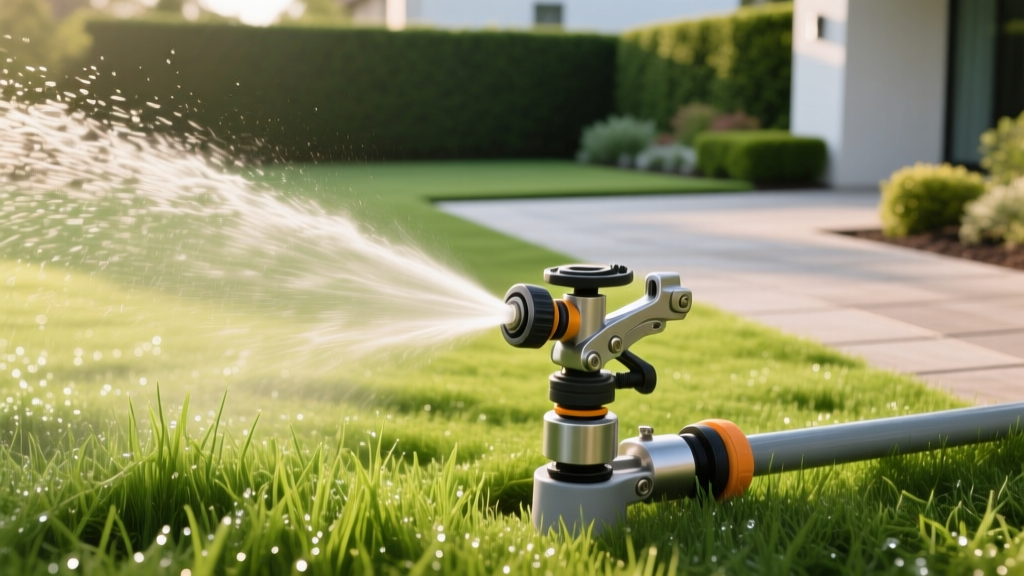
Rotary Sprinkler Nozzle Upgrades: Calibration and Coverage Guide
The Physics of Sprinkler Precipitation Rates
Traditional fixed-spray sprinkler heads apply water at a precipitation rate (PR) of 1.5 to 2.5 inches per hour. However, most clay-loam and compacted urban soils only possess an infiltration rate of 0.2 to 0.5 inches per hour. This fundamental mismatch between application speed and soil absorption guarantees surface runoff, wasted water, and dry root zones. Upgrading to multi-stream rotary sprinkler nozzles resolves this hydraulic bottleneck by reducing the application rate to 0.4 to 0.6 inches per hour, allowing water to penetrate the soil profile rather than pooling on the surface or washing into storm drains.
Key Metric: According to the EPA WaterSense program, replacing standard spray nozzles with high-efficiency rotary nozzles can reduce outdoor water use by up to 30% while improving distribution uniformity (DU) across the turf canopy.
Fixed Spray vs. Rotary Sprinkler Heads
Choosing the correct sprinkler nozzle requires understanding the mechanical differences between traditional spray and modern rotary technologies. Fixed spray heads use a stationary deflector to fan water across a set arc, resulting in high-velocity droplets that are highly susceptible to wind drift. Rotary nozzles utilize a gear-driven turbine to spin multiple streams of water across the arc, producing larger, heavier droplets that penetrate wind and canopy resistance.
| Feature | Standard Fixed Spray | Hunter MP Rotator | Rain Bird R-VAN |
|---|---|---|---|
| Precipitation Rate | 1.5 - 2.5 in/hr | 0.4 - 0.6 in/hr | 0.5 - 0.7 in/hr |
| Optimal Pressure | 30 PSI | 40 PSI | 45 PSI |
| Wind Drift Resistance | Low (Fine mist) | High (Heavy streams) | High (Heavy streams) |
| Filter Mechanism | Basic mesh screen | Dual pop-up flush filter | Removable inline filter |
Executing the Sprinkler Catch Cup Audit
Do not rely on controller estimates. To accurately calibrate your sprinkler system, you must conduct a physical catch cup audit. This empirical test measures the exact volume of water your specific zones deliver. UC Agriculture and Natural Resources recommends this method to establish baseline irrigation schedules.
- Deploy the Grid: Place 6 to 8 identical flat-bottomed catch cups (or standard 32oz tuna cans) in a grid pattern across a single sprinkler zone. Ensure cups are at least 2 feet away from the sprinkler heads and 1 foot away from hardscape edges.
- Run the Zone: Activate the specific sprinkler zone manually from your controller. Let it run for exactly 15 minutes. Do not run adjacent zones, as overlapping spray will skew the data.
- Measure and Average: Use a millimeter ruler to measure the water depth in each cup. Add the measurements together and divide by the number of cups to find the average depth in inches.
- Calculate the PR: Multiply the average depth by 4 to determine your inches-per-hour precipitation rate. For example, if your cups average 0.15 inches in 15 minutes, your PR is 0.6 inches per hour.
- Assess Distribution Uniformity (DU): Subtract the lowest cup measurement from the highest. If the variance exceeds 20%, your sprinkler heads require re-alignment, pressure regulation, or nozzle cleaning.
Warning: Never mix fixed spray heads and rotary sprinkler nozzles on the same irrigation valve zone. The fixed spray will deliver 2 inches of water in the time it takes the rotary nozzle to deliver 0.5 inches, resulting in severe localized flooding and dry spots.
Troubleshooting Rotary Sprinkler Failure Modes
Rotary nozzles contain moving internal gears that are sensitive to hydraulic anomalies. If your system is underperforming, diagnose the specific failure mode before replacing parts.
Stalled Rotation or Incomplete Arcs
Cause: Debris lodged in the turbine gear or insufficient water pressure. Rotary nozzles require a minimum of 35-40 PSI at the head to engage the internal gear drive.
Fix: Pull the riser up, unscrew the nozzle, and remove the internal plastic filter. Flush the filter and the sprinkler body with water. If pressure at the head is below 35 PSI (measured with a pitot tube or pressure gauge attached to a hose bib on the same zone), you must reduce the number of heads on the valve or upgrade the main supply line.
Misting and Fogging at the Nozzle
Cause: Excessive water pressure (above 55 PSI). High pressure shatters the cohesive water streams into a fine mist, which evaporates or blows away before reaching the turf.
Fix: Install pressure-regulating spray bodies (PRS) that cap output at 40 or 45 PSI, or install a master pressure-reducing valve (PRV) at the point of connection if the entire property exceeds 65 PSI.
Stream Streaking (Dry Spots Directly in Front of Head)
Cause: The riser is tilted, or the nozzle is not seated perfectly vertical.
Fix: Excavate around the sprinkler body. Ensure the body is perfectly plumb using a torpedo level. Backfill with coarse gravel to stabilize the body and prevent future heaving from frost or soil settling.
2026 Cost Analysis and ROI for Irrigation Upgrades
Upgrading an entire lawn to rotary sprinkler nozzles requires an upfront material investment, but the reduction in municipal water billing typically yields a return on investment within 14 to 22 months, depending on local tier-based water pricing.
| Component | Unit Cost (2026) | Quantity (Avg 5,000 sq ft Lawn) | Total Estimated Cost |
|---|---|---|---|
| Hunter MP Rotator Nozzles | $7.50 - $9.00 | 25 | $187.50 - $225.00 |
| 40 PSI Regulating Spray Bodies | $12.00 - $15.00 | 25 | $300.00 - $375.00 |
| Smart Wi-Fi Controller (e.g., Rachio 3) | $229.00 | 1 | $229.00 |
| Total DIY Material Cost | $716.50 - $829.00 |
According to Texas A&M AgriLife Extension, optimizing irrigation uniformity and matching application rates to soil infiltration can reduce seasonal turf water consumption by 15,000 to 20,000 gallons for an average residential lot. In municipalities with tiered water pricing, this volume reduction frequently drops the homeowner from Tier 3 to Tier 2 billing, accelerating the payback period for the hardware upgrade.
Seasonal Runtime Adjustments
Because rotary sprinkler nozzles apply water much slower than traditional spray heads, your controller run times must be increased. A zone that previously required 8 minutes with fixed spray heads will typically require 25 to 35 minutes with rotary nozzles to deliver the same total volume of water.
- Spring/Fall (Cool Season): Run rotary zones for 20 minutes, twice a week.
- Summer (Peak Heat): Run rotary zones for 35-45 minutes, three times a week.
- Cycle and Soak: If your soil is heavy clay and runoff still occurs at 30 minutes, split the run time. Program the controller to run the zone for 15 minutes, wait 45 minutes for infiltration, and then run the zone for a second 15-minute cycle.
By aligning your sprinkler hardware with the physical limits of your soil, you eliminate runoff, deepen root growth, and build a turf profile capable of withstanding peak summer drought stress.

