
Lawn Care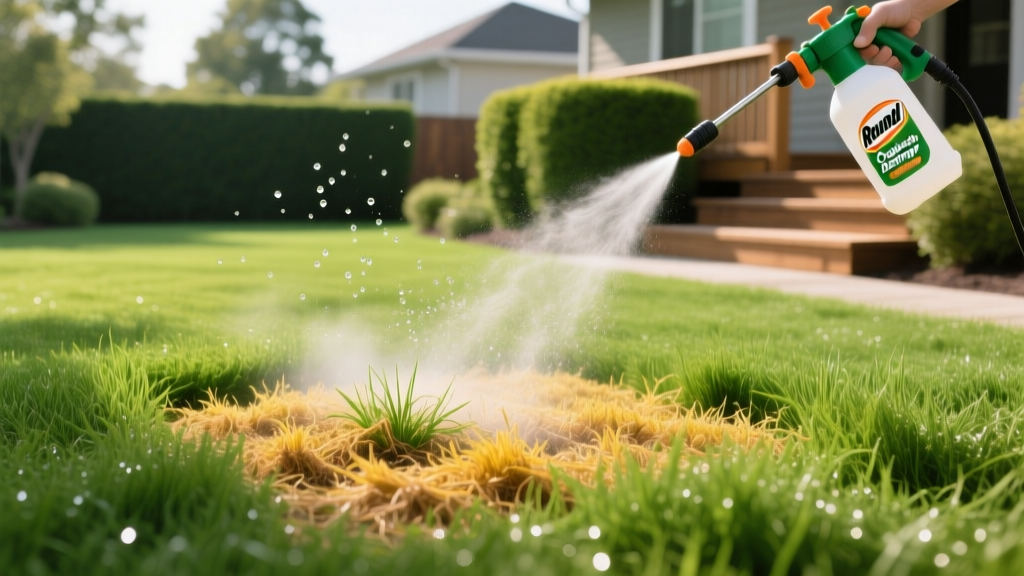
Roundup Crabgrass Destroyer: Spot-Treatment Guide & Grass Safety
The Chemistry of Selective Crabgrass Control
When homeowners hear the word 'Roundup,' they instinctively think of glyphosate—the notorious non-selective herbicide that kills any plant it touches. However, Roundup For Lawns Crabgrass Destroyer is an entirely different formulation. The active ingredient in this specific product line is Quinclorac, a synthetic auxin (Group 4 herbicide) designed to selectively target grassy weeds like crabgrass while leaving most desirable turfgrasses unharmed.
Quinclorac mimics natural plant hormones, triggering uncontrolled, unsustainable growth in susceptible weeds. This leads to epinasty (twisting and curling of stems), chlorosis (yellowing), and eventual necrosis (tissue death). Because desirable turfgrasses possess the metabolic pathways to rapidly detoxify quinclorac, they survive the application while the crabgrass effectively grows itself to death.
⚠️ CRITICAL WARNING: The Glyphosate Trap
Do not confuse Roundup For Lawns Crabgrass Destroyer with standard Roundup Weed & Grass Killer. Standard Roundup contains glyphosate or diquat, which will obliterate your desirable turfgrass along with the crabgrass, leaving dead brown patches in your lawn. Always verify the active ingredient listed on the label is Quinclorac before spraying your lawn.
Do not confuse Roundup For Lawns Crabgrass Destroyer with standard Roundup Weed & Grass Killer. Standard Roundup contains glyphosate or diquat, which will obliterate your desirable turfgrass along with the crabgrass, leaving dead brown patches in your lawn. Always verify the active ingredient listed on the label is Quinclorac before spraying your lawn.
Grass Compatibility Matrix: Is Your Lawn Safe?
Quinclorac is highly selective, but it is not universally safe for all turfgrass species. Applying this product to incompatible grasses will result in severe phytotoxicity, manifesting as extreme stunting, chlorosis, and turf thinning. Before purchasing, identify your specific grass type.
| Turfgrass Species | Season Type | Quinclorac Safety | Notes & Restrictions |
|---|---|---|---|
| Kentucky Bluegrass | Cool-Season | Safe | Excellent tolerance; ideal for northern lawns. |
| Tall Fescue / Fine Fescue | Cool-Season | Safe | Highly tolerant; standard for transition zones. |
| Perennial Ryegrass | Cool-Season | Safe | Safe, but avoid applications during spring seedling establishment. |
| Bermudagrass | Warm-Season | Caution | Safe when fully dormant or fully green. Avoid during spring green-up. |
| Zoysiagrass | Warm-Season | Caution | May cause temporary yellowing; apply only to established turf. |
| St. Augustinegrass | Warm-Season | UNSAFE | Severe phytotoxicity. Do not use. Use Atrazine or Penoxsulam instead. |
| Centipedegrass | Warm-Season | UNSAFE | High risk of turf injury and stunting. |
For authoritative guidance on identifying your turf species and regional weed pressures, consult resources like the University of Missouri Extension or your local university turfgrass program.
Step-by-Step Spot-Treatment Protocol
Spot-treating requires precision. Broadcast spraying quinclorac over an entire lawn when only isolated patches of crabgrass exist wastes product and unnecessarily stresses your turf. Follow this exact protocol for optimal results.
1. Identify the Tiller Stage
Crabgrass susceptibility to quinclorac drops dramatically as the plant matures. Count the 'tillers' (side shoots branching from the base of the main stem).
- 1 to 3 Tillers (Seedling to Early Stage): Highly susceptible. One application is usually sufficient.
- 4 to 5 Tillers (Mid-Stage): Moderate susceptibility. Expect to apply a second treatment.
- 5+ Tillers (Mature/Pregnant Stage): Low susceptibility. Requires sequential applications spaced 14 to 21 days apart, and complete control is not guaranteed before the plant naturally dies in autumn.
2. Prepare the Surfactant (For Concentrates Only)
Crabgrass leaves are coated in a waxy cuticle and fine hairs that repel water-based sprays. If you are using the Ready-To-Use (RTU) pump bottle, the surfactant is already mixed in. If you are using the Concentrate, you must add a Methylated Seed Oil (MSO) or a high-quality Non-Ionic Surfactant (NIS) at a rate of 0.25% to 0.5% v/v (roughly 1/2 to 1 teaspoon per gallon of water). Without a surfactant, the quinclorac will bead up and roll off the leaf, resulting in total failure. The Environmental Protection Agency (EPA) emphasizes strictly following label adjuvant requirements for efficacy and environmental safety.
3. Check Environmental Conditions
Quinclorac relies on active plant translocation to move the herbicide from the leaves down to the roots. This requires the plant to be actively growing.
- Temperature: Apply when daytime highs are between 65°F and 85°F. Applications above 85°F increase the risk of turf phytotoxicity (leaf burn) and reduce weed translocation.
- Moisture: Do not apply if the lawn is drought-stressed. Water the lawn deeply 24 hours before application.
- Wind: Apply when winds are below 5 mph to prevent drift onto sensitive ornamental beds or neighboring lawns.
4. Execute the Application
- Mow: Mow your lawn 2 days before application to ensure the crabgrass leaves are exposed and not shaded by taller desirable turf.
- Spray: Spray the crabgrass foliage until it is visibly wet, but not to the point of runoff. Focus on the center crown of the weed.
- Wait: Do not water the lawn for at least 24 hours post-application to allow the herbicide to fully absorb through the leaf cuticle.
- Mow Again: Wait at least 2 days after application before your next mowing to prevent removing the treated leaf tissue.
Troubleshooting: Why Didn't the Crabgrass Die?
If you applied the product and the crabgrass is still thriving two weeks later, one of the following failure modes is likely responsible:
Common Failure Mode 1: Omitted Surfactant
If using the concentrate without MSO or NIS, the active ingredient never penetrated the waxy leaf surface. Fix: Reapply with the correct surfactant ratio immediately.
If using the concentrate without MSO or NIS, the active ingredient never penetrated the waxy leaf surface. Fix: Reapply with the correct surfactant ratio immediately.
Common Failure Mode 2: Application During Heat Stress
If applied when temperatures exceeded 88°F, the crabgrass shut down its metabolic processes to conserve water, halting the translocation of the quinclorac to the roots. Fix: Wait for a cool front (below 85°F) and reapply.
If applied when temperatures exceeded 88°F, the crabgrass shut down its metabolic processes to conserve water, halting the translocation of the quinclorac to the roots. Fix: Wait for a cool front (below 85°F) and reapply.
Common Failure Mode 3: Mowed Too Soon
Mowing the day after spraying physically removed the treated leaf tissue before the chemical could reach the root crown. Fix: Allow the plant to regenerate new leaves (about 5-7 days) and re-treat.
Mowing the day after spraying physically removed the treated leaf tissue before the chemical could reach the root crown. Fix: Allow the plant to regenerate new leaves (about 5-7 days) and re-treat.
Post-Treatment Lawn Recovery and Overseeding
One of the most critical, yet frequently overlooked, characteristics of quinclorac is its soil residual activity. While this residual helps prevent new crabgrass seeds from germinating, it also severely inhibits the germination and root development of desirable turfgrass seeds.
If you plan to overseed your lawn to fill in the bare spots left by the dead crabgrass, you must wait a minimum of 28 days after your last application of Roundup Crabgrass Destroyer. For higher application rates or multiple sequential treatments, turfgrass managers recommend extending this waiting period to 8 weeks (56 days) to prevent seedling stunting and root pruning.
Frequently Asked Questions
Will Roundup Crabgrass Destroyer kill broadleaf weeds like dandelions?
While quinclorac has some efficacy on certain broadleaf weeds (like white clover and wild violet), it is specifically optimized for grassy weeds. For heavy broadleaf infestations, you will achieve faster and more complete control using a dedicated broadleaf herbicide containing 2,4-D, Dicamba, or Triclopyr.
Can I use this product near my vegetable garden?
No. Quinclorac is highly mobile in certain soil types and can persist in the soil. Keep a minimum buffer zone of 10 to 15 feet between your treated lawn and any edible crops, particularly tomatoes and peppers, which are highly sensitive to synthetic auxin herbicides.
How long does it take to see results?
Under ideal conditions (70°F to 80°F and adequate soil moisture), you will notice the crabgrass leaves beginning to twist, curl, and yellow (epinasty and chlorosis) within 5 to 7 days. Complete necrosis and browning of the weed typically takes 14 to 21 days.

