
Lawn Care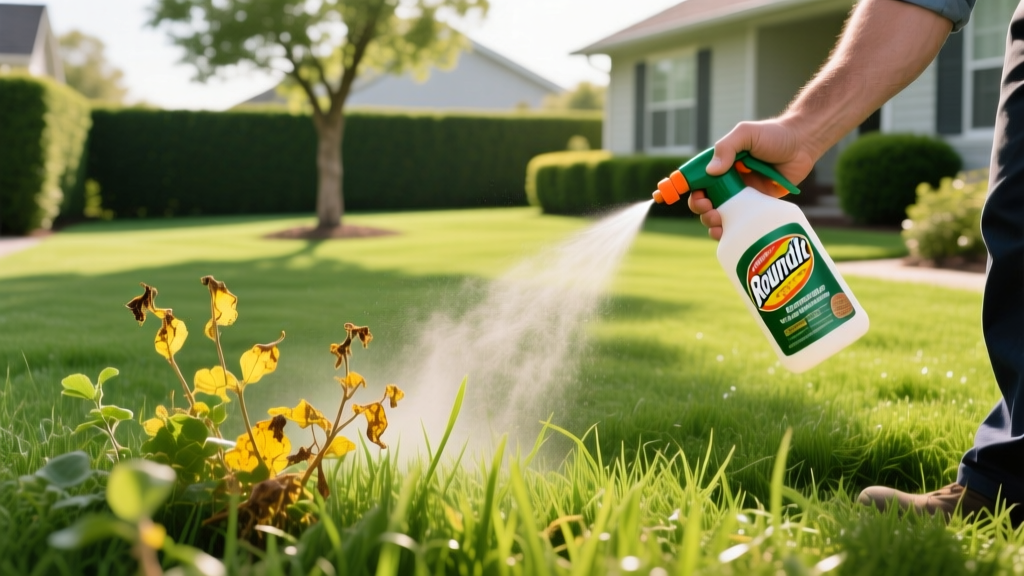
How Long Does It Take Roundup to Kill Weeds? Dosage & Cost Guide
When dealing with aggressive lawn invaders like crabgrass, dandelions, or creeping charlie, the most common question homeowners ask is: how long does it take Roundup to kill weeds? The short answer is that visible wilting occurs within 12 to 24 hours, but complete root death takes 7 to 14 days. However, this timeline is not fixed. It fluctuates wildly based on your dilution ratios, the specific active ingredient concentration, ambient temperatures, and the weed species.
As a dosage and coverage guide, this article moves beyond the basic label instructions. We will break down the exact hour-by-hour translocation process, reveal the 'overdosing paradox' that actually slows down kill times, and calculate the true cost-per-square-foot of Ready-To-Use versus Concentrate formulations for your 2026 lawn care budget.
The Roundup Timeline: What to Expect Hour by Hour
Glyphosate, the primary active ingredient in standard Roundup, is a systemic, non-selective herbicide. It must be absorbed through the foliage and translocated down through the phloem to the root system. Here is the biological timeline of a standard application on broadleaf weeds and annual grasses:
- 12 to 24 Hours (Initial Wilting): The weed's leaves will begin to lose turgor pressure. You will notice slight drooping, particularly at the growing tips. At this stage, the plant is still actively moving the herbicide.
- 48 to 72 Hours (Chlorosis and Yellowing): The plant stops producing essential amino acids (specifically EPSP synthase is blocked). Leaves turn yellow, starting at the new growth and leaf margins.
- 5 to 7 Days (Necrosis): Tissue death begins. Leaves turn brown and crispy. Annual weeds will appear completely dead, but perennial weeds may still have viable root systems.
- 10 to 14 Days (Complete Root Kill): The systemic translocation is complete. The rhizomes, taproots, and stolons are dead. The weed can be safely raked or pulled without risk of regrowth.
⚠️ The Overdosing Paradox: Why More is Not Faster
A critical mistake homeowners make is doubling the concentrate dose to 'speed up' the kill. If you mix Roundup Super Concentrate at 12 oz per gallon instead of the recommended 3 to 6 oz, you cause rapid contact burn. The leaf tissue dies so quickly that the plant's vascular system shuts down before the glyphosate can translocate to the roots. The top of the weed will brown in 48 hours, but the roots will survive and push up new shoots in three weeks. Always stick to the label's dilution rates for optimal systemic kill.
Dosage, Dilution, and Cost Matrix
Understanding how long it takes Roundup to kill weeds requires matching the right product concentration to your specific weed pressure. Below is a breakdown of the most common consumer formulations, their exact mix rates, and the real-world coverage costs.
| Product Formulation | Active Ingredient % | Mix Rate (per 1 Gal Water) | Avg. Cost (2026) | Kill Timeline |
|---|---|---|---|---|
| Ready-To-Use Weed & Grass Killer III | 2% Glyphosate | No mixing (Spray directly) | $22.00 / 1.33 Gal | 12 hrs visible / 14 days root |
| Super Concentrate | 50.2% Glyphosate | 3 oz (light) to 6 oz (heavy) | $45.00 / 35.2 oz | 24 hrs visible / 10 days root |
| Max Control 365 | 18% Glyphosate + Imazapic | No mixing (Spray directly) | $38.00 / 1.1 Gal | 12 hrs visible / 14 days + 12mo barrier |
Coverage Math: Calculating Your True Cost Per Square Foot
When budgeting for large-scale lawn renovations or driveway edging, the upfront price tag is misleading. Let us calculate the true cost efficiency based on standard coverage rates (assuming 1 gallon of mixed spray covers roughly 200 square feet):
- Ready-To-Use (1.33 Gallon Jug): Covers approximately 400 sq ft. At $22.00, your cost is $0.055 per square foot. This is highly inefficient for large areas but convenient for spot-treating 5 or 6 isolated weeds.
- Super Concentrate (35.2 oz Bottle): At the standard 3 oz per gallon mix rate for common lawn weeds, one bottle yields nearly 11.7 gallons of spray. This covers roughly 2,340 sq ft. At $45.00, your cost drops to $0.019 per square foot—a 65% savings over the Ready-To-Use version.
For any job exceeding 500 square feet, purchasing a pump sprayer and the Super Concentrate is mathematically mandatory to keep costs down.
Environmental Variables That Delay Efficacy
According to research from the University of Minnesota Extension, environmental stress severely limits a plant's ability to translocate systemic herbicides. If your Roundup application seems to be taking longer than 14 days, one of the following variables is likely the culprit:
1. Temperature Extremes
Glyphosate works best when weeds are actively growing. The ideal temperature window for application is between 60°F and 85°F. If you spray when temperatures are below 50°F, the plant's metabolism slows to a crawl, and the herbicide will remain trapped in the leaves without reaching the roots. Conversely, spraying during a 95°F heatwave causes the plant to close its stomata to conserve water, drastically reducing foliar absorption.
2. Soil Moisture and Drought Stress
Weeds suffering from severe drought stress develop thick, waxy cuticles on their leaves to prevent moisture loss. This cuticle acts as a physical barrier against glyphosate absorption. If your lawn is parched, water the area lightly 24 hours before applying Roundup to stimulate active growth and soften the leaf cuticle.
3. The Rainfast Window
Standard Roundup formulations require a minimum of 6 hours of dry weather to fully absorb into the leaf tissue. If it rains 3 hours after application, the herbicide will wash off, and you will need to reapply. Products labeled as 'Max Control' or those containing surfactant blends typically achieve rainfast status in 30 minutes to 2 hours.
💡 Pro-Tip: Add a Non-Ionic Surfactant
If you are using a basic agricultural glyphosate concentrate that does not include a built-in surfactant, add 1 teaspoon of a dedicated non-ionic surfactant (or a few drops of plain dish soap in a pinch) per gallon of water. This breaks the surface tension of the water, allowing the spray to spread flat across the waxy weed leaf rather than beading up and rolling off. This single step can cut the kill time down by 2 to 3 days.
When to Reapply: The 14-Day Rule
Patience is the most difficult aspect of systemic weed control. Homeowners often see green tissue remaining at the base of the weed after 7 days and assume the application failed. The Environmental Protection Agency (EPA) notes that glyphosate's systemic action requires time to move through complex perennial root networks like those of bindweed or Canada thistle.
The Decision Framework for Reapplication:
- Days 1 to 13: Do nothing. Do not pull the weed, do not mow over it, and do not apply more herbicide. Removing the leaves stops the translocation process.
- Day 14: Inspect the base of the weed. If the crown and new growth are completely brown and brittle, the weed is dead. Rake it out.
- Day 14 (Green Base): If the center of the weed is still pushing green growth, the root system survived. Apply a second, targeted spot-treatment directly to the new growth.
Frequently Asked Questions
Does Roundup kill weed seeds in the soil?
No. Glyphosate has no soil residual activity. It binds tightly to soil particles and is broken down by microbes. It will only kill weeds that have already emerged and have green foliage to absorb the spray. If you need to prevent future weed seeds from germinating, you must apply a pre-emergent herbicide (like prodiamine) separately.
Can I mow my lawn before applying Roundup?
You should avoid mowing for at least 48 hours before and 7 days after application. Mowing before removes the leaf surface area needed to absorb the chemical. Mowing after can sever the weed's vascular system before the herbicide has reached the roots, leading to inevitable regrowth.
Why did my Roundup kill my lawn grass too?
Standard Roundup is a non-selective herbicide, meaning it kills almost all green plant tissue it touches, including desirable turfgrasses like Kentucky Bluegrass, Bermuda, and Fescue. If you are trying to kill weeds without harming your lawn, you must use a selective broadleaf herbicide (containing 2,4-D, dicamba, or MCPP) instead of glyphosate.

