
Lawn Care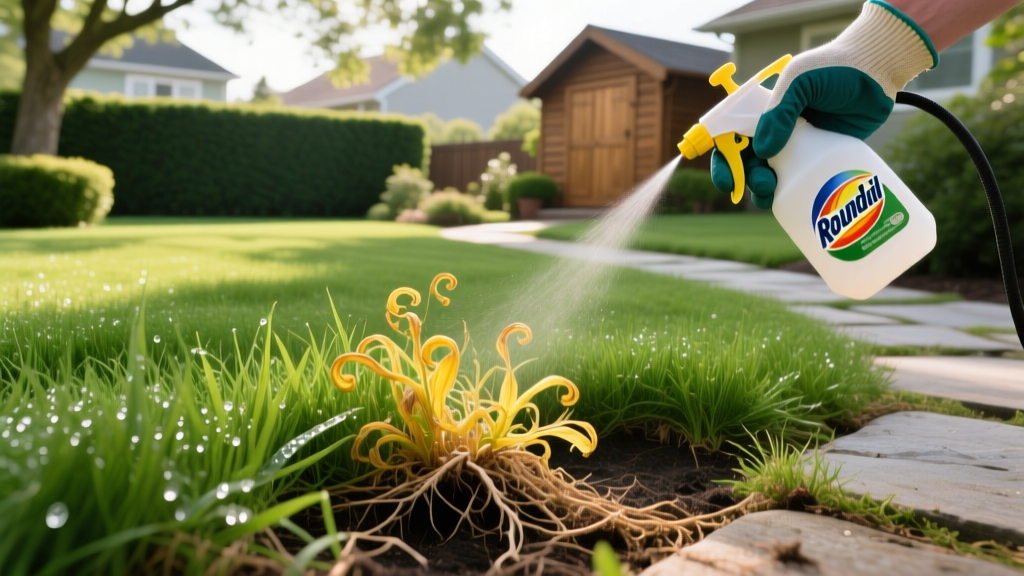
Does Roundup Kill Weeds Not Grass? Selective Spot-Treatment Guide
The Great Herbicide Misconception: Glyphosate vs. Selective Formulas
If you are searching for how roundup kills weeds not grass, you are likely navigating a dangerous misconception that could permanently damage your turf. Standard Roundup Weed & Grass Killer relies on glyphosate (typically 18% to 50.2% concentration), a non-selective systemic herbicide. According to the Environmental Protection Agency (EPA), glyphosate inhibits the EPSP synthase enzyme, effectively killing any green plant tissue it contacts. It does not distinguish between a dandelion and your Kentucky bluegrass.
To achieve selective weed control—where the weed dies but the grass survives—you must abandon standard glyphosate products and transition to the Roundup for Lawns product line. These formulations replace glyphosate with a cocktail of selective synthetic auxins and PPO inhibitors that target broadleaf and specific grassy weeds while leaving monocot turfgrasses unharmed.
⚠️ CRITICAL WARNING: Never use a sprayer that previously contained glyphosate (standard Roundup) to apply selective lawn herbicides. The residual glyphosate in the wand and tank lines will leach out and cause localized dead spots in your turf. Always dedicate one sprayer strictly for non-selective hardscape edging and a second, distinctly colored sprayer for selective lawn treatments.
Decoding the Label: Which Formula Matches Your Turf?
The phrase "Roundup for Lawns" is not a single product; it is a segmented lineup engineered for specific grass types and weed spectrums. Applying a Northern formula to a Southern warm-season lawn can cause severe phytotoxicity (chemical burn). Below is the 2026 breakdown of the selective lineup, their active ingredients, and retail pricing.
| Product Variant | Active Ingredients | Safe For Turf Types | Avg. Price (2026) |
|---|---|---|---|
| Roundup for Lawns (Northern) | MCPA, Dicamba, Sulfentrazone, Penoxsulam | Kentucky Bluegrass, Fescue, Perennial Ryegrass | $24 (32 oz RTU) |
| Roundup for Lawns (Southern) | 2,4-D, Dicamba, Penoxsulam | Bermudagrass, Zoysia, Centipede, St. Augustine | $24 (32 oz RTU) |
| Roundup for Lawns Crabgrass Destroyer | Quinclorac | Most cool & warm-season grasses (check label) | $28 (20 oz RTU) |
Weed Species Spot-Treatment Protocols
Spot-treating is vastly superior to broadcast spraying when weed coverage is under 15% of your total lawn area. It minimizes chemical load, reduces soil microbiome disruption, and saves money. Here is how to tackle specific invaders using selective Roundup formulations.
1. Deep-Rooted Broadleaf Weeds (Dandelion, Plantain, Dock)
Broadleaf weeds with thick taproots require systemic translocation. The MCPA and Dicamba in the Northern/Southern formulas mimic natural plant hormones, causing uncontrolled cellular growth that eventually ruptures the plant's vascular system.
- Targeting: Hold the wand 14 to 18 inches above the turf canopy. Use a flat-fan nozzle to apply a fine mist directly over the weed rosette.
- Volume: Spray only until the leaf surface is uniformly wet. Do not spray to the point of runoff. Dripping herbicide wastes product and increases the risk of soil accumulation.
- Timing: Apply when daytime temperatures are between 60°F and 80°F. The plant must be actively photosynthesizing to pull the chemical down into the taproot.
2. Grassy Weeds (Crabgrass, Foxtail)
Standard selective broadleaf herbicides will not touch crabgrass because crabgrass is a monocot, biologically similar to your lawn. You must use Roundup for Lawns Crabgrass Destroyer (Quinclorac).
- Growth Stage Matters: Quinclorac is highly effective on 1-tiller to 3-tiller crabgrass. If the crabgrass has matured past the 5-tiller stage (late summer), spot treatments will only suppress it, not kill it.
- Surfactant Requirement: If you are mixing Quinclorac concentrate rather than using the Ready-To-Use (RTU) wand, you must add a Methylated Seed Oil (MSO) surfactant at 1% v/v. Crabgrass leaves have a waxy cuticle that repels water-based sprays; MSO breaks this surface tension.
3. Sedges (Yellow Nutsedge, Purple Nutsedge)
Nutsedge is technically neither a grass nor a broadleaf weed; it is a sedge. The secret weapon here is Sulfentrazone, found in the Northern Roundup for Lawns formula. Sulfentrazone is a PPO inhibitor that causes rapid cell membrane disruption in sedges.
- Identification: Confirm it is nutsedge by rolling the stem between your fingers. Grass stems are flat; sedge stems are distinctly triangular ("sedges have edges").
- Application: Spot treat individual nutsedge shoots. Expect the visible shoot to necrotic (turn brown) within 48 hours. However, nutsedge reproduces via underground tubers (nutlets). A second spot-treatment application 21 days later is almost always required to kill the secondary shoots emerging from the tuber bank.
💡 Pro-Tip for Ornamental Beds: If spot-treating weeds near the base of trees or in flower beds, never use the spray wand. Instead, pour the selective herbicide into a shallow pan and use a standard 2-inch foam paintbrush to physically paint the chemical onto the weed leaves. This guarantees zero drift.
Environmental Constraints and Failure Modes
The most common reason selective herbicides fail—or worse, damage desirable plants—is ignoring environmental boundaries. According to University of Minnesota Extension turf specialists, herbicide efficacy and safety are strictly bound by weather conditions.
- The 85°F Vapor Drift Threshold: Dicamba and 2,4-D are volatile esters or amines. When ambient temperatures exceed 85°F, these chemicals can vaporize off the leaf surface, turn into a gas, and drift into neighboring yards, causing severe leaf-curling on ornamental trees, tomatoes, and shrubs. Never spot-treat on hot summer afternoons.
- Wind Speed Limits: Only spot-treat when wind speeds are below 5 mph. Use a local weather app to verify. Even a light breeze can carry micro-droplets of selective herbicide onto non-target broadleaf plants.
- Rainfast Timelines: Selective auxin herbicides require time to penetrate the leaf cuticle. Standard Roundup (glyphosate) is rainfast in 30 minutes. Selective Roundup for Lawns formulas require a minimum of 4 to 6 hours of dry weather post-application to ensure adequate foliar absorption.
Post-Treatment Lawn Recovery
Once the weeds undergo senescence (browning and dying back), you are left with bare soil patches. Leaving these patches exposed invites new weed seeds to germinate.
- Wait Period: Wait exactly 14 to 21 days after your selective herbicide application before introducing new seed. While selective herbicides are safe for established grass, residual soil activity can inhibit the germination of new turfgrass seed.
- Soil Prep: Use a hand cultivator to break the top 1/2 inch of soil in the dead weed patch.
- Overseeding: Apply a premium turf-type tall fescue or Kentucky bluegrass seed blend at a rate of 4 to 6 lbs per 1,000 sq ft for spot repairs. Top-dress with 1/4 inch of screened compost and keep the area consistently moist for 14 days.
Frequently Asked Questions
Can I mix standard Roundup with my selective lawn herbicide to make it stronger?
Absolutely not. Adding even a few ounces of glyphosate to a selective tank mix will destroy your turfgrass. The glyphosate will bypass the selective biological pathways and kill the grass upon contact. Keep your chemical arsenal strictly separated.
Why did my selective Roundup treatment only burn the top of the dandelion?
This is a classic symptom of "over-spraying." If you apply the herbicide so heavily that it drips off the leaf and hits the soil before the plant can absorb it, the chemical binds to soil particles and deactivates. The plant receives a sub-lethal dose, burns the top foliage, but the taproot survives and regenerates. Apply a fine, even mist—less is more.
Is Roundup for Lawns safe for pets?
Once the liquid application has completely dried into the leaf tissue (typically 2 to 4 hours depending on humidity), the treated area is generally safe for pets and children to walk on. However, keep animals off the lawn during the application process and while the grass is still visibly wet.

