
Lawn Care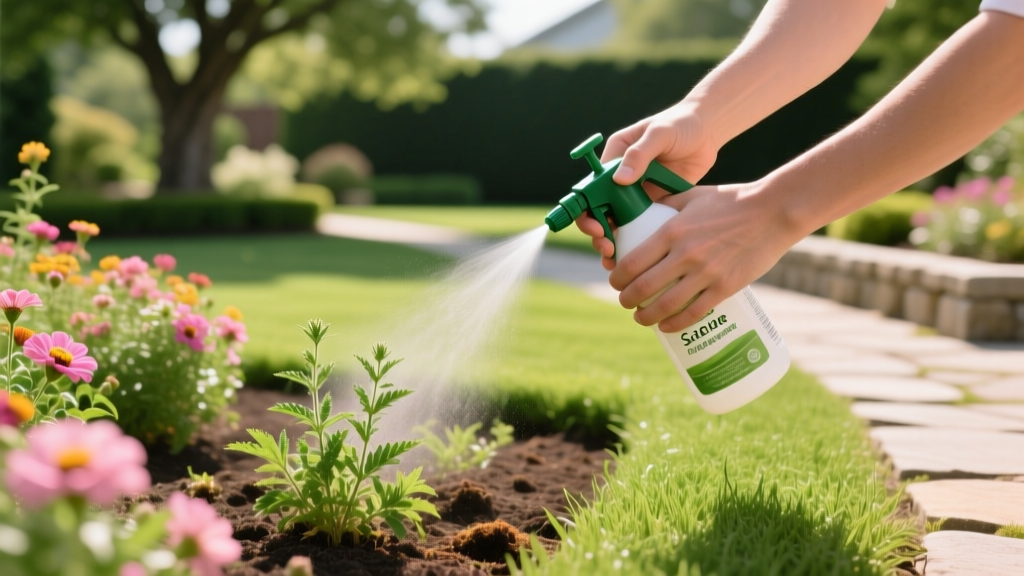
Safe Weed Control Products for Flower Beds: A Spot-Treatment Guide
The Unique Challenge of Flower Bed Weed Management
Managing weeds in ornamental landscapes requires a fundamentally different approach than turfgrass care. In a lawn, you can broadcast a selective broadleaf herbicide (like 2,4-D or dicamba) to eradicate dandelions and clover without harming the grass. Flower beds, however, are filled with broadleaf ornamentals—roses, petunias, hostas, and hydrangeas. Applying a standard lawn weed killer in these areas will defoliate or kill your desired plants just as effectively as the weeds.
Because of this botanical overlap, selecting the right weed control products for flower beds demands a bifurcated strategy: establishing pre-emergent chemical barriers to stop germination, and utilizing highly precise, non-selective post-emergent spot treatments for active invaders. This guide details the exact active ingredients, application techniques, and species-specific protocols required to maintain pristine ornamental beds in 2026 without causing collateral damage to your landscaping.
⚠️ CRITICAL WARNING: Never use "Weed and Feed" or "Broadleaf Weed Killer" products labeled for lawns in or near flower beds. Root uptake and soil drift of selective herbicides can cause severe phytotoxicity, leaf cupping, and stunted growth in ornamental shrubs and perennials for up to 12 months after application.
Pre-Emergent Strategies: Stopping Weeds Before They Sprout
The most effective weed control product for flower beds is one that prevents weeds from ever seeing the sunlight. Pre-emergent herbicides work by creating a chemical barrier in the top 1 to 2 inches of soil. When weed seeds germinate and their radical (first root) contacts the barrier, cell division is inhibited, and the seedling dies before emerging.
According to NC State Extension, pre-emergents must be applied before soil temperatures reach 55°F in early spring for summer annuals, and in early fall for winter annuals like henbit and chickweed. They will not control existing weeds or perennial weeds spreading via rhizomes.
Pre-Emergent Active Ingredient Comparison
| Active Ingredient | Brand Example | Target Weeds | Est. Cost per 1,000 sq ft |
|---|---|---|---|
| Trifluralin | Preen Garden Weed Preventer | Annual grasses & small-seeded broadleaves | $0.15 - $0.20 |
| Isoxaben | Gallery Pre-Emergent | Broadleaf weeds (over 60 species) | $0.45 - $0.60 |
| Prodiamine | Barricade (Ornamental label) | Annual grasses (crabgrass, goosegrass) | $0.25 - $0.35 |
Pro Tip: For maximum efficacy, combine Trifluralin (grass control) with Isoxaben (broadleaf control) in a tank mix or sequential application, creating a dual-spectrum barrier that stops nearly all annual weed species.
Post-Emergent Spot-Treatment: Killing Active Weeds Safely
When weeds breach your pre-emergent barrier or emerge from deep perennial root systems, you must use post-emergent products. Because you cannot use selective broadleaf killers, you are restricted to non-selective herbicides or contact organic acids. The safety of your ornamentals relies entirely on application technique rather than chemical selectivity.
1. Systemic Non-Selectives (Glyphosate & Glufosinate)
Glyphosate (e.g., Roundup Precision Weed Killer) and glufosinate (e.g., Finale) are non-selective, meaning they will kill any green tissue they contact. Glyphosate is systemic, traveling down to the roots to kill perennials, while glufosinate is primarily a contact burner with limited translocation.
- The Cardboard Shield Method: Never spray openly in a flower bed. Cut a 2-foot by 2-foot piece of heavy corrugated cardboard. Cut a slit from the edge to the center. Slip the weed stem through the slit so the cardboard rests on the ground, completely shielding your surrounding mulch and ornamental foliage from overspray.
- The Wick Applicator: For weeds growing intimately intertwined with desirable perennials, use a rope wick applicator or a simple sponge brush. Dip the sponge in a 2% glyphosate solution and physically wipe it only onto the weed's leaves. This eliminates drift entirely.
2. Organic Contact Herbicides (Pelargonic Acid & Acetic Acid)
Products containing pelargonic acid (e.g., Ortho GroundClear for Tough Weeds) or 20% horticultural vinegar act as rapid desiccants. They strip the waxy cuticle off leaves, causing the plant to dehydrate and die within hours.
💡 EXPERT INSIGHT: Organic contact herbicides are highly effective on young, tender annual weeds (under 4 inches tall). However, they possess zero soil residual activity and will not kill the root systems of mature perennials. If you use pelargonic acid on mature bindweed, the top growth will die, but the weed will resprout from the taproot within 10 days.
Species-Specific Spot-Treatment Protocols
Different weed species require tailored eradication strategies to prevent recurrence while protecting nearby flowers. According to the University of California IPM, understanding weed biology is critical for long-term control in ornamental beds.
Field Bindweed (Convolvulus arvensis)
The Problem: A vining perennial with roots that can plunge 15 feet deep. Pulling it snaps the brittle roots, leaving fragments that sprout new shoots.
The Protocol: Do not use contact herbicides. Allow the bindweed to grow until it has at least 6 inches of active vine. Use a sponge wick to apply a 2% glyphosate solution directly to the bindweed leaves, ensuring no drip falls onto the soil or desired plants. The systemic chemical will translocate to the deep root system over 14 days. Expect to repeat this once more in late summer.
Yellow Nutsedge (Cyperus esculentus)
The Problem: A sedge, not a grass or broadleaf. It spreads via underground tubers (nutlets) and easily penetrates standard mulch and landscape fabric.
The Protocol: Most pre-emergents fail against nutsedge. Post-emergent, halosulfuron-methyl (SedgeHammer) is highly effective, but you must verify the product label explicitly lists your specific ornamental plants as tolerant. If your plants are not on the label, manual extraction is required. Pull the plant gently when the soil is wet to extract the entire chain of nutlets; leaving even one tuber behind guarantees a return.
Prostrate Spurge (Euphorbia maculata)
The Problem: A low-growing summer annual that forms a dense mat, choking out low-growing groundcovers like creeping thyme.
The Protocol: Spurge has a shallow taproot and is highly susceptible to contact burns. Spray a 20% horticultural vinegar solution directly onto the mat on a hot, sunny day (above 80°F). The heat accelerates the desiccation process. Wear gloves, as broken spurge stems exude a milky sap that can cause severe contact dermatitis.
Mulch and Mechanical Barriers: The Non-Chemical Baseline
Chemical weed control products for flower beds will ultimately fail if the physical environment is not optimized to suppress germination. A properly installed mechanical barrier reduces the need for herbicides by up to 90%.
- Ditch the Plastic: Never use solid black plastic sheeting under mulch. It prevents water and oxygen from reaching the root zones of your ornamentals, leading to shallow root growth and plant decline. It also degrades into microplastics that tangle in your soil.
- Use Woven Geotextile Fabric: If a barrier is necessary for high-traffic beds or pathways, use a commercial-grade woven polypropylene geotextile fabric (minimum 3 oz per square yard). This allows water permeability while blocking light.
- The 3-Inch Mulch Rule: Apply exactly 3 inches of coarse arborist wood chips or pine bark. Research shows that less than 2 inches allows light penetration, triggering weed seed germination. More than 4 inches creates an anaerobic, sour environment that breeds artillery fungus and harms shrub trunks. Keep mulch at least 3 inches away from the base of woody ornamental stems to prevent crown rot.
Frequently Asked Questions
Can I use corn gluten meal as a natural pre-emergent in flower beds?
Yes, corn gluten meal (CGM) inhibits root formation in germinating seeds. However, it requires a massive application rate—roughly 20 pounds per 1,000 square feet—to be effective. Because CGM is 10% nitrogen by weight, applying 20 lbs adds 2 lbs of actual nitrogen to your beds. This excess nitrogen can cause excessive, weak, leafy growth in flowering perennials and reduce bloom production. For flower beds, synthetic or specialized organic pre-emergents are generally more predictable.
How long after applying a pre-emergent can I plant new flowers?
Pre-emergents do not discriminate between weed seeds and flower seeds. If you plan to sow seeds directly into the bed (like cosmos or zinnias), you cannot use a pre-emergent. If you are transplanting established plugs or potted plants with intact root balls, you can apply granular pre-emergents like trifluralin immediately after planting, provided you water it in and avoid piling the granules directly against the tender stems of the new transplants.
Will herbicide drift from my lawn damage my flower bed?
Yes. When spraying selective broadleaf herbicides (like 2,4-D ester formulations) on your lawn, vapor drift can occur if temperatures exceed 85°F. The chemical vaporizes and floats into adjacent flower beds, causing severe leaf cupping and twisting in sensitive plants like tomatoes, redbuds, and hydrangeas. Always use amine formulations instead of esters near landscape beds, and spray only when temperatures are below 80°F with wind speeds under 5 mph.

