
Lawn Care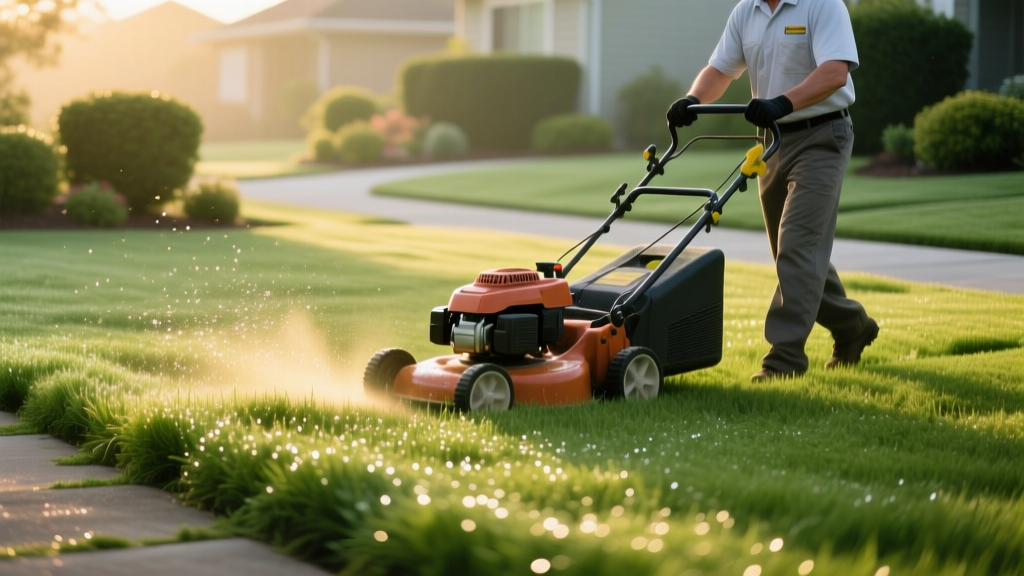
Mowing Grass With Dew: A Step-by-Step Maintenance Guide
The Science of Leaf Wetness and Dew Formation
Morning schedules often force homeowners to maintain their lawns before the sun fully burns off overnight moisture. Mowing grass with dew introduces significant mechanical stress to the turf canopy and creates ideal vectors for fungal pathogens. Dew forms when the turf canopy temperature drops below the ambient dew point, resulting in a microscopic film of water coating the leaf blades. In agronomy, this is measured as Leaf Wetness Duration (LWD). When LWD exceeds 12 to 14 hours, the germination rate for destructive pathogens like Clarireedia jacksonii (Dollar Spot) and Rhizoctonia solani (Brown Patch) increases exponentially. Cutting wet grass tears the cellular structure of the blade rather than shearing it cleanly, creating open wounds that invite these water-borne spores.
Decision Matrix: Should You Mow Today?
Not all dew conditions are equal. Use this matrix to determine if your specific turf type and current moisture level permit safe mowing, or if you should delay operations.
| Dew Condition | Turfgrass Type | Mowing Recommendation | Required Prep |
|---|---|---|---|
| Light Dew (Tips only, <20% coverage) | Warm-Season (Bermuda, Zoysia) | Proceed with caution | Raise deck 0.25 inches, use high-lift blade |
| Light Dew (Tips only, <20% coverage) | Cool-Season (Fescue, Kentucky Bluegrass) | Proceed with caution | Raise deck 0.5 inches, ensure sharp blades |
| Heavy Dew (Visible droplets, >50% coverage) | Warm-Season | Delay or mechanically remove dew first | Whip or drag mat required before mowing |
| Heavy Dew (Visible droplets, >50% coverage) | Cool-Season | Do Not Mow | Wait for solar evaporation; high disease risk |
Step-by-Step Procedure: Mowing Grass With Dew
If time constraints dictate that you must mow while the grass is wet with dew, follow this precise operational sequence to minimize turf damage and equipment wear.
Step 1: Mechanical Dew Removal
Before starting your mower, physically remove the surface moisture. Professional turf managers use a technique called 'whipping' or 'dragging'. For residential lawns, you can purchase a fiberglass dew whip (such as the Par Aide dew whip, typically costing between $60 and $85) or use a lightweight drag mat. Walk the lawn at a brisk pace, sweeping the whip just above the soil surface to knock the heavy dew droplets off the leaf blades and into the soil. This reduces surface moisture by up to 70% and significantly decreases the likelihood of grass clumping under your mower deck.
Step 2: Mower Deck and Blade Calibration
Wet grass bends easily under the weight of water droplets. If your mower deck is set to its standard height, the wheels will push the wet grass down, and the blade will scalp the uneven canopy once the grass springs back up.
- Raise the Deck: Increase your cutting height by exactly 0.5 inches. If your standard summer cut is 2.5 inches, set the deck to 3.0 inches for this specific mow.
- Swap to High-Lift Blades: Mulching blades are designed to recut clippings, which requires dry conditions to prevent clogging. Install high-lift blades (which feature pronounced upward-curved wings) to generate maximum airflow under the deck. This vacuum effect stands the wet grass blades upright before the cutting edge engages.
- Verify Sharpness: A dull blade will shred wet grass, leaving a ragged, white tip that takes weeks to recover. Sharpen your blades if they have more than 25 hours of runtime since their last service.
Step 3: Optimized Mowing Patterns
When mowing grass with dew, the weight of the mower wheels will leave deep, visible tracks in the soft, wet soil and turf canopy. To mitigate this, adopt a straight-line mowing pattern. Avoid tight, zero-radius turns at the end of each pass, as the spinning wheels will tear the wet root zone. Instead, execute wide, looping turns on your driveway or a designated turning strip. Overlap your mowing passes by only 1 inch rather than the standard 2 to 3 inches to reduce the total number of wheel passes over the damp turf.
Step 4: Undercarriage Sanitation
Wet grass clippings are highly acidic and will rapidly corrode your mower deck if left to dry. Furthermore, if your lawn harbors any latent fungal spores, the damp clippings trapped under the deck will act as a biological incubator. Immediately after mowing, use a garden hose or a pressure washer (set below 1,500 PSI to avoid stripping the deck paint) to blast all accumulated clippings from the undercarriage, the blade housing, and the discharge chute. Allow the mower to air-dry in direct sunlight.
WARNING: Disease Vectoring Risk
If you notice circular, silver-dollar-sized bleached spots (Dollar Spot) or large irregular brown patches on your lawn, do not mow, even if the dew is light. Mowing over active fungal lesions will pick up the spores on your mower wheels and blades, mechanically vectoring the disease across your entire property. Wait until the lawn is completely dry and a preventative fungicide has been applied.
Fungicide and Nutrient Protocols for Dew-Heavy Lawns
Lawns situated in shaded areas or low-lying topography frequently experience prolonged dew retention. If your turf regularly remains wet past 10:00 AM, you must adjust your chemical maintenance program.
According to turfgrass pathology guidelines from NC State TurfFiles, prolonged leaf wetness is the primary catalyst for summer turf diseases. If mechanical dew removal is impossible due to property size, integrate a systemic preventative fungicide containing Azoxystrobin or Propiconazole into your late-spring program. Apply these at the curative rate (typically 2.0 to 4.0 fluid ounces per 1,000 square feet, depending on the specific product label) before the onset of heavy summer dew cycles.
Furthermore, never apply granular fertilizers to grass with dew. Fast-release nitrogen sources like Urea (46-0-0) will stick to the wet leaf blades instead of falling to the soil surface. As the dew evaporates, the concentrated salt and nitrogen will cause severe foliar burn, leaving permanent yellow streaks across the lawn. Always apply granular nutrients to completely dry turf, or switch to liquid foliar feeds if morning moisture is unavoidable.
Frequently Asked Questions
Can I use a string trimmer on grass with dew?
String trimmers are actually more forgiving than rotary mowers when dealing with wet grass, provided you use a high-RPM setting and a thick, aerodynamic trimmer line (such as a 0.095-inch twisted line). However, the nylon line will still smear wet chlorophyll onto hardscapes, so keep the trimmer head angled away from concrete and siding.
Does mowing grass with dew dull the mower blade faster?
Yes. Water acts as a mild abrasive when combined with silica-rich grass blades and soil dust. Mowing wet turf can reduce the lifespan of a sharpened edge by 20% to 30% compared to mowing dry turf. Inspect the cutting edge after every wet mow for micro-chips or rolling.
How can I speed up dew evaporation on my lawn?
Pruning lower tree branches to increase early morning solar penetration is the most effective long-term solution. For immediate results, dragging a wide push-broom or a specialized turf drag mat across the lawn will physically knock the water into the soil profile, reducing evaporation wait times by up to two hours. For deeper insights on managing turf microclimates, refer to the cultural practice guidelines published by Penn State Extension Turfgrass.

