
Lawn Care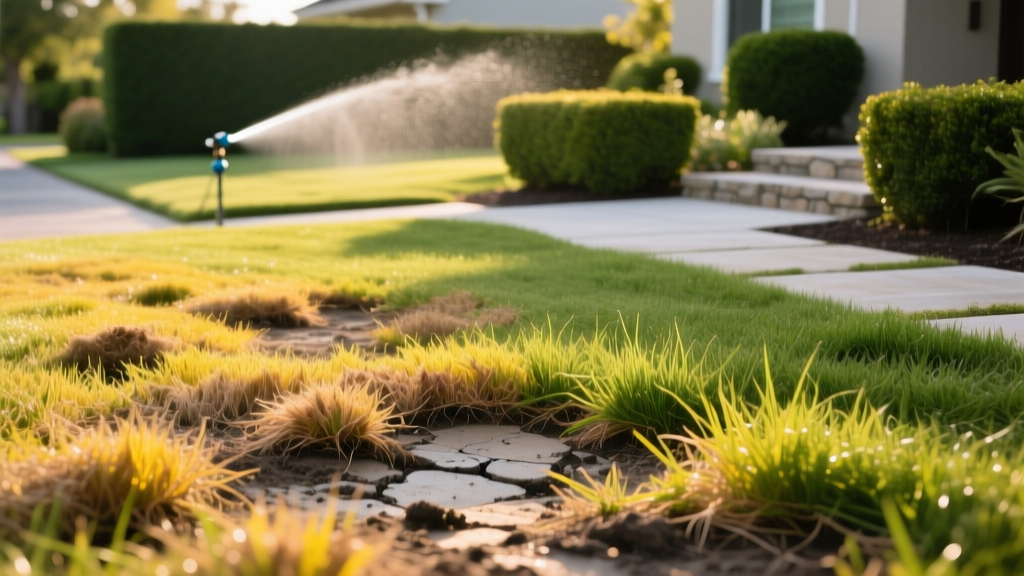
Salt Damaged Grass: Symptom Diagnosis & Rescue Fixes
The Anatomy of Salt Burn in Turfgrass
Winter de-icing agents and coastal salt spray do not just burn grass blades; they fundamentally alter soil chemistry. When sodium chloride (NaCl) accumulates in the root zone, it triggers two destructive mechanisms: osmotic drought and soil dispersion. Sodium ions outcompete calcium and magnesium on the soil's cation exchange sites, causing clay particles to repel one another. This destroys soil structure, seals the surface, and prevents water infiltration, effectively suffocating the turf even when moisture is present.
Diagnosing salt damaged grass requires distinguishing it from winter desiccation, snow mold, or standard drought stress. The primary indicator is spatial distribution. Salt burn almost exclusively manifests in linear strips adjacent to hardscapes—driveways, sidewalks, and roadways—or in low-lying drainage swales where runoff pools.
Diagnostic Warning: Do not confuse salt burn with winter desiccation. Desiccation typically occurs on exposed, elevated areas with high wind exposure and poor snow cover. Salt damage is localized to depressions and edges where sodium-laden meltwater accumulates. If the soil surface exhibits a faint white crust and feels unusually hard or sealed, sodium toxicity is the primary culprit.
Soil Testing: The EC Threshold Matrix
Visual diagnosis must be confirmed with a soil test measuring Electrical Conductivity (EC), which quantifies soluble salt concentrations. Standard soil pH tests will not reveal sodium toxicity. You must request a saturated paste extract EC test from a lab like Penn State Extension's Agricultural Analytical Services Lab. The results are measured in decisiemens per meter (dS/m).
| Soil EC Level (dS/m) | Turf Response & Diagnosis | Required Intervention |
|---|---|---|
| 0.0 - 2.0 | Non-saline. Normal turf growth. | Routine maintenance. |
| 2.0 - 4.0 | Mildly saline. Sensitive species (Kentucky Bluegrass) show tip burn and reduced tillering. | Heavy spring leaching and liquid humic acid. |
| 4.0 - 8.0 | Moderately saline. Severe stunting, widespread chlorosis, and soil surface crusting. | Gypsum application (50 lbs/1,000 sq ft) + aggressive leaching. |
| > 8.0 | Severely saline. Complete turf loss, bare soil, extreme compaction. | Core aeration, double-rate gypsum, and replanting with halophytic cultivars. |
The 4-Step Rescue Protocol for Salt Damaged Grass
Reversing sodium toxicity requires a precise sequence of chemical displacement and physical flushing. Applying fertilizer to salt-burned turf will only increase the soil's osmotic pressure and accelerate root death. Follow this exact protocol in early spring once the soil thaws.
Step 1: Deep Leaching (The Math)
You must physically push sodium ions below the root zone. According to University of Minnesota Extension, leaching requires applying water well beyond the soil's field capacity. To remove 50% of soluble salts, you need to apply roughly 6 inches of water. To remove 80%, you need 12 inches.
- Execution: Apply 1 to 1.5 inches of water per irrigation cycle, 2 to 3 times a week over a month.
- Edge Case: If the soil is heavily dispersed (sealed), water will pool and run off. You must core aerate first to create physical channels for the water to penetrate.
Step 2: Cation Displacement with Gypsum
Leaching alone fails if sodium remains bound to the soil's cation exchange capacity (CEC). You must introduce a high concentration of calcium to knock the sodium off the soil particles. Gypsum (Calcium Sulfate Dihydrate) is the only correct amendment. Do not use lime (Calcium Carbonate), as it requires acidic soil to dissolve and will not effectively displace sodium in neutral or alkaline urban soils.
Product & Rate Specifics: Use pelletized gypsum (e.g., Espoma Organic Gypsum or Profile Calcitic Gypsum) to ensure even spreader distribution. Apply at a rate of 50 lbs per 1,000 square feet. Expect to spend between $18 and $28 per 40-50 lb bag. Apply immediately before a scheduled leaching irrigation cycle so the calcium is carried into the root zone.
Step 3: Biostimulant Root Rehabilitation
Once the sodium is displaced and flushed, the turf's root system will be compromised. Apply a liquid biostimulant containing humic acid and seaweed extract (kelp). Humic acid chelates residual heavy metals and stimulates lateral root branching, while kelp provides cytokinins to break apical dominance and force new tiller production. Products like Simple Lawn Solutions Humic Acid (approx. $25 for 32 oz) applied at 3 oz per 1,000 sq ft via hose-end sprayer yield excellent recovery results within 14 days.
Step 4: Overseeding with Halophytic Cultivars
If the salt damaged grass has resulted in bare patches exceeding 3 inches in diameter, overseeding is mandatory. Do not replant standard Kentucky Bluegrass in high-salt zones; it will fail the following winter. Select cultivars specifically bred for salinity tolerance.
| Grass Species | Recommended Salt-Tolerant Cultivars | Max Tolerable EC (dS/m) |
|---|---|---|
| Tall Fescue (Cool-Season) | 'Spyder', 'Titan Ultra', 'Rhambler' | 6.0 - 8.0 |
| Perennial Ryegrass (Cool-Season) | 'Manhattan 7', 'Caddieshack' | 5.0 - 7.0 |
| Seashore Paspalum (Warm-Season) | 'Salam', 'Diamond', 'Aloha' | > 10.0 (Can tolerate seawater) |
| Bermudagrass (Warm-Season) | 'Tifway 419', 'Celebration' | 6.0 - 8.0 |
Preventative Measures: Rethinking De-Icers
The most effective rescue fix is preventing the initial sodium load. Standard rock salt (NaCl) costs roughly $8 for a 50 lb bag but causes hundreds of dollars in turf and concrete damage. Transitioning to alternative de-icing compounds protects your soil structure.
- Calcium Magnesium Acetate (CMA): A biodegradable, chloride-free de-icer. It is non-toxic to turf and does not elevate soil EC. Cost is higher (approx. $45 for 20 lbs), but it eliminates spring turf renovation costs.
- Beet Juice Blends: Products like Beet-It lower the freezing point of water using agricultural byproducts. They contain trace organic matter that actually benefits soil biology, though they can temporarily stain concrete.
- Physical Barriers: Install heavy-duty polyethylene snow fencing or burlap screens along the edges of driveways to block salt-laden slush from being thrown onto the turf by plows and snowblowers.
By combining accurate EC testing, targeted calcium displacement, and strategic cultivar selection, you can fully rehabilitate salt damaged grass and fortify the soil profile against future winter toxicity.

