
Lawn Care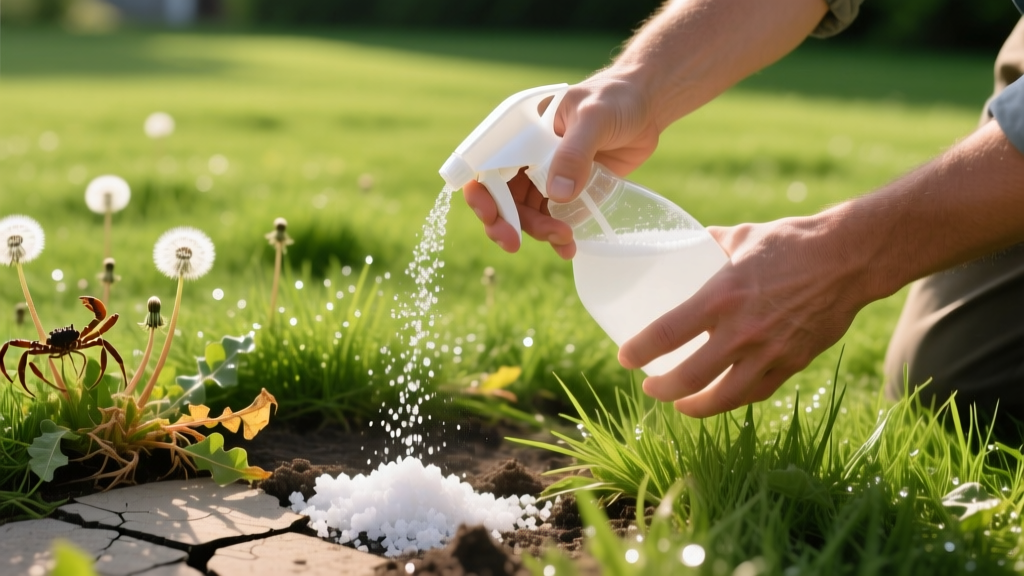
Using Salt Vinegar to Kill Weeds: The Truth Behind the DIY Hack
The Anatomy of the Internet's Favorite Weed Killer
If you have spent more than five minutes searching for organic lawn care tips, you have inevitably encountered the legendary DIY recipe: mixing household vinegar, table salt, and dish soap. Marketed as a cheap, chemical-free miracle cure, the promise of using salt vinegar to kill weeds appeals to homeowners looking to avoid synthetic herbicides like glyphosate or 2,4-D. The standard recipe calls for one gallon of 5% white vinegar, one cup of sodium chloride (table salt), and a tablespoon of liquid dish soap.
From a purely chemical standpoint, the mechanics of this mixture are straightforward. The acetic acid in the vinegar acts as a rapid desiccant, dissolving plant cell membranes and causing immediate foliage burn. The salt induces severe osmotic stress, aggressively drawing water out of plant tissues. Meanwhile, the dish soap acts as a surfactant, breaking the surface tension of the water so the solution coats the waxy cuticle of the weed leaves rather than beading up and rolling off.
However, as turfgrass agronomists and soil scientists, we must look beyond the immediate visual gratification of a wilting weed. While this mixture technically kills the top growth of certain weeds, it triggers a cascade of long-term soil degradation that can permanently ruin your lawn's ecosystem.
Why the Hack Fails on Perennial Weeds
The most significant limitation of the salt and vinegar mixture is that it is strictly a contact herbicide, not a systemic one. When you spray a perennial weed like a dandelion, Canada thistle, or nutsedge, the acetic acid burns the foliage down to the crown within 24 hours. To the naked eye, the weed appears dead.
Yet, because the solution does not translocate down into the root system, the deep taproot or underground rhizome remains entirely unaffected. Within 7 to 14 days, the perennial weed will simply push out new foliage from its intact root crown. You are left in a cycle of continuously spraying the same weeds, which leads directly to the most dangerous consequence of this DIY hack: soil accumulation.
⚠️ CRITICAL WARNING: Salt (sodium chloride) does not degrade, evaporate, or break down in the environment. Every single application permanently increases the salinity of your soil. What you are creating is not a weed-free lawn, but a sterile salt flat.
The Hidden Cost: Soil Sterilization and Sodium Toxicity
To understand why salt is so destructive to turfgrass, we have to look at soil chemistry—specifically, the Cation Exchange Capacity (CEC) and soil flocculation. Healthy soil relies on calcium and magnesium ions to bind soil particles together into porous aggregates. This structure allows water, oxygen, and nutrients to reach grassroots.
When you introduce high concentrations of sodium via table salt, the sodium ions displace the calcium and magnesium on the soil's exchange sites. This process, known as dispersion, causes soil particles to repel one another and collapse. The result is a compacted, impermeable hardpan. Water infiltration drops to near zero, and beneficial soil microbes die off due to osmotic dehydration.
According to the University of California Integrated Pest Management program, when the Sodium Adsorption Ratio (SAR) in soil exceeds 13, severe structural degradation occurs. At this point, your soil becomes toxic to turfgrass. Grass roots cannot penetrate the hardpan, and the high salinity prevents the roots from absorbing water, leading to drought-like symptoms even if you are watering daily. You have effectively sterilized the ground.
DIY Salt & Vinegar vs. Commercial Organic Herbicides
Homeowners often resort to the salt and vinegar hack because they assume commercial organic options are either ineffective or prohibitively expensive. Below is a direct comparison of the DIY method against scientifically backed, soil-safe organic herbicides available in 2026.
| Treatment Type | Active Ingredient | Root Kill? | Soil Impact | Cost per 1,000 sq ft |
|---|---|---|---|---|
| DIY Hack | 5% Acetic Acid + NaCl | No | Severe (Sterilizes) | ~$0.50 |
| Horticultural Vinegar | 20-30% Acetic Acid | No | Low (Rapid pH rebound) | ~$2.00 |
| Chelated Iron | FeHEDTA (e.g., Fiesta) | Yes (Broadleaf) | Positive (Adds Iron) | ~$4.50 |
| Fatty Acid Burners | Pelargonic Acid (Scythe) | No | None (Biodegrades in hours) | ~$3.00 |
As noted by Penn State Extension, while high-concentration horticultural vinegar (20% to 30%) is a highly effective contact burner that does not leave toxic salt residue, it is a severe eye and skin irritant that requires full Personal Protective Equipment (PPE) to apply safely. It still will not kill the roots of perennial weeds.
4 Effective, Soil-Safe Organic Alternatives
If your goal is to maintain an organic, chemical-free lawn without destroying your soil biome, transition to these proven alternatives:
1. Chelated Iron (FeHEDTA)
Products like Fiesta or Natria Lawn Weed Control utilize chelated iron. Broadleaf weeds (dandelions, clover, plantain) absorb iron differently than turfgrass. When sprayed, the weeds absorb toxic levels of iron, causing cellular necrosis and death down to the root, while the grass simply turns a temporary, healthy dark green. It is highly effective, safe for pets, and leaves beneficial iron in the soil.
2. Pelargonic Acid (Nonanoic Acid)
Found in commercial products like Scythe, pelargonic acid is a naturally occurring fatty acid. It acts as a devastating contact herbicide, stripping the waxy cuticle off weeds in minutes. Unlike acetic acid, it is rapidly broken down by soil microbes within 48 hours, leaving zero residual impact on soil structure or pH.
3. Corn Gluten Meal (Pre-Emergent)
For organic crabgrass and annual weed prevention, apply corn gluten meal in early spring when soil temperatures reach 55°F. Applied at a rate of 20 lbs per 1,000 square feet, it inhibits root formation in germinating seeds while providing a slow-release nitrogen boost (10-0-0) to your existing turf.
4. Thermal Weeding
For weeds growing in driveway cracks or patio pavers where soil health is less of a concern, use a propane weed torch (such as the Red Dragon kit). Passing the flame over the weed for just one second boils the water inside the plant cells, causing them to rupture. The weed will dry out and die over the next 48 hours without introducing any chemicals to the environment.
Step-by-Step: Transitioning to a Safe Organic Weed Protocol
Follow this framework to reclaim a lawn previously damaged by DIY salt applications:
- Flush the Soil: If you have already applied salt, you must leach it out. Apply 2 to 3 inches of water over the affected area to push the sodium below the root zone. Ensure your lawn has adequate drainage before doing this.
- Apply Gypsum (Calcium Sulfate): Spread pelletized gypsum at a rate of 50 lbs per 1,000 square feet. The calcium in the gypsum will displace the sodium on the soil exchange sites, allowing it to be flushed away and restoring soil aggregation.
- Core Aerate: Physically pull 3-inch soil plugs to relieve the hardpan compaction caused by the sodium dispersion.
- Spot Treat with FeHEDTA: Once the soil is recovering, use chelated iron to target the remaining broadleaf weeds without harming the recovering grass.
- Overseed and Thicken: The best weed control is a dense turf canopy. Overseed with a competitive grass blend suited to your hardiness zone to choke out future weed germination.
Frequently Asked Questions
Will Epsom salt kill weeds?
No. Epsom salt is magnesium sulfate, not sodium chloride. It does not sterilize soil; in fact, it is often used as a fertilizer to correct magnesium deficiencies. However, spraying high concentrations of Epsom salt and vinegar will still only act as a contact burner and will not kill perennial weed roots.
Is vinegar considered an EPA-approved pesticide?
Yes, but with caveats. According to the Environmental Protection Agency (EPA), acetic acid is often classified under Section 25(b) as a minimum-risk pesticide when used in low concentrations. However, this exemption means these products are not rigorously tested for efficacy by the EPA, which is why many DIY vinegar recipes yield inconsistent results in the field.
Can I use the salt and vinegar hack on driveway cracks?
While it is technically safer to use on gravel or concrete cracks where there is no turfgrass to protect, the salt will eventually wash into adjacent soil beds or storm drains during heavy rains. Thermal weeding with a propane torch remains the superior, zero-residue choice for hardscape weed control.

