
Lawn Care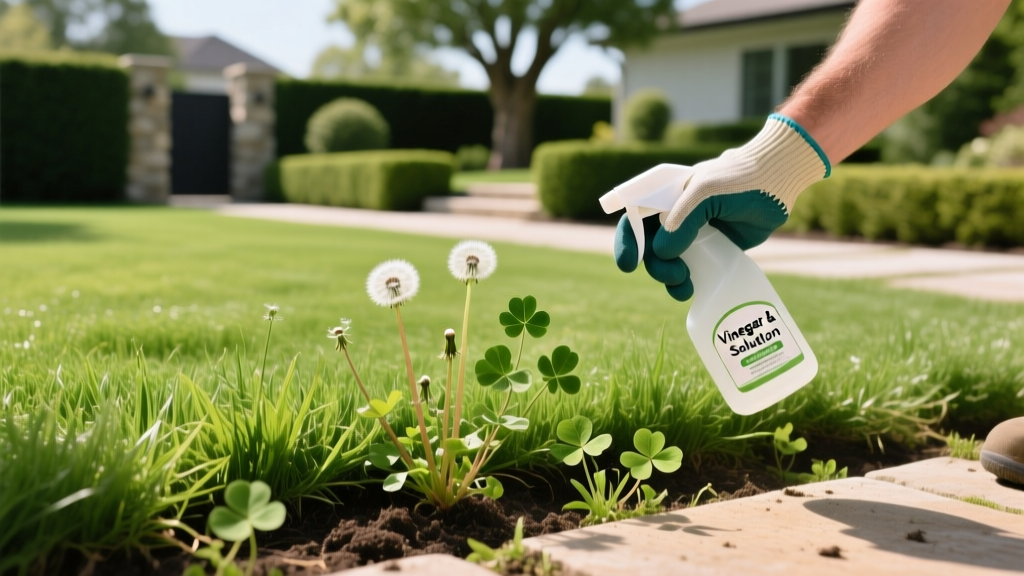
Can You Kill Weeds With Salt And Vinegar? The Soil Science Truth
The Viral Hack: Why Homeowners Search to Kill Weeds with Salt and Vinegar
Every spring, social media feeds flood with DIY weed control recipes promising a chemical-free utopia. The most persistent of these is the instruction to kill weeds with salt and vinegar. The appeal is obvious: both ingredients sit in your kitchen pantry, cost less than $5 combined, and carry no EPA warning labels. However, as a lawn care and soil science principle, this viral recipe contains a catastrophic flaw that separates amateur internet hacks from professional organic land management.
While acetic acid (vinegar) is a legitimate, EPA-exempt organic contact herbicide, sodium chloride (table salt) is a soil-destroying sterilant. Applying salt to your lawn, garden beds, or even driveway cracks introduces severe salinization risks that can render soil barren for years. This guide breaks down the exact chemistry of these compounds, provides a safe, professionally formulated organic vinegar recipe, and outlines the exact remediation steps if you have already damaged your soil with salt.
The Chemistry of Desiccation: Acetic Acid vs. Sodium Chloride
To understand why one ingredient works safely and the other destroys your landscape, we must look at how they interact with plant cellular structures and soil chemistry.
Acetic Acid (Vinegar): The Contact Burner
Vinegar acts as a rapid desiccant. When acetic acid contacts a leaf, it instantly drops the pH of the plant tissue, rupturing the cell membranes and causing the foliage to leak its cellular contents. This results in the visible 'burn' or browning of the weed within hours. According to Penn State Extension, acetic acid is strictly a contact herbicide. It does not translocate to the roots. Therefore, it is highly effective on young annual weeds but often fails to kill the taproots of mature perennials like dandelions or bindweed, which will simply resprout from the undamaged root crown.
Sodium Chloride (Salt): The Osmotic Chokehold
Salt kills plants through osmotic stress. High sodium concentrations in the soil reverse the natural osmotic gradient, pulling water out of the plant roots and causing plasmolysis (cellular collapse). While this effectively kills the target weed, the sodium ions (Na+) do not degrade or evaporate. They remain in the soil profile indefinitely, accumulating with every application and creating a toxic environment for all future plant life, including your desirable turfgrass and ornamentals.
⚠️ CRITICAL SOIL WARNING: Never use salt (NaCl, Epsom salts, or water softener salts) as a weed killer in any area where you intend to grow plants in the future. Sodium destroys soil structure, leading to permanent compaction and anaerobic conditions.
The Safe Organic Recipe: Horticultural Vinegar Formulation
Standard 5% household white vinegar is largely ineffective on mature weeds; it lacks the acidic concentration to penetrate the waxy cuticle of broadleaf plants. To effectively kill weeds with vinegar, professionals use 20% to 30% horticultural acetic acid. Because 20%+ acetic acid is a severe eye and skin irritant, you must wear chemical-resistant gloves, long sleeves, and ANSI-approved safety goggles during mixing and application.
Professional Organic Contact Herbicide Recipe
- 1 Gallon 20% Acetic Acid (Horticultural Vinegar): Cost is approximately $25–$32 per gallon. Look for brands like Green Gobbler or Harris.
- 2 oz Liquid Castile Soap or Non-Ionic Surfactant: Acetic acid has high surface tension and will bead up on waxy leaves. The surfactant breaks this tension, ensuring complete foliar coverage.
- 2 oz d-Limonene (Citrus Oil Extract): This organic solvent dissolves the waxy epicuticular layer of the weed, allowing the acetic acid to penetrate the leaf tissue 40% faster.
Application Parameters for Maximum Efficacy
Organic contact herbicides rely on environmental conditions to succeed. Apply this mixture only when ambient temperatures are above 70°F (21°C) and the forecast calls for full, direct sunlight. The heat and UV radiation accelerate the cellular rupture process. Spray until the leaves are uniformly wet, but avoid drenching the soil, as excessive soil acidification can temporarily harm beneficial mycorrhizal fungi.
DIY Vinegar vs. Commercial Organic Herbicides
While the DIY horticultural vinegar recipe is effective for hardscape cracks and driveway edges, commercial organic herbicides offer specialized modes of action for lawn care. The table below compares the efficacy, cost, and soil safety of top organic weed control methods in 2026.
| Product / Method | Active Ingredient | Est. Cost (RTU Gallon) | Efficacy on Perennials | Lawn Safe? |
|---|---|---|---|---|
| DIY 20% Vinegar Mix | Acetic Acid (20%) | $28.00 | Low (Top-growth only) | No (Burns grass) |
| Avenger Weed Killer | d-Limonene (Citrus Oil) | $45.00 | Moderate | No (Non-selective) |
| Captain Jack's Deadweed Brew | Iron HEDTA (Chelated Iron) | $38.00 | High (Systemic action) | Yes (Selective broadleaf) |
| Suppress Herbicide | Fatty Acids (Octanoic/Nonanoic) | $65.00 | Moderate | No (Non-selective) |
For homeowners looking to kill broadleaf weeds in a cool-season turfgrass lawn without harming the grass, Iron HEDTA is the undisputed champion of organic controls. It exploits the fact that broadleaf weeds cannot regulate iron uptake, causing them to succumb to iron toxicity, while monocot grasses simply absorb the iron as a fertilizer, turning a deeper green.
The Hidden Cost of Salt: Destroying Soil Cation Exchange Capacity
To understand why soil scientists vehemently oppose using salt for weed control, you must understand Cation Exchange Capacity (CEC). Soil particles (clay and humus) carry a negative electrical charge, allowing them to hold onto positively charged nutrient ions (cations) like Calcium (Ca2+), Magnesium (Mg2+), and Potassium (K+). This is how soil retains fertilizer and feeds plant roots.
When you introduce massive amounts of Sodium (Na+) via salt weed killers, the sodium ions displace the calcium and magnesium on the soil's exchange sites. Because sodium is a monovalent ion (carrying only a single positive charge), it fails to bind soil particles together. According to Colorado State University Extension, this leads to a process called soil dispersion or deflocculation. The soil particles repel one another, collapsing the soil architecture. The result is a hard, concrete-like crust that prevents water infiltration, blocks oxygen from reaching roots, and suffocates soil microbiology.
"Sodic soils, characterized by high exchangeable sodium, suffer from poor water penetration, poor aeration, and toxicities to plants. Reclaiming these soils requires the application of calcium amendments and extensive leaching." — EPA Guidelines on Soil Health and Organic Management
Remediation Protocol: Fixing Salt-Damaged Soil
If you have previously used salt and vinegar to kill weeds in your garden beds or lawn edges, the sodium is still there. You cannot flush it out with plain water; water alone will not displace the sodium from the soil's cation exchange sites. You must use a chemical displacement strategy.
Step-by-Step Sodium Remediation
- Test the Soil: Order a standard soil test from your local university extension to check the Exchangeable Sodium Percentage (ESP). An ESP above 15% indicates severe sodicity.
- Apply Pelletized Gypsum (Calcium Sulfate): Gypsum provides massive amounts of Calcium (Ca2+). The divalent calcium ions will aggressively kick the monovalent sodium ions off the soil exchange sites. Apply 50 lbs of pelletized gypsum per 1,000 square feet of affected area.
- Deep Leaching: After the gypsum is watered in, you must apply 2 to 3 inches of water over the course of several days. This physically flushes the newly displaced sodium salts down and out of the root zone.
- Rebuild Organic Matter: Incorporate 2 inches of high-quality compost to restore the humus levels and rebuild the soil's structural aggregation.
The Organic Weed Control Decision Matrix
Use this framework to select the correct organic control method based on your specific landscape zone and weed pressure.
- Scenario A: Weeds in Driveway Cracks & Patio Pavers.
Action: Use the 20% Horticultural Vinegar + Surfactant recipe. Hardscapes lack soil biology, so the temporary pH drop and lack of residual control are perfectly acceptable here. - Scenario B: Broadleaf Weeds (Dandelions, Clover) in a Grass Lawn.
Action: Do NOT use vinegar or salt; they will kill the grass. Use a chelated iron product (Iron HEDTA). Apply at a rate of 1.5 oz per gallon of water, targeting only the broadleaf foliage on a cool, overcast day to prevent grass blade burn. - Scenario C: Annual Weeds in Mulched Garden Beds.
Action: Use a d-Limonene (citrus oil) based contact herbicide, or apply a 2-inch layer of arborist wood chips to block photosynthesis and smother weed seedlings organically.
Mastering organic lawn care requires moving beyond kitchen-pantry folklore. By understanding the biochemical mechanisms of acetic acid and the destructive physical reality of sodium salinization, you can effectively manage weeds while preserving the long-term vitality and structure of your soil ecosystem.

