
Lawn Care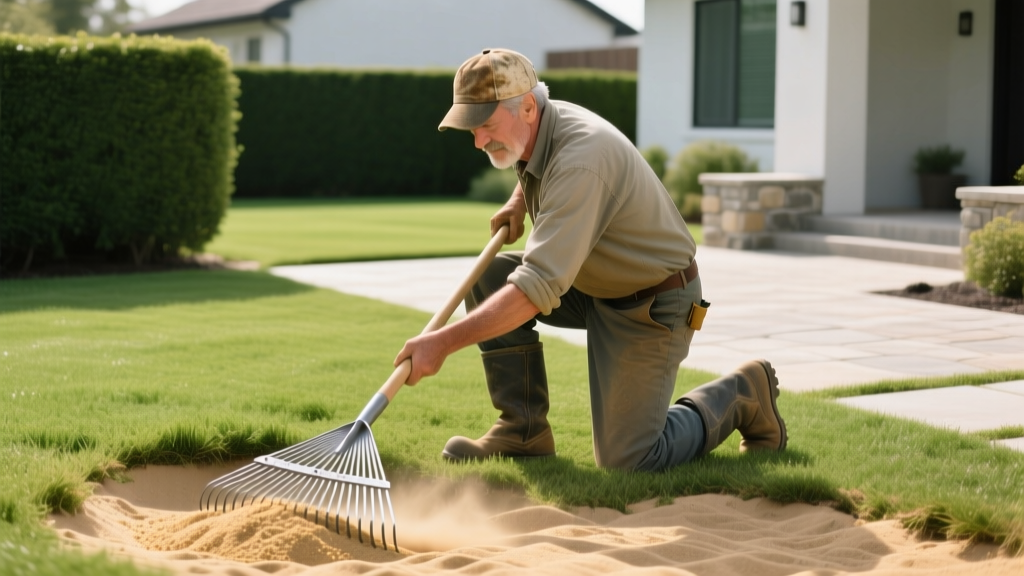
Using Sand for Grass: A Step-by-Step Lawn Leveling Guide
Applying sand for grass is one of the most effective agronomic practices for leveling uneven terrain, improving surface drainage, and firming up spongy soil. However, treating your lawn with sand is not a universal fix. Misapplying the wrong type of sand, or applying it to incompatible soil structures, can permanently damage your turf's root zone. This guide details the exact materials, measurements, and step-by-step procedures required to successfully topdress and level your lawn.
The Soil Texture Prerequisite (Read Before Buying)
Before purchasing any materials, you must understand your existing soil profile. Sand particles are large and do not hold nutrients or water well. If you have heavy clay soil and apply pure sand directly to the surface, the small clay particles will bind with the large sand particles, creating a concrete-like matrix that suffocates roots and prevents water infiltration.
Critical Rule: If your soil is heavy clay, you must never use pure sand for grass. You must use a topdressing blend (typically 70% sand and 30% finely screened compost) to maintain soil porosity and organic matter. Pure sand topdressing is strictly reserved for lawns that already have sandy or loamy native soils, or for highly maintained sports turf profiles.
According to the Clemson University Home and Garden Information Center, topdressing should only be performed when the turfgrass is actively growing to ensure the grass can quickly push through the new material layer without being smothered.
Sourcing the Correct Sand for Grass
Not all sand is created equal. The hardware store play sand is useless for lawn leveling because its particles are too rounded, preventing them from interlocking and stabilizing the surface.
- Washed Masonry Sand: The gold standard for residential lawn leveling. It features sub-angular particles that lock together. Ensure it is 'washed' to remove silt, clay dust, and weed seeds.
- Silica Sand: Excellent for golf greens and high-end sports turf due to its uniform particle size and chemical inertness, but usually cost-prohibitive for large residential yards.
- ASTM C33 Standard: When ordering from a landscape supply yard, ask for sand that meets ASTM C33 specifications for fine aggregates. The ideal particle size distribution for warm-season grasses (Bermuda, Zoysia) is between 0.25mm and 0.50mm (medium sand).
Material Calculator and 2026 Pricing Matrix
Calculating the correct volume prevents both material shortages and turf smothering. A general rule for leveling is to apply no more than 1/4 inch to 1/2 inch of material per application. The table below outlines the material requirements for a standard 1,000 square foot lawn area based on 2026 landscape supply averages.
| Application Depth | Cubic Yards (per 1,000 sq ft) | Estimated Tons | 2026 Bulk Cost Estimate |
|---|---|---|---|
| 1/8 Inch (Light Topdressing) | 0.38 cu yd | 0.52 tons | $35 - $50 |
| 1/4 Inch (Standard Leveling) | 0.77 cu yd | 1.05 tons | $65 - $95 |
| 1/2 Inch (Deep Rut Filling) | 1.54 cu yd | 2.10 tons | $120 - $180 |
Note: Avoid bagged sand from big-box stores for large projects. A 50lb bag of Quikrete costs roughly $4.50, which equates to over $180 per cubic yard. Bulk delivery from a local landscape yard is significantly more cost-effective.
Step-by-Step Lawn Leveling Procedure
Proper execution requires specific tools and timing. For warm-season grasses, schedule this procedure for late spring or early summer. For cool-season grasses, target early fall.
Step 1: Scalping and Core Aeration
Mow your lawn significantly lower than your standard maintenance height. For hybrid Bermuda, scalp it down to 0.5 inches; for Zoysia, drop to 1.0 inch. This prevents the sand from getting trapped in tall grass blades. Following the mow, run a core aerator over the lawn, pulling 3-inch deep plugs on 3-inch centers. This opens the soil profile, allowing the sand to integrate directly into the root zone rather than sitting on top.
Step 2: Mixing the Topdressing Blend
If your soil test indicated a clay-loam profile, mix your washed masonry sand with finely screened compost at a 70/30 ratio by volume. Use a mortar mixer or a skid steer for large batches to ensure homogeneity. The compost provides the necessary cation exchange capacity (CEC) to hold nutrients, while the sand provides the structural drainage.
Step 3: Application and Dragging
Dump the sand or topdressing mix in small piles across the lawn. Using a specialized leveling rake (such as a 36-inch aluminum Rocklin Industry Levelawn or Standard Golf Levelawn), spread the material evenly. Do not use a standard garden rake, as the tines will pull up the turf roots. Once spread, attach a weighted wooden drag mat or a chain-link drag behind a utility vehicle and pull it across the lawn in multiple directions. This forces the sand down into the aeration holes and low spots while leaving the grass blades exposed to sunlight.
Step 4: Hydration and Recovery
Immediately after dragging, run your irrigation system for 15 to 20 minutes. This washes any residual sand dust off the grass blades and settles the material into the soil profile. Do not mow the lawn for at least 7 to 10 days to allow the turf to recover from the scalping and push through the new sand layer. Resume standard fertilization protocols once the grass has regained its normal color.
Troubleshooting Common Application Errors
Even with the right materials, execution errors can lead to turf decline. The University of Minnesota Extension notes that improper topdressing timing and material depth are the leading causes of homeowner lawn failure.
- Symptom: Grass turns yellow and thins out.
Cause: You applied more than 1/2 inch of material, smothering the turf crown and blocking photosynthesis. Fix: Wait for recovery, and in the future, split deep applications into two separate 1/4 inch treatments spaced four weeks apart. - Symptom: Hard, crusty surface that repels water.
Cause: You used unwashed masonry sand containing high silt/clay content, or applied pure sand over heavy native clay. Fix: Perform deep-tine aeration and apply a liquid soil surfactant to break surface tension, followed by heavy compost topdressing the following season to restore organic structure. - Symptom: Sand washes away during heavy rain.
Cause: The sand particle size is too fine (less than 0.15mm), or the lawn was not core aerated prior to application, leaving no voids for the sand to lock into. Fix: Ensure future sand purchases meet the 0.25mm minimum threshold and always aerate before spreading.
By adhering to precise particle sizes, respecting your native soil texture, and utilizing specialized leveling tools, sand topdressing transitions from a messy chore to a highly effective agronomic practice that yields a perfectly graded, professional-quality lawn.

