
Lawn Care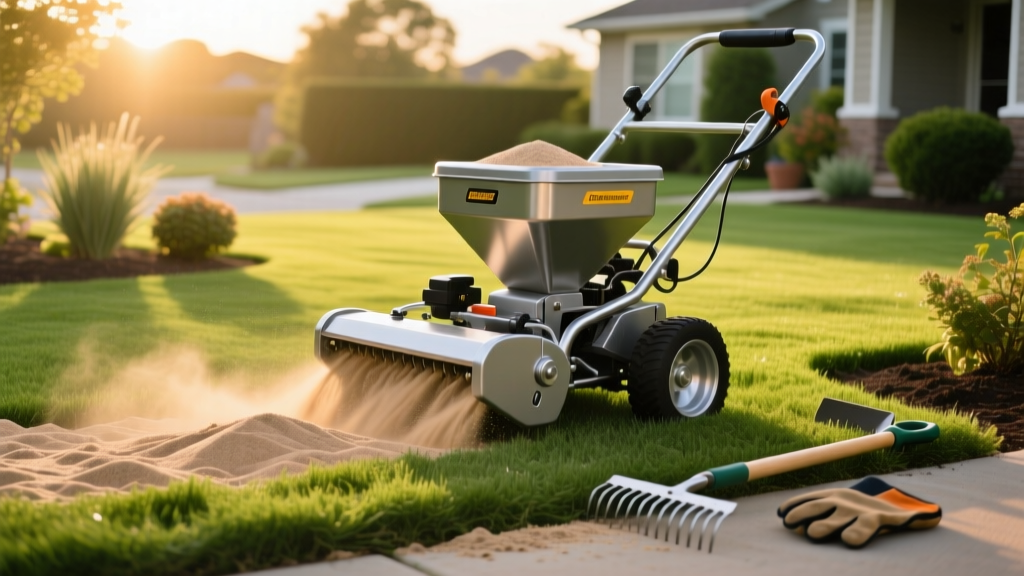
Choosing the Right Sand Spreader for Lawns: Models & Care
The Physics of Sand vs. Standard Fertilizer
Applying sand to a lawn for topdressing or leveling is fundamentally different from distributing prilled fertilizer. Masonry sand is dense, highly abrasive, and prone to moisture bridging. A standard poly-hopper broadcast spreader designed for 50 lbs of lightweight urea will quickly fail under the torque required to move 80 lbs of damp sand. The internal agitators in budget-friendly models often snap, and the narrow drop-gates clog when sand moisture content exceeds 4%.
To achieve a uniform 1/8-inch topdressing layer without suffocating your turfgrass, you need equipment with a high-torque gear ratio, a wide-flow hopper geometry, and corrosion-resistant materials. According to Texas A&M AgriLife Extension, improper topdressing application can lead to severe thatch burial and localized turf necrosis, making equipment precision just as critical as the sand quality itself.
Equipment Selection Matrix: Broadcast vs. Drop vs. Tow-Behind
Selecting the correct sand spreader for lawns depends on your yard size, turf type, and the specific grading goals. Below is a functional comparison of the three primary spreader categories used by turf professionals.
| Spreader Type | Best Application | Avg. Price Range | Sand Flow Control | Primary Limitation |
|---|---|---|---|---|
| Commercial Broadcast | Large lawns (5,000+ sq ft), general topdressing | $160 - $250 | High (Adjustable deflector) | Over-spray near hardscapes |
| Precision Drop | Tight spaces, edging near gardens, spot leveling | $120 - $180 | Medium (Gravity fed) | Requires perfectly dry sand |
| Tow-Behind | Multi-acre properties, sports fields, deep ruts | $400 - $650 | Very High (Vibrated gate) | Requires ATV/tractor, heavy storage |
2026 Market Picks for Sand Spreading
Based on current durability standards and hopper geometry, these specific models lead the market for residential and prosumer sand application:
- Lesco 80 lb Commercial Broadcast Spreader (Model 190104): Priced around $189. Features a stainless steel hopper and a heavy-duty enclosed gear box. The 14-inch pneumatic tires prevent sinking into soft, freshly aerated soil.
- Earthway 50 lb Drop Spreader (Model 2150): Priced around $135. Ideal for applying sand directly into low spots without contaminating adjacent flower beds. The straight-drop design requires sand to be bone-dry to prevent bridging.
- Spyker 125 lb Tow-Behind Broadcast Spreader: Priced around $450. Equipped an internal vibrating agitator that mechanically breaks up moisture clumps in damp masonry sand, a feature entirely absent in push-models.
Precision Calibration for Masonry Sand
Guessing your spreader setting will result in uneven mounds and bare spots. Sand weighs approximately 2,600 lbs per cubic yard. A standard light topdressing (1/8-inch depth) requires roughly 1,000 lbs of sand per 1,000 square feet. Follow this exact calibration protocol recommended by Penn State Extension to dial in your flow rate.
Pro Tip: The Moisture Threshold
Masonry sand must have a moisture content below 4% before loading it into any spreader. Squeeze a handful of sand; if it holds a distinct shape or drips water, it is too wet and will bridge inside the hopper. Let it bake on a tarp in direct sunlight for 4 hours before use.
Step-by-Step Calibration Flow
- Define the Test Area: Measure a 100-square-foot test strip on your driveway or a tarp (e.g., 10 feet long by 10 feet wide). Mark the start and stop lines clearly.
- Weigh the Baseline: For a 1/8-inch topdressing, your target is 100 lbs of sand per 100 sq ft. Weigh exactly 105 lbs of dry masonry sand and load it into the hopper.
- Set the Gate: Open the flow control lever to the manufacturer's suggested 'heavy material' setting (usually 75% open for Lesco models).
- Execute the Pass: Walk at your normal mowing pace (approx. 3 mph) across the 10-foot strip, opening the gate exactly at the start line and closing it at the stop line.
- Calculate the Delta: Weigh the remaining sand in the hopper. Subtract the remaining weight from the starting 105 lbs. If you distributed exactly 100 lbs, your calibration is perfect. If you distributed only 60 lbs, open the gate one notch wider and repeat the test with a fresh 105 lb batch.
Critical Maintenance: Preventing Hopper Corrosion
Sand is highly abrasive and, when combined with residual fertilizer salts or morning dew, creates an electrolytic paste that accelerates galvanic corrosion. Even stainless steel hoppers will suffer from surface pitting and bearing seizure if not maintained correctly after a sand application.
The 3-Step Post-Use Protocol
- High-Pressure Wash: Immediately after use, rinse the hopper interior, the agitator blades, and the undercarriage with a pressure washer (minimum 1,800 PSI). Pay special attention to the pivot points of the flow-control lever, where wet sand packs tightly and hardens like concrete.
- Silicone Coating: Once the spreader is completely dry, spray the interior walls of the hopper with a 100% silicone lubricant spray. Do not use WD-40 or petroleum-based oils. Petroleum products attract dust and create a sticky residue that causes dry sand to cling to the hopper walls during your next use. Silicone creates a dry, frictionless barrier that improves the angle of repose for damp sand.
- Bearing Lubrication: Sand dust infiltrates standard wheel bearings, grinding away the factory grease. Every 10 hours of sand-spreading operation, purge the axle bearings with a marine-grade lithium complex grease, such as Lucas Oil Red 'N' Tacky. The tackifier agents in marine grease resist being washed out during your post-use hose cleaning.
Frequently Asked Questions
Can I use a sand spreader for lawns to apply pelletized lime?
Yes, but you must recalibrate. Pelletized lime flows much faster than masonry sand due to its spherical shape and lower density. Reduce your gate opening by approximately 30% compared to your sand settings to avoid over-applying lime, which can rapidly spike your soil pH above the optimal 6.5 threshold.
Why is my drop spreader leaving distinct rows of sand?
Drop spreaders rely on gravity and a fixed-width gate. If you are leaving distinct rows, your walking speed is likely inconsistent, or the sand is slightly damp, causing intermittent bridging. Switch to a commercial broadcast spreader with a rotary agitator to mechanically force the sand through the gate for a uniform, feathered edge.
How often should I replace the spreader tires?
When spreading sand, the extreme weight (often exceeding 150 lbs total) causes premature wear on plastic wheel rims and flattens pneumatic tires. Inspect the tire tread and axle bushings annually. If the plastic rims show stress fractures near the hub, upgrade to aftermarket steel-rimmed pneumatic wheels, which typically cost $45 per pair and double the equipment lifespan.

