
Lawn Care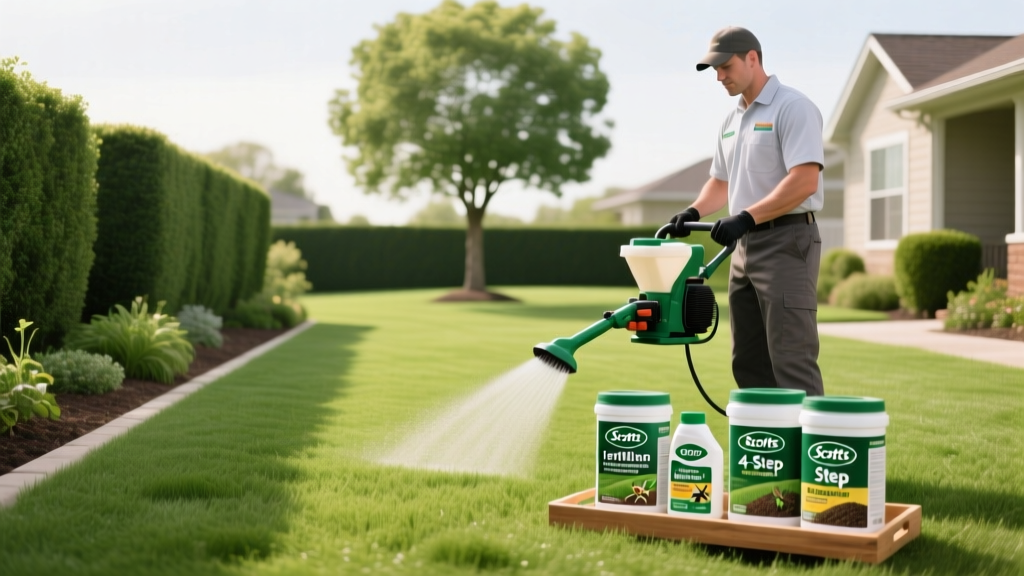
Scotts 4 Step Lawn Care Program: 2026 Application and Cost Guide
The Blueprint to a Weed-Free Lawn: Understanding the Scotts System
For decades, the Scotts 4 Step lawn care program has been the default regimen for North American homeowners seeking a simplified, calendar-based approach to turf nutrition and weed control. Rather than guessing which NPK (Nitrogen-Phosphorus-Potassium) ratio to buy or when to apply pre-emergent herbicides, this system bundles four specific granular products designed to be applied sequentially from early spring through late fall. However, blindly following the back-of-bag instructions without understanding the underlying agronomy often leads to fertilizer burn, herbicide resistance, or wasted money. In this 2026 guide, we deconstruct the exact chemical formulations, optimal soil-temperature triggers, and real-world costs of the program, while highlighting the critical modifications required for warm-season grasses.
Deconstructing the Cool-Season Program (Northern Grasses)
The standard Scotts 4 Step program is engineered primarily for cool-season grasses like Kentucky Bluegrass, Perennial Ryegrass, and Tall Fescue. Here is the precise agronomic breakdown of each phase.
Step 1: Crabgrass Preventer Plus Lawn Food (Early Spring)
Typical NPK: 28-0-3
Active Herbicide: Dithiopyr (Dimension)
Target Window: When soil temperatures consistently reach 50°F to 55°F at a 2-inch depth. According to Purdue University Turfgrass Science, crabgrass germination triggers at these specific soil temps, not air temps. Dithiopyr is unique because it provides both pre-emergent and early post-emergent control, meaning it can still kill crabgrass even if it has just sprouted (up to the 1-tiller stage). Warning: Do not use Step 1 if you plan to overseed in the spring, as the pre-emergent will prevent grass seed germination.
Step 2: Weed & Feed (Late Spring)
Typical NPK: 28-0-3
Active Herbicides: 2,4-D, Dicamba, Quinclorac
Target Window: 4 to 6 weeks after Step 1, typically when daytime air temperatures are between 60°F and 80°F. This step targets broadleaf weeds like dandelions, clover, and chickweed. The inclusion of Quinclorac provides a secondary attack on any late-germinating crabgrass. Apply when weeds are young and actively growing, and ensure the grass is slightly damp so the granules adhere to the weed leaves.
Step 3: SummerGuard (Early Summer)
Typical NPK: 26-0-2
Active Insecticide: Bifenthrin
Target Window: Early to mid-summer. This formulation drops the nitrogen slightly to avoid pushing excessive, stress-inducing top growth during peak heat. The Bifenthrin targets surface-feeding insects like chinch bugs, armyworms, and grubs near the soil surface. Because summer heat stresses cool-season grasses, watering this product in immediately with 1/4 inch of irrigation is mandatory to prevent fertilizer burn.
Step 4: WinterGuard (Fall)
Typical NPK: 32-0-10
Target Window: Early to mid-fall, roughly 6 weeks before the first expected hard freeze. This is arguably the most important application of the year for cool-season grasses. The high nitrogen content promotes rapid root growth and carbohydrate storage, while the elevated potassium (the '10' in the NPK) increases cellular winter hardiness and drought tolerance for the following spring.
Warm-Season Modifications (The Southern Program)
Applying the standard Northern program to Bermudagrass, Zoysia, or St. Augustine will result in severe damage or ineffective weed control. Warm-season grasses require a different chemical profile and timing schedule.
| Program Phase | Cool-Season Product (North) | Warm-Season Equivalent (South) | Key Timing Difference |
|---|---|---|---|
| Step 1 | Halts Crabgrass Preventer | Scotts Bonus S (Weed & Feed + Atrazine) | Apply South when grass is 50% green, not early spring. |
| Step 2 | Weed & Feed (2,4-D) | Scotts Southern Weed & Feed | South relies on Atrazine/Penoxsulam; 2,4-D can burn St. Augustine. |
| Step 3 | SummerGuard | Scotts Turf Builder Southern Lawn Food | South needs higher iron content to combat alkaline soil chlorosis. |
| Step 4 | WinterGuard (High N) | Scotts WinterGuard (Low N, High K) | South must avoid high Nitrogen in fall to prevent spring dead spot disease. |
2026 Real-World Cost and Coverage Breakdown
Fertilizer prices have fluctuated over the last few years due to global supply chain shifts. As of 2026, homeowners should budget accordingly based on their lot size. Scotts typically sells these products in 5,000, 10,000, and 15,000 square foot coverage bags.
| Bag Coverage | Avg. Cost Per Bag (2026) | Cost Per 1,000 Sq. Ft. | Total Annual Program Cost |
|---|---|---|---|
| 5,000 sq. ft. | $38.00 | $7.60 | $152.00 |
| 10,000 sq. ft. | $55.00 | $5.50 | $220.00 |
| 15,000 sq. ft. | $72.00 | $4.80 | $288.00 |
Pro Tip: Purchasing the 15,000 sq. ft. bags yields a 36% discount per square foot compared to the 5,000 sq. ft. bags. Store excess granular fertilizer in a sealed, climate-controlled bin to prevent the prills from absorbing ambient humidity and clumping.
Critical Application Mistakes to Avoid
The Spreader Calibration Trap: The dial settings printed on the Scotts bag are baseline recommendations. If your spreader's hopper gate is worn, or if you walk at a brisk 4 MPH instead of the assumed 2.5 MPH, you will over-apply by up to 30%. Always calibrate your spreader using the 'catch cup' method or by measuring out a 10x100 ft test strip before treating the entire lawn.
Temperature and Hydration Restrictions
- The 85°F Rule: Never apply Step 2 (Weed & Feed) when daytime air temperatures exceed 85°F. The volatile ester formulations of 2,4-D can vaporize in high heat, drifting onto and killing nearby ornamental plants, tomatoes, and shrubs.
- Watering In: Steps 1, 3, and 4 require immediate watering (about 1/4 to 1/2 inch) to move the granules off the grass blade and into the soil profile. Step 2, however, should not be watered in for at least 24 hours, as the broadleaf herbicides need time to be absorbed through the weed's foliage.
Scotts 4 Step vs. Custom Soil-Test-Based Fertilization
While the Scotts program offers unmatched convenience, it operates on a 'blanket application' philosophy. It assumes your soil is deficient in Nitrogen and Potassium, and that it has adequate Phosphorus (hence the '0' in the middle of the NPK ratios).
According to environmental guidelines outlined by the Environmental Protection Agency (EPA), applying unnecessary chemicals can lead to nutrient runoff. If you live in an area with naturally high soil phosphorus, or if your soil pH is below 6.0 (which locks up nutrient availability regardless of how much fertilizer you apply), the Scotts program will yield diminishing returns. For maximum agronomic efficiency, run a baseline soil test through a university extension office in year one. If your soil test reveals severe deficiencies or pH imbalances, a custom-blended liquid or granular regimen from a local turf supplier will outperform the boxed program. However, for the average homeowner with relatively healthy, established turf who values time-saving convenience and predictable weed suppression, the 4 Step system remains a highly effective, cost-efficient baseline.

