
Lawn Care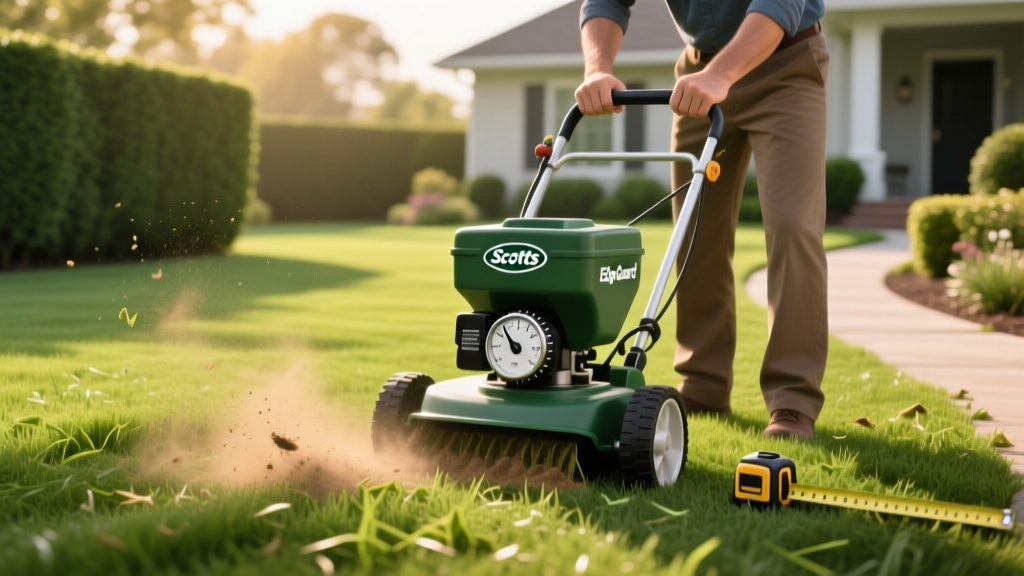
Scotts EdgeGuard Spreader Settings Chart and Coverage Cost Guide
The Financial Cost of Spreader Miscalibration
Applying granular fertilizer or pre-emergent herbicide without verifying your spreader settings is one of the most expensive mistakes in lawn care. An improperly calibrated broadcast spreader can over-apply nitrogen by up to 40%, resulting in severe fertilizer burn that costs an average of $0.15 to $0.25 per square foot to remediate through sod replacement and soil flushing. Conversely, under-applying pre-emergents like Scotts Halts leaves your turf vulnerable to crabgrass, rendering the entire $45 product application useless.
The Scotts EdgeGuard series solves the problem of product drift onto hardscapes and garden beds, but the integrated deflector shield alters the effective swath width. This means standard broadcast spreader settings will result in under-application if you do not account for the blocked right-side throw. Below is the definitive Scotts EdgeGuard spreader settings chart, paired with a 2026 cost and coverage analysis to ensure precise dosage and maximum return on investment.
The Master Scotts EdgeGuard Spreader Settings Chart
The following settings are calibrated for a standard walking speed of 3.0 miles per hour (roughly 4.4 feet per second). These settings apply to the current 2026 formulations of Scotts' most popular granular products.
| Product Name | N-P-K / Active | EdgeGuard Mini | EdgeGuard Standard | EdgeGuard Elite | Target Rate (lbs/1k sq ft) |
|---|---|---|---|---|---|
| Scotts Turf Builder Lawn Food | 32-0-4 | 3.5 | 3.0 | 3.0 | 2.8 |
| Scotts Halts Crabgrass Preventer | 0-0-0 (Bensulide) | 2.5 | 2.0 | 2.0 | 1.8 |
| Scotts GrubEx | 0-0-0 (Chlorantraniliprole) | 4.0 | 3.5 | 3.5 | 3.3 |
| Scotts Weed & Feed | 28-0-3 (2,4-D) | 4.5 | 4.0 | 4.0 | 3.6 |
| Scotts Starter Food for New Grass | 24-25-4 | 3.0 | 2.5 | 2.5 | 2.2 |
| Scotts WinterGuard Fall Lawn Food | 32-0-10 | 3.5 | 3.0 | 3.0 | 2.8 |
⚠️ Critical Calibration Note: If you are using a third-party professional product (like Lesco or SiteOne) in a Scotts EdgeGuard spreader, do not rely on the generic settings printed on the third-party bag. Those bags assume a standard 10-to-12-foot broadcast swath. Because the EdgeGuard deflector blocks roughly 20% of the right-side throw, you must increase the third-party dial setting by 0.5 to 1.0 full clicks, or slow your walking speed to 2.5 mph to maintain the correct dosage per 1,000 square feet.
Hardware Breakdown: Mini vs. Standard vs. Elite
Choosing the right EdgeGuard model impacts both your upfront hardware costs and your long-term chemical efficiency. Here is how the 2026 lineup breaks down in terms of coverage and ROI.
1. EdgeGuard Mini Spreader
- Capacity: Up to 5,000 sq. ft. of product.
- Hardware Cost: $45 - $55.
- Best For: Urban lots, townhomes, and lawns under 4,000 sq. ft. with complex landscaping.
- ROI Factor: The narrower axle and smaller impeller require more passes, increasing the time cost. However, the lower upfront price makes it the most economical choice for small-footprint properties.
2. EdgeGuard Standard Spreader
- Capacity: Up to 10,000 sq. ft. of product.
- Hardware Cost: $75 - $90.
- Best For: Standard suburban lots (5,000 to 8,000 sq. ft.).
- ROI Factor: This is the highest-volume seller for a reason. The wider pneumatic-style tires prevent ruts in soft spring soil, and the larger hopper accommodates standard 12.5 lb to 15 lb bags without requiring mid-lawn refills.
3. EdgeGuard Elite Spreader
- Capacity: Up to 15,000 sq. ft. of product.
- Hardware Cost: $110 - $130.
- Best For: Large estates, rural properties, or lawn care professionals managing multiple residential accounts.
- ROI Factor: The Elite features a fully enclosed gearbox that prevents granular dust from corroding the internal gears—a common failure point in the Standard model after 3 to 4 seasons of heavy use.
The Physics of EdgeGuard: Why Settings Differ
To understand why the Scotts EdgeGuard spreader settings chart differs from standard rotary spreaders, you must understand the mechanics of the deflector. When the EdgeGuard lever is engaged, a plastic shield drops down on the right side of the impeller.
This shield does not just stop product from flying into your driveway; it physically alters the aerodynamic distribution pattern. A standard broadcast spreader throws product in a 180-degree fan. The EdgeGuard restricts this to roughly a 135-degree fan. If you walk the exact same speed and use the exact same dial setting as a standard spreader, the product is concentrated into a narrower left-side swath, leading to a 15-20% over-application on the left and a complete miss on the right.
💡 Pro Application Technique: Always keep the EdgeGuard deflector on your right side, facing the hardscape or garden bed. When turning around for your next pass, overlap your left wheel track with the center of your previous swath. This ensures the concentrated left-side throw is properly distributed and feathered into the previous pass.
Step-by-Step Calibration for Non-Scotts Products
According to turfgrass researchers at the University of Minnesota Extension, relying on printed bag settings can result in application errors of up to 30% due to variations in granule size, humidity, and individual walking speed. If you are using a generic or professional-grade product, use the 50-Foot Test Strip Method to dial in your exact dosage.
The 50-Foot Test Strip Method
- Measure the Test Area: Mark off a 50-foot long by 10-foot wide strip on your driveway or a tarp (500 square feet total). The EdgeGuard throws roughly 8 to 10 feet wide when the deflector is engaged.
- Calculate the Target Weight: Check your product bag for the application rate per 1,000 sq. ft. Divide that number by 2. For example, if the bag calls for 3.0 lbs per 1,000 sq. ft., you need exactly 1.5 lbs for your 500 sq. ft. test strip.
- Weigh the Product: Use a digital kitchen scale to weigh out exactly 1.5 lbs of granules and pour it into the spreader hopper.
- Execute the Pass: Set your dial to a guessed setting (e.g., 3.0). Walk the 50-foot strip at your normal, comfortable pace. Engage the hopper exactly at the start line and close it exactly at the end line.
- Measure the Remainder: Weigh the leftover product in the hopper. Subtract it from your starting 1.5 lbs. If you applied 1.2 lbs, your setting is too low. If you applied 1.8 lbs, your setting is too high.
- Adjust and Repeat: Adjust the dial by 0.5 clicks and repeat the test until you apply exactly 1.5 lbs over the 50-foot strip.
Financial Impact of Spreader Errors
Failing to consult an accurate settings chart or calibrate your machine has direct financial consequences. Based on 2026 national average pricing for lawn care inputs, here is what common errors cost the average homeowner managing a 5,000 sq. ft. lawn:
- Overlapping Passes by 50% Instead of 20%: Results in a 30% over-application of product. On a $40 bag of Scotts Turf Builder, this wastes $12.00 per application and increases the risk of nitrogen leaching, which the EPA notes contributes significantly to local watershed pollution.
- Walking Too Fast (4.0 mph vs 3.0 mph): Drops your application rate by roughly 25%. Your pre-emergent herbicide falls below the active threshold required to create a chemical barrier in the top inch of soil, resulting in a crabgrass breakout by July. Remediation via post-emergent herbicides (like Quinclorac) will cost an additional $25 to $40 in chemicals and time.
- Spreading on Wet Grass: Granules stick to the grass blades instead of reaching the soil. This not only burns the foliage but wastes up to 15% of the product to evaporation and wind drift before it can be watered in.
Maintenance and Storage Costs
The EdgeGuard series utilizes a combination of plastic hoppers and metal axles. The most common point of failure is the corrosion of the rate control lever spring and the impeller gearbox due to fertilizer salt buildup. To protect your $80+ hardware investment:
- Wash with Cold Water: After every use, wash the hopper and undercarriage with a garden hose. Do not use hot water, as it can warp the polypropylene hopper over time.
- Lubricate the Gearbox: Once a season, apply a dry PTFE (Teflon) lubricant to the impeller shaft. Avoid wet WD-40 or grease, which will attract fertilizer dust and create a grinding paste that destroys the gears.
- Store Indoors: UV degradation from direct sunlight will make the plastic deflector shield brittle within two to three seasons, leading to cracks that allow product to leak onto your driveway. Store the spreader in a garage or shed, out of direct sunlight.
For further reading on professional turf management and precise nutrient delivery, consult the Scotts official spreader library to verify settings for newly released regional seed and fertilizer blends.

