
Lawn Care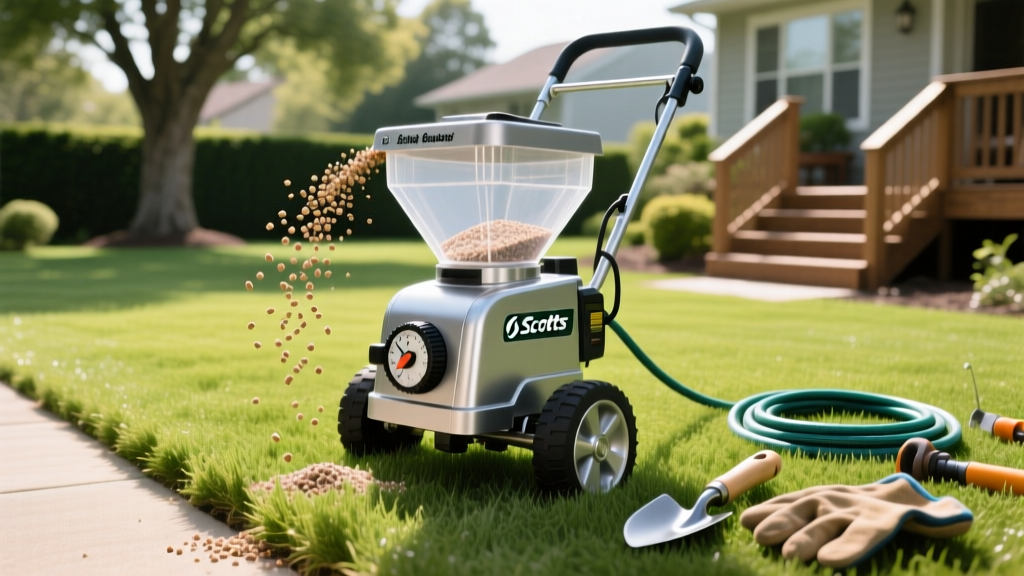
Scotts Elite Broadcast Spreader Calibration & Setup Guide
The Hidden Cost of Uncalibrated Fertilizer Application
Achieving professional-grade soil nutrition relies entirely on uniform distribution. Over-applying nitrogen causes severe turf burn and groundwater leaching, while under-applying starves the root zone and invites weed infiltration. The Scotts Elite broadcast spreader is engineered to solve these distribution issues with its dual-rotor agitator and EdgeGuard technology, but factory dial settings are merely baseline estimates. Because granular density varies wildly between a 32-0-4 synthetic urea blend and an organic 5-2-0 milorganite product, relying solely on the bag's recommended dial setting often results in a 15% to 20% application variance.
This guide provides a definitive, step-by-step framework for calibrating your Scotts Elite spreader, optimizing your walking cadence, and maintaining the mechanical components to ensure flawless coverage across cool- and warm-season lawns.
Anatomy of the Scotts Elite Broadcast Spreader
Before adjusting the dial, you must understand the mechanical advantages of the Elite series compared to standard drop or basic broadcast models. The current Scotts Elite model (often identified by its heavy-duty pneumatic tires and dark green hopper) features three critical components that dictate application accuracy:
- EdgeGuard Ramp: A mechanical deflector that blocks the right side of the spread pattern. When engaged, it prevents fertilizer from landing in flower beds or driveways, but it shifts the effective swath width from 12 feet down to roughly 8 feet on the active side.
- Dual-Rotor Agitator: Unlike single-bar agitators that bridge over clumpy product, the dual-rotor system fractures hygroscopic clumps (common in high-urea fertilizers) before they reach the discharge opening.
- Pneumatic Tires: Air-filled tires maintain a consistent hopper height. Solid plastic wheels on cheaper models sink into soft soil, altering the drop angle and shortening the broadcast throw distance.
Warning: The EdgeGuard Swath Shift
When you engage the EdgeGuard lever to treat perimeter zones, the spreader's effective coverage width changes. If your calibration test was performed with EdgeGuard OFF, but you apply the perimeter with EdgeGuard ON without adjusting your overlap stride, you will double-apply fertilizer on the outer 4 feet of your lawn, resulting in chemical burn.
The 100-Square-Foot Calibration Framework
University turfgrass programs universally recommend the 100-square-foot test method to determine exact application rates. According to Penn State Extension, this method eliminates the guesswork of varying granular sizes and densities. Here is how to execute it with your Scotts Elite spreader.
Step 1: Establish the Test Zone
Measure a 10-foot by 10-foot area on your driveway or a flat tarp. Do not test on grass, as you cannot easily collect and weigh the scattered granules. Mark the start and stop lines clearly.
Step 2: Weigh the Test Product
Fill the hopper with the exact fertilizer you plan to use. Weigh the spreader plus the product on a digital scale. Record this starting weight.
Step 3: Execute the Test Pass
Set the dial to the manufacturer's suggested baseline (e.g., 5.5 for Scotts Turf Builder). Walk the 10-foot distance at your normal mowing pace (target 2.75 mph, which is roughly 12 seconds per 10 feet). Engage the trigger exactly at the start line and release it exactly at the stop line.
Step 4: Calculate the Variance
Weigh the spreader again. The difference is the amount of product applied to 100 square feet. Multiply that number by 10 to find your actual application rate per 1,000 square feet.
If the bag dictates 3.5 lbs per 1,000 sq ft, your 100 sq ft test should yield exactly 0.35 lbs (5.6 ounces) of product. If you collected 7 ounces, your dial setting is too high. Lower the dial by half a number and repeat the test until the output matches the target weight.
2026 Dial Settings Matrix for Popular Fertilizers
While manual calibration is mandatory for perfect accuracy, having a verified baseline matrix saves time. The following settings are calibrated for a standard walking speed of 2.75 mph with the EdgeGuard disengaged. Always verify against the specific lot number on your bag, as Scotts officially updates these matrices based on seasonal prill size variations.
| Fertilizer Product | N-P-K Ratio | Target Rate (per 1k sq ft) | Scotts Elite Dial Setting |
|---|---|---|---|
| Scotts Turf Builder Lawn Food | 32-0-4 | 3.3 lbs | 5.5 |
| Milorganite Organic Nitrogen | 5-2-0 | 32.0 lbs | 13.0 |
| Lesco Professional Starter | 18-24-12 | 4.0 lbs | 6.25 |
| Scotts Winterguard Fall Weed & Feed | 3.8 lbs | 6.0 |
Troubleshooting Application Failures & Streaking
Even with perfect dial calibration, environmental and mechanical factors can ruin your soil nutrition profile. Use this diagnostic guide to identify and fix common spreader failures.
Symptom: Dark Green and Yellow Alternating Stripes
Cause: Inconsistent walking speed or improper swath overlap. The Scotts Elite throws product up to 12 feet wide. If you walk too fast, the centrifugal force of the impeller throws the heavier granules further, leaving a gap in the center of your pass. If you walk too slow, the product piles up in the center.
Fix: Use a metronome app set to 100 BPM. Take one step per beat. This locks your pace to exactly 2.75 mph. Overlap your passes by exactly 2 feet (using the wheel track of your previous pass as a visual guide).
Symptom: Agitator Jamming Mid-Application
Cause: Hygroscopic clumping. Synthetic fertilizers containing high levels of urea absorb ambient humidity rapidly. If you leave the product in the hopper for more than 20 minutes on a humid morning, it forms a solid bridge over the discharge hole.
Fix: Never store fertilizer in the hopper. Pour only what you need for the current pass. If clumping occurs, do not strike the plastic hopper with a tool, which can crack the resin. Instead, engage the trigger and push the spreader backward over a tarp to manually break the bridge with a wooden dowel.
Symptom: Product Throwing Asymmetrically (Heavy Left, Light Right)
Cause: Worn impeller fins or debris lodged in the discharge chute. Over time, hitting small rocks or hardened fertilizer clumps can chip the plastic fins on the spinning impeller, altering the aerodynamics of the throw.
Fix: Invert the spreader on a workbench. Inspect the impeller fins for chips. If more than 10% of the fin surface is degraded, order a replacement impeller assembly (Part #10551) directly from the manufacturer.
Post-Application Maintenance & Storage Protocols
The lifespan of your Scotts Elite broadcast spreader is dictated entirely by post-use cleaning. Fertilizer salts are highly corrosive and will seize the axle bearings within a single season if ignored. According to University of Minnesota Turfgrass Science, proper equipment maintenance ensures consistent application rates year over year.
- The Dry Rinse: Immediately after emptying the hopper, use a leaf blower or compressed air to clear residual dust from the agitator housing and impeller fins. Do not use water first, as water turns fertilizer dust into a corrosive paste.
- The Wet Wash: Once the dust is cleared, wash the hopper and undercarriage with a garden hose. Avoid high-pressure nozzles directly on the axle bearings, which can force water past the seals.
- Lubrication (Critical): Allow the spreader to dry completely in the sun. Apply a 100% silicone spray lubricant to the axle, the trigger linkage, and the agitator shaft. Never use WD-40 or petroleum-based oils. Petroleum oils attract fertilizer dust and dirt, creating a grinding compound that destroys plastic gears.
- Storage: Store the spreader indoors, hanging from a wall hook by the handle. Storing it on its wheels in an unclimate-controlled shed exposes the pneumatic tires to dry rot and flat-spotting.
By treating the Scotts Elite broadcast spreader as a precision soil-nutrition instrument rather than a simple wheelbarrow, you guarantee that every dollar spent on premium fertilizer is translated directly into root-zone health, minimizing environmental runoff and maximizing turf density.

