
Lawn Care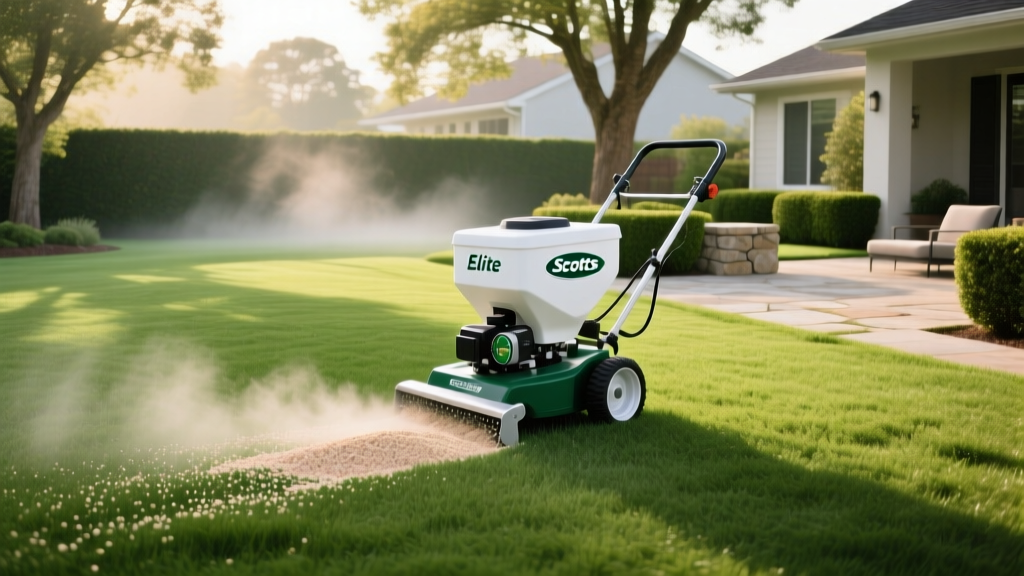
Scotts Elite Spreader Settings & Calibration Guide 2026
Hardware Architecture: Why the Scotts Elite Demands Precision
The Scotts Elite 80-lb Dual-Rotor Broadcast Spreader represents a significant upgrade from standard impeller-driven models. By utilizing a dual-rotor system, it generates a consistent 6-foot spread pattern that minimizes the striping and burn marks common with single-rotor centrifugal spreaders. However, this mechanical advantage introduces specific calibration variables that most homeowners overlook. When applying high-nitrogen granular fertilizers or pre-emergent herbicides, a 10% deviation in application rate can result in localized turf burn or failed weed control.
Core Specifications & Baseline Metrics
| Component | Specification | Calibration Impact |
|---|---|---|
| Hopper Capacity | 80 lbs (Covers up to 15,000 sq ft) | Heavy loads increase downward pressure on the gate mechanism, slightly accelerating flow rates when the hopper is completely full. |
| Tire Type | 12-inch Pneumatic (Air-filled) | Tire pressure directly alters wheel circumference, changing the gear ratio between ground travel and rotor speed. |
| Agitator System | Dual-Rotor with Helical Gearing | Provides uniform lateral distribution but is highly sensitive to hygroscopic (moisture-absorbing) fertilizer clumping. |
| Spread Width | 6 feet (Effective overlap) | Requires exact 50% overlap on return passes to maintain uniform nutrient density. |
The Pneumatic Tire Variable: A Hidden Calibration Failure
The most frequent cause of over-application with the Scotts Elite Spreader is under-inflated tires. The 12-inch pneumatic tires are designed to operate at 15 to 20 PSI. If the tire pressure drops to 10 PSI, the overall diameter of the wheel shrinks. Because the spreader’s internal gearbox is driven by the axle’s rotation, a smaller wheel circumference means the spreader travels a shorter physical distance per axle rotation, while the dual rotors continue to spin at the same RPM relative to the axle. The result? The spreader drops more fertilizer per square foot than the dial setting indicates.
Pro Tip: Before every fertilization session, check the tire pressure with a standard gauge. Maintain exactly 18 PSI for optimal ground-speed-to-rotor-RPM synchronization. Never use solid foam inserts in the Elite model, as they alter the rotational mass and gear engagement dynamics.
The 100 Sq Ft Catch Test: Verifying Your Dial Settings
While the Scotts Spreader Settings Library provides baseline dial numbers for their proprietary blends, third-party fertilizers and regional soil amendments require empirical verification. According to Penn State Extension, the catch test is the only reliable method to guarantee accurate nutrient delivery.
Step-by-Step Calibration Protocol
- Calculate the Target Weight: Determine the application rate from the fertilizer bag (e.g., 3.2 lbs per 1,000 sq ft). Divide by 10 to find the target weight for 100 sq ft (0.32 lbs, or roughly 145 grams).
- Prepare the Catchment: Tape a lightweight plastic catch bag or a wide bucket securely to the underside of the spreader, completely covering the dual-rotor discharge ports. Ensure it does not interfere with the axle or gears.
- Measure the Test Course: Mark off a straight line on your driveway. For a 6-foot spread width, you need to walk exactly 16.6 feet to cover 100 sq ft (6 ft x 16.6 ft = 99.6 sq ft). Mark the start and stop lines with chalk.
- Execute the Run: Load the hopper with your specific granular product. Set the dial to the manufacturer's suggested baseline. Open the gate and walk at your normal, steady mowing pace (roughly 2.75 mph) across the 16.6-foot course.
- Weigh and Adjust: Close the gate, remove the catch bag, and weigh the contents on a digital kitchen scale. If you caught 160 grams, your setting is too high; drop the dial by 0.5 and repeat. If you caught 120 grams, increase the dial by 0.5.
Fertilizer Application Matrix: Baseline Settings for 2026
The following matrix provides verified baseline dial settings for the Scotts Elite Spreader. These assume a standard walking speed of 2.75 mph and properly inflated 18 PSI tires. Always perform a catch test when switching between drastically different granule sizes (e.g., moving from fine pre-emergents to large pelletized organics).
| Product Category | Specific Product Example | Target Rate (per 1k sq ft) | Elite Dial Setting |
|---|---|---|---|
| Standard Synthetic | Scotts Turf Builder WinterGuard (32-0-10) | 3.2 lbs | 5.5 |
| Organic / Biosolid | Milorganite (6-4-0) | 3.6 lbs | 11.0 |
| Pre-Emergent Herbicide | Lesco Pre-Emergent (0-0-7 with Prodiamine) | 2.3 lbs | 7.0 |
| Fast-Release Nitrogen | Urea (46-0-0) | 1.0 lb | 3.5 |
| Weed & Feed Combo | Scotts Turf Builder Weed & Feed | 3.6 lbs | 6.5 |
Edge Cases: Hygroscopic Clumping and Rotor Jamming
The dual-rotor system on the Scotts Elite is highly efficient for uniform distribution, but it introduces a specific vulnerability when handling hygroscopic fertilizers. Products with high urea content (like 46-0-0 Urea or certain quick-release winterizers) aggressively absorb ambient moisture. If relative humidity exceeds 70%, urea granules will begin to dissolve slightly and fuse together inside the hopper.
Warning: Never leave urea-based fertilizers in the Elite hopper for more than 45 minutes. If a clump enters the dual-rotor housing, it will jam the helical gears. Forcing the spreader forward while the rotors are jammed will strip the internal plastic drive teeth, permanently destroying the gearbox.
Pattern Verification on Hardscapes
To verify the 6-foot spread pattern and ensure the dual rotors are not throwing heavy concentrations to the left or right, perform a hardscape test. Sweep a clean concrete driveway and lightly mist it with water so it is damp but not pooling. Fill the hopper with a cheap, highly visible granular material like talcum powder mixed with sand, or a brightly colored starter fertilizer. Walk a straight line down the center of the driveway. Measure the physical width of the deposited material. The heaviest concentration should be in the center 3 feet, tapering off evenly to the 6-foot mark. If the pattern is skewed, inspect the rotors for dried fertilizer crust on the vanes, which alters the aerodynamic throw angle.
Post-Application Maintenance & Storage Protocol
Ammonium sulfate and urea-based fertilizers are highly corrosive to untreated metals and will degrade the painted steel components of the spreader frame if left uncleaned. Implement this exact maintenance routine after every use to ensure the gearbox and hopper gate remain friction-free:
- Dry Brush: Use a stiff-bristled nylon brush to remove all loose granules from the hopper interior, the gate slide, and the dual-rotor vanes. Never use a wire brush, as it will scratch the protective powder coating.
- Compressed Air: Use an air compressor (set to 40 PSI) to blow out the gearbox housing and the axle bearings. Granular dust trapped in the bearings will mix with ambient moisture and form an abrasive paste.
- Silicone Lubrication: Spray a light coat of 100% pure silicone lubricant on the inside of the hopper, the gate slide mechanism, and the dual rotors. Do not use WD-40 or petroleum-based oils. Petroleum oils will attract dust and cause fertilizers to cake into a concrete-like substance upon the next use. Silicone creates a dry, non-stick barrier that repels moisture.
- Tire Care: Deflate the pneumatic tires slightly (down to 10 PSI) if storing the spreader in an unclimate-controlled shed for the winter. This prevents the rubber from developing flat spots on the contact patch, which would cause a bumpy, uneven application rate the following spring.
By treating the Scotts Elite Spreader as a precision agricultural instrument rather than a simple yard cart, you ensure exact nutrient delivery, eliminate turf burn, and maximize the ROI of your soil nutrition program.