
Lawn Care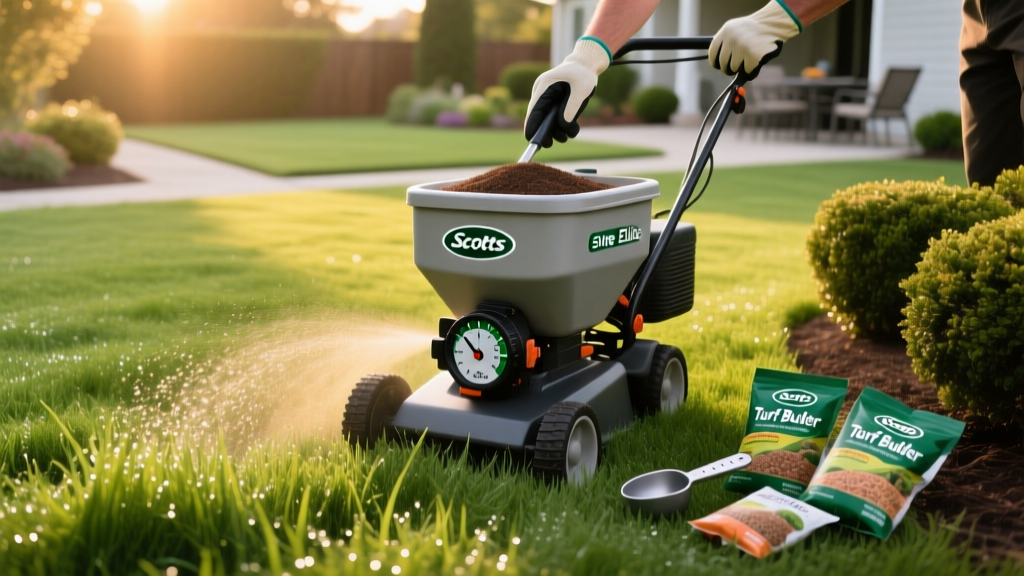
Scotts Elite Spreader Settings: Exact Dosage & Coverage Guide
The Scotts Elite Broadcast Spreader with EdgeGuard represents a significant upgrade over standard rotary models, featuring a dual-action hopper and an agitated agitator bar designed to prevent clogging. However, precision application relies entirely on dialing in the correct settings. Misinterpreting the dial by even a half-step can result in a 15% variance in product distribution, leading to fertilizer burn or ineffective weed control. This guide provides exact dosage mappings, coverage mathematics, and real-world cost analyses to maximize the efficiency of your Elite Spreader.
The Mechanics of the Elite Spreader Dial
Unlike basic broadcast spreaders that rely on a simple gravity-fed slide gate, the Elite Spreader utilizes a dual-action hopper system. This mechanism keeps the granular product agitated, ensuring consistent flow rates even with irregularly shaped prills or coated seeds. The dial ranges from 1 to 15, with half-step increments available for fine-tuning.
EdgeGuard Calibration Warning: The EdgeGuard feature blocks the right third of the spread pattern to prevent product from landing on hardscapes or garden beds. When EdgeGuard is engaged, the spreader automatically compensates by increasing the flow rate on the left side to maintain the correct overall dosage per 1,000 square feet. Never adjust the dial setting downward to 'compensate' for EdgeGuard; the factory settings already account for this asymmetrical distribution.
Master Dosage Chart: Scotts Elite Spreader Settings
The following settings are calibrated for the Scotts Elite Broadcast Spreader (Model 76622). These mappings align with the manufacturer's recommended application rates for standard residential turfgrasses.
| Product Name | Target Rate (lbs/1k sq ft) | Elite Dial Setting | Bag Weight | Total Coverage |
|---|---|---|---|---|
| Scotts Turf Builder Lawn Food | 2.5 lbs | 5.5 | 12.5 lbs | 5,000 sq ft |
| Scotts Weed & Feed | 3.6 lbs | 6.0 | 13.3 lbs | 3,700 sq ft |
| Scotts Thick'R Lawn | 8.5 lbs | 8.5 | 20.0 lbs | 2,350 sq ft |
| Scotts Halts Crabgrass Preventer | 1.8 lbs | 4.0 | 13.5 lbs | 7,500 sq ft |
| Scotts SummerGuard Lawn Food | 3.2 lbs | 5.5 | 13.4 lbs | 4,200 sq ft |
| Scotts EZ Seed Sun & Shade | 6.0 lbs | 7.5 | 10.0 lbs | 1,650 sq ft |
Coverage Math and Cost Analysis
Upgrading to the Scotts Elite Spreader requires a higher initial capital outlay compared to entry-level models. As of current retail pricing, the Elite model retails between $105 and $115, while the standard Scotts Broadcast Spreader averages $55 to $65. To justify the $50 premium, we must analyze the cost of product waste caused by poor calibration and uneven distribution.
Real-World Product Cost Breakdown
- Standard Spreader Inefficiency: Independent turf studies indicate that standard rotary spreaders without agitation or edge control can result in up to 12% overlap waste and 8% hardscape runoff. On a $65 bag of premium Weed & Feed, this equates to $13.00 wasted per application.
- Elite Spreader Efficiency: With EdgeGuard and the dual-action hopper, overlap waste is reduced to under 3%, and hardscape runoff is virtually eliminated.
- ROI Timeline: Assuming four major applications per year (Spring Preventer, Early Summer Feed, Late Summer Insect Control, Fall Winterizer), the Elite Spreader saves approximately $40 to $48 annually in wasted granular product. The unit pays for its price premium within 1.2 lawn care seasons.
Calibrating for Non-Scotts and Generic Products
The dial settings printed on Scotts product bags do not apply to professional-grade fertilizers like Lesco, Anderson's, or generic store-brand seed. Because prill size and bulk density vary wildly between manufacturers, you must manually calibrate the Elite Spreader. According to the University of Minnesota Extension, the 100-square-foot test method is the most reliable way to determine your custom dial setting.
The 100 Sq Ft Calibration Formula:
1. Measure a 10 ft x 10 ft (100 sq ft) test area on your driveway or a tarp.
2. Weigh out exactly 1/10th of the product's recommended rate per 1,000 sq ft. (e.g., If the bag calls for 4.0 lbs per 1,000 sq ft, weigh out exactly 0.4 lbs or 6.4 ounces).
3. Set the Elite dial to an estimated medium setting (e.g., 6.0).
4. Spread the pre-weighed product over the 100 sq ft area.
5. If product remains in the hopper, increase the dial by 0.5. If you run out early, decrease the dial by 0.5. Repeat until the hopper empties exactly at the edge of the test area.
Troubleshooting Application Failures
Even with perfect dial settings, environmental and mechanical factors can disrupt coverage. Use this diagnostic framework to identify and resolve common application anomalies.
- Symptom: Alternating dark and light green stripes in the turf.
Cause: Inconsistent overlap. The Elite Spreader casts a 6-foot wide pattern. You must align the left wheel of the spreader with the right wheel track of your previous pass. Stripes indicate you are either overlapping too much (causing double-dosing and potential nitrogen burn) or leaving gaps. - Symptom: Product clumping and halting mid-application.
Cause: High ambient humidity combined with hygroscopic fertilizers (like those containing high urea or potassium chloride). While the Elite's agitator bar mitigates this, it cannot break up severe moisture clumps. Fix: Store fertilizer in a climate-controlled garage, not a damp shed, and add a quarter-cup of dry silica sand to the hopper to absorb residual moisture and improve flow. - Symptom: Fertilizer burn along the edge of driveways despite EdgeGuard.
Cause: Walking too fast or engaging EdgeGuard on sloped terrain. EdgeGuard relies on a mechanical baffle that assumes a level walking plane. On a slope angled toward the driveway, gravity pulls the granules under the baffle. Fix: Disengage EdgeGuard on slopes and use a physical drop cloth, or reduce your walking speed to 2.5 mph to shorten the throw distance.
Hopper Maintenance for Dial Longevity
The EPA emphasizes that regular equipment calibration and maintenance are critical for environmental safety and application accuracy. Fertilizer salts are highly corrosive to the Elite Spreader's metal linkage and plastic hopper. After every use, empty the remaining product into a sealed bucket. Wash the hopper, agitator bar, and impeller with a garden hose, ensuring the dial mechanism is rotated back and forth to flush out trapped prills. Allow the unit to dry completely in direct sunlight before storing. Failure to clean the agitator bar will result in salt crystallization, which increases friction on the dial cable and causes the physical setting to drift from the numerical indicator over time.