
Lawn Care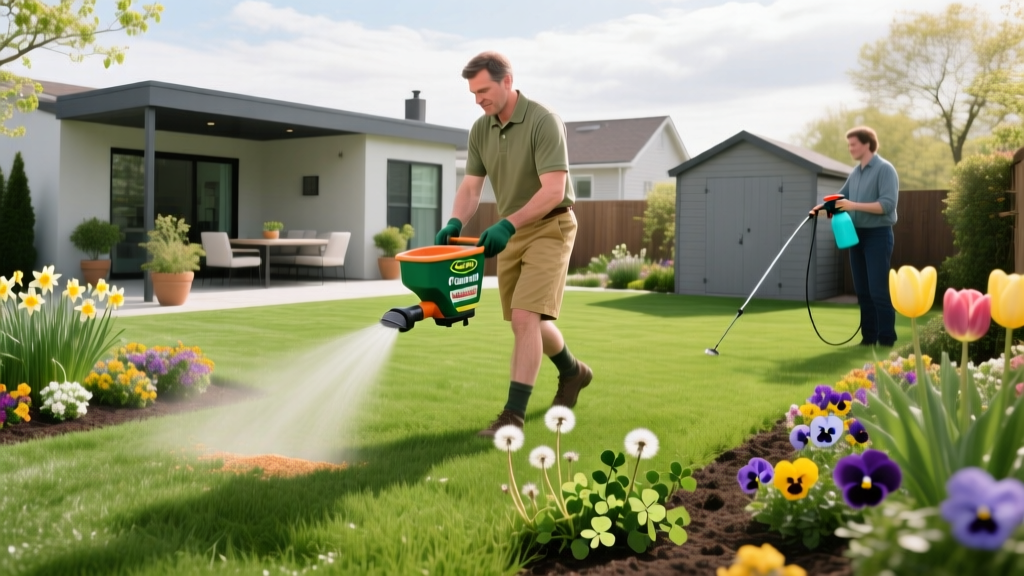
Scotts Feed and Weed Instructions: Broadcast vs Spot Weed Control
Scotts Turf Builder Weed & Feed3 remains one of the most widely used broadcast lawn care products, combining a 24-0-6 nitrogen-heavy fertilizer with a broadleaf herbicide blend (0.72% 2,4-D, 0.36% Quinclorac, and 0.18% Dicamba). While the Scotts Feed and Weed instructions on the bag provide a baseline for broadcast application, they fail to address a critical reality of modern turf management: broadcast granular applications cannot eradicate every weed species. Certain invasive grasses and sedges are entirely immune to 2,4-D and Dicamba, requiring targeted liquid spot-treatments to prevent them from overtaking your turf.
This guide bridges the gap between the manufacturer's broadcast guidelines and the advanced spot-treatment protocols required for the 20% of stubborn weeds that survive a standard Weed & Feed application.
The Core Scotts Feed and Weed Instructions (Granular Broadcast)
To achieve maximum foliar absorption, granular weed and feed products must physically stick to the leaves of the target weeds. If applied to dry foliage, the granules bounce off and settle into the soil, where the herbicide component is rendered largely ineffective. Follow these precise calibration and application steps:
- Mow and Prep: Mow your lawn to its standard height (typically 2.5 to 3.5 inches for cool-season fescue or Kentucky bluegrass). Do not bag the clippings if the lawn is relatively weed-free, but if weeds are currently flowering or going to seed, bag them to prevent redistribution.
- Moisture Requirement: Apply when grass is damp. Early morning dew is ideal. If the lawn is completely dry, water it lightly with a hose for 5 minutes before application to create surface tension on the weed leaves.
- Spreader Calibration: For the standard 15,000 sq. ft. bag (Model 49915), set your Scotts Rotary Spreader to 5.5. If using a Scotts Drop Spreader, set it to 8.5. Walk at a steady pace of roughly 3 feet per second.
- The 48-Hour Watering Rule: Do not water the lawn for 24 to 48 hours after application. The herbicide requires 24 hours of contact time to translocate through the weed's vascular system. After 48 hours, water deeply (approx. 0.5 inches) to wash the remaining fertilizer granules into the soil and activate the nitrogen.
⚠️ Volatilization Warning: Never apply Scotts Weed & Feed when daytime temperatures exceed 85°F. At high temperatures, the active ingredient Dicamba undergoes volatilization—turning into a gas that drifts onto non-target plants, causing severe curling and necrosis in nearby ornamental beds and desirable turf.
Weed Species Susceptibility: What Broadcast Misses
According to turfgrass research from the University of Minnesota Extension, broadleaf herbicides like 2,4-D are highly effective against dicot weeds but biologically blind to monocots (grassy weeds) and sedges. Understanding this distinction dictates your spot-treatment strategy.
| Weed Species | Classification | Scotts Weed & Feed Efficacy | Required Spot-Treatment Active Ingredient |
|---|---|---|---|
| Dandelion | Broadleaf | High (90%+ kill rate) | None (Broadcast sufficient) |
| White Clover | Broadleaf | Moderate (Requires good contact) | Triclopyr (if surviving) |
| Yellow Nutsedge | Sedge | Immune (0% kill rate) | Halosulfuron-methyl |
| Crabgrass (Mature) | Grassy Weed | Low (Quinclorac fails on mature) | Fenoxaprop-p-ethyl |
| Poa Annua | Grassy Weed | Immune | Mesotrione (Tenacity) |
Spot-Treatment Protocols for Surviving Weeds
After executing the broadcast application and waiting 14 days for the 2,4-D and Dicamba to translocate, assess the lawn. The weeds listed below will remain entirely unaffected by the granular application and require immediate liquid spot-treatment.
Protocol 1: Eradicating Yellow and Purple Nutsedge
Nutsedge is a sedge, identifiable by its triangular stem ("sedges have edges") and rapid vertical growth that outpaces turfgrass between mowings. Because it reproduces via underground tubers (nutlets), pulling it manually often leaves the tubers intact to resprout.
- Product Selection: Use a spot-treatment spray containing Halosulfuron-methyl (e.g., SedgeHammer). Standard Scotts liquid spot weed killers do not contain this active ingredient.
- Application Timing: Spray when the nutsedge is actively growing and has reached the 3-to-8 leaf stage. Applying too early (before the 3-leaf stage) prevents the chemical from translocating down to the tubers.
- Adjuvant Requirement: Halosulfuron-methyl requires a non-ionic surfactant (NIS) at 0.25% v/v to penetrate the waxy cuticle of the sedge leaf. Mix 1/2 teaspoon of surfactant per gallon of spray solution.
- Expectations: Nutsedge will stop growing within 48 hours, but visible yellowing and necrosis take 10 to 14 days. Do not mow for 48 hours post-spray.
Protocol 2: Managing Mature Crabgrass and Poa Annua
While the Quinclorac in Scotts Weed & Feed3 can suppress very young, 1-leaf crabgrass, it is entirely ineffective against mature crabgrass (3+ tillers) or Poa Annua (annual bluegrass).
- For Mature Crabgrass: Spot-treat with Fenoxaprop-p-ethyl (e.g., Acclaim Extra). This chemical is safe for most cool-season turfgrasses and selectively targets mature annual grassy weeds. Apply at a rate of 0.4 fluid ounces per 1,000 square feet.
- For Poa Annua: Spot-treat with Mesotrione (e.g., Tenacity). Mesotrione acts as a bleaching herbicide, inhibiting photosynthesis. The Poa Annua will turn stark white before dying. Note: Mesotrione can temporarily bleach desirable Kentucky Bluegrass, so restrict application strictly to the weed clusters using a low-volume wand.
Cost and Coverage Matrix: Broadcast vs. Spot Spraying
Understanding the economics of dual-application lawn care helps homeowners budget effectively for the 2026 season. Relying solely on broadcast weed and feed often leads to over-application of nitrogen in a desperate attempt to kill resistant weeds, which risks turf burn and environmental runoff.
| Treatment Method | Target Area | Approx. 2026 Cost | Cost per 1,000 sq. ft. |
|---|---|---|---|
| Scotts Weed & Feed3 (15k Bag) | 15,000 sq ft (Broadcast) | $68.00 | $4.53 |
| SedgeHammer (Halosulfuron) | Up to 1,000 sq ft (Spot) | $18.00 (per packet) | $18.00 |
| Tenacity (Mesotrione 4oz) | 2-3 acres (Broadcast/Spot) | $65.00 (bottle) | $0.75 |
| Scotts Spot Weed Control (Aerosol) | Small clusters (Spot) | $12.00 | N/A (Micro-targeting) |
Timing the Dual-Approach Strategy
Coordinating granular and liquid applications prevents chemical antagonism. If you apply a liquid spot-treatment on the same day as a granular weed and feed, the liquid solvent can wash the granular herbicide off the weed leaf before it absorbs, neutralizing both treatments.
The 14-Day Rule: Always execute your granular Scotts Weed & Feed broadcast application first. Wait exactly 14 days. This allows the 2,4-D to complete its systemic kill cycle on broadleaves and the nitrogen to initiate a growth flush. On day 15, walk the lawn and spot-treat the surviving sedges and grassy weeds with your targeted liquid solutions.
According to weed management guidelines published by Texas A&M AgriLife Extension, staggering applications also reduces the total chemical load on the soil microbiome, preventing the localized die-off of beneficial mycorrhizal fungi that aid in turf root development.
Frequently Asked Questions
Can I mix Scotts Weed & Feed granules with water and spray them?
No. The fertilizer salts in the granular formulation are not designed for liquid dissolution. Attempting to dissolve them will clog your sprayer nozzle, result in an uneven application, and likely cause severe nitrogen burn to your turf due to concentrated salt deposits.
Why did the weeds turn yellow but not die after using Scotts Weed & Feed?
This is a common failure mode caused by applying the product to dry foliage or watering the lawn too soon (within 24 hours). The granules must adhere to the damp leaf surface to dissolve and penetrate the cuticle. If washed into the soil prematurely, the herbicide is deactivated by soil microbes, while the fertilizer component continues to feed the weed's root system, resulting in temporary yellowing followed by vigorous regrowth.
Is it safe to use Scotts Weed & Feed on St. Augustine grass?
Standard Scotts Turf Builder Weed & Feed3 is not safe for St. Augustine, Floratam, or Centipede grass. The 2,4-D concentration will cause severe stunting and chlorosis in these warm-season species. You must use a specialized product formulated specifically for southern lawns, such as Scotts Turf Builder Southern Weed & Feed, which utilizes Atrazine or Penoxsulam instead of 2,4-D.

