
Lawn Care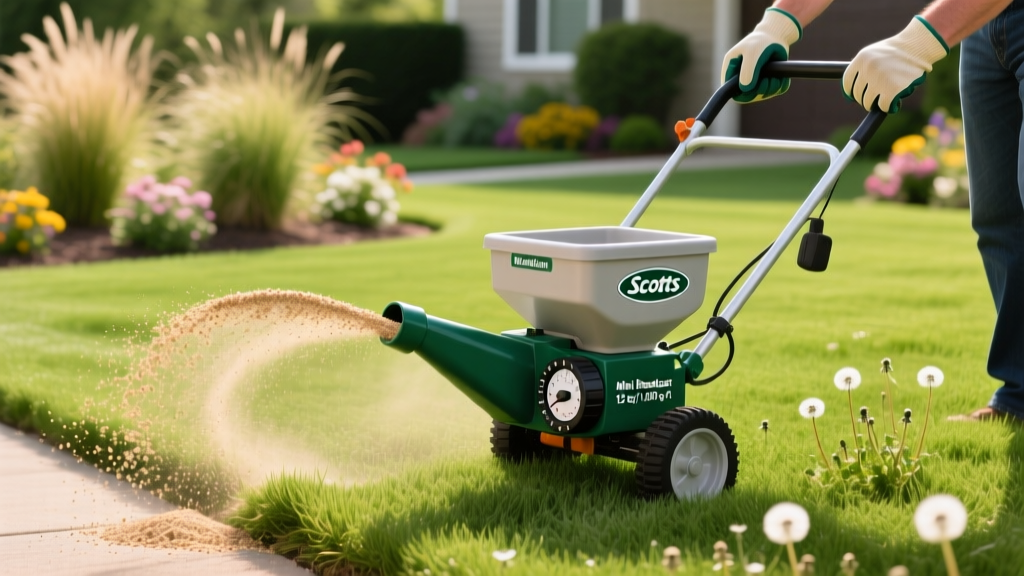
Scotts Mini Broadcast Spreader Settings: Dosage & Coverage Guide
The Hidden Challenge of Mini Broadcast Spreaders
The Scotts Turf Builder Mini Broadcast Spreader is engineered specifically for urban lots, townhouses, and lawns under 5,000 square feet. While its compact hopper and lightweight frame make it easy to store and maneuver around tight landscaping beds, its narrower throw pattern—typically 4 to 6 feet compared to the 10 to 12 feet of full-sized models—introduces unique dosage variables. If you apply standard full-size spreader logic to a mini model, you will almost certainly end up with visible striping, localized fertilizer burn, or underfed turf.
The most critical failure mode with the mini broadcast spreader is improper overlap. Because the distribution bell-curve on a 5-foot throw drops off sharply at the edges, walking edge-to-edge (as you might with a commercial spreader) leaves the outer 12 inches of your pass severely under-dosed. According to turfgrass management principles outlined by the University of Minnesota Extension, achieving uniform granular application with narrow-throw spreaders requires a deliberate 50% overlap on each pass.
⚠️ The 50% Overlap Rule: When using the Scotts Mini Broadcast Spreader, do not walk wheel-to-wheel on your return pass. Align the center of the spreader hopper with the outer wheel track of your previous pass to ensure the heavy center of the distribution pattern covers the light edges of the previous pass.
Exact Scotts Mini Broadcast Spreader Settings Chart
The dial on the Scotts Mini Broadcast Spreader typically ranges from 1 to 5 (or A to F on older variants). The settings below are calibrated for the current generation mini push model with the standard orange dial. These settings assume a normal walking pace of roughly 3 miles per hour (a brisk, purposeful walk).
| Scotts Product | Bag Weight & Coverage | Mini Spreader Dial Setting | Avg. Retail Cost |
|---|---|---|---|
| Scotts Turf Builder Lawn Food | 14.29 lbs (5,000 sq ft) | 3.5 | $34.98 |
| Scotts Weed & Feed | 13.15 lbs (5,000 sq ft) | 4.0 | $32.48 |
| Scotts Halts Crabgrass Preventer | 10.06 lbs (5,000 sq ft) | 3.5 | $29.98 |
| Scotts Turf Builder Grass Seed (Sun & Shade) | 3 lbs (1,000 sq ft) | 3.0 | $12.98 |
| Scotts WinterGuard Fall Lawn Food | 14.29 lbs (5,000 sq ft) | 3.5 | $35.98 |
Note: Always verify your specific bag's label. Scotts frequently updates formulations, and the official Scotts Spreader Settings Tool remains the ultimate authority for newly released product variations.
Step-by-Step Calibration: The 100-Square-Foot Test
Factory dial settings are baselines. Your specific walking speed, terrain slope, and the ambient humidity affecting granule size will alter the actual output rate. To prevent burning your lawn with excess nitrogen, perform the 100-square-foot calibration test before your first full application.
The Calibration Math
First, determine how much product should be applied to a 100-square-foot area (a 10x10 foot section of lawn). Use this formula:
(Bag Weight in Ounces ÷ Total Bag Coverage in Sq Ft) × 100 = Target Ounces
For a 14.29 lb bag of Turf Builder covering 5,000 sq ft:
- 14.29 lbs × 16 oz = 228.64 ounces.
- (228.64 ÷ 5,000) × 100 = 4.57 ounces.
The Field Test Procedure
- Measure the Test Zone: Use a tape measure to mark off a 10x10 foot area on your driveway or a hidden patch of lawn.
- Weigh the Product: Use a digital kitchen scale to measure exactly 4.6 ounces of the fertilizer.
- Load and Set: Pour the measured product into the mini hopper and set the dial to the recommended setting (e.g., 3.5).
- Execute the Pass: Walk over the 100-square-foot area at your normal application pace, engaging the drop lever.
- Evaluate the Hopper:
- If product remains in the hopper, your spreader is under-applying. Move the dial up by 0.5 increments.
- If the hopper empties before you finish the 100 sq ft, you are over-applying. Move the dial down by 0.5 increments.
- If the hopper empties exactly as you cross the finish line, your dial is perfectly calibrated to your walking speed.
Dosage & Cost Matrix: DIY vs. Professional Application
Using a mini broadcast spreader is highly cost-effective for small lots, but the economics shift depending on the product tier you choose. Below is a breakdown of the actual cost per 1,000 square feet when executing a standard 4-step seasonal program using the Scotts Mini Broadcast Spreader versus hiring a regional lawn care franchise.
| Application Step | DIY Product Cost (per 1k sq ft) | Pro Service Cost (per 1k sq ft) | Primary Active Ingredient Focus |
|---|---|---|---|
| Step 1: Early Spring (Pre-Emergent) | $6.00 | $18.00 - $22.00 | Prodiamine / Benefin |
| Step 2: Late Spring (Weed & Feed) | $6.50 | $18.00 - $22.00 | 2,4-D / Dicamba / Nitrogen |
| Step 3: Summer (Maintenance) | $7.00 | $20.00 - $25.00 | Slow-release Urea / Iron |
| Step 4: Fall (Winterizer) | $7.20 | $18.00 - $22.00 | Fast-release Nitrogen / Potassium |
| Annual Total (5,000 sq ft lawn) | $133.50 | $370.00 - $455.00 | Net Savings: $236+ per year |
For a 5,000 square foot lawn, the DIY route using the mini spreader yields roughly $250 in annual savings. However, this requires strict adherence to Clemson University's turfgrass fertilization guidelines, which warn that applying summer nitrogen during peak heat stress can scorch cool-season grasses regardless of the spreader used.
Troubleshooting Mini Spreader Edge Cases
The physical design of the Scotts Mini Broadcast Spreader creates specific mechanical vulnerabilities that do not exist on larger, commercial-grade models. Address these proactively to maintain accurate dosage.
Hopper Clumping and Humidity
The mini hopper sits closer to the ground and has a smaller opening, making it highly susceptible to morning dew and high ambient humidity. Granular fertilizers containing urea are hygroscopic—they absorb moisture from the air rapidly. If you load the hopper and let it sit for 15 minutes while you edge the driveway, the bottom layer will bridge and clump, blocking the agitator.
The Fix: Never load the hopper until you are ready to walk. If storing the spreader in a humid garage between seasonal applications, place two silica gel desiccant packets inside the empty, dry hopper to prevent internal rust on the metal agitator bar.
Wheel Slip on Wet Turf
The mini spreader utilizes small, solid plastic wheels with minimal tread. If you attempt to apply Weed & Feed on damp grass (which is often recommended so the granules stick to broadleaf weeds), the wheels will slip. Because the spreader's internal gear is driven directly by the axle, wheel slip means the agitator stops spinning while you continue walking forward, resulting in a total drop in dosage for that section.
The Fix: Apply weed control products when the grass is wet from dew, but ensure the soil surface is firm. If the wheels begin to slide, switch to a pushing motion that applies downward pressure on the handle to increase wheel traction, or wait two hours for the topsoil to firm up.
Edge Guard Miscalibration
When engaging the EdgeGuard feature (which blocks the right side of the spread pattern to keep fertilizer off driveways), the overall volume of product leaving the hopper remains the same, but it is funneled to the left. This alters the distribution weight. Do not use the EdgeGuard feature while performing your 100-square-foot calibration test, or your baseline settings will be skewed when you turn the guard off for open lawn passes.

