
Lawn Care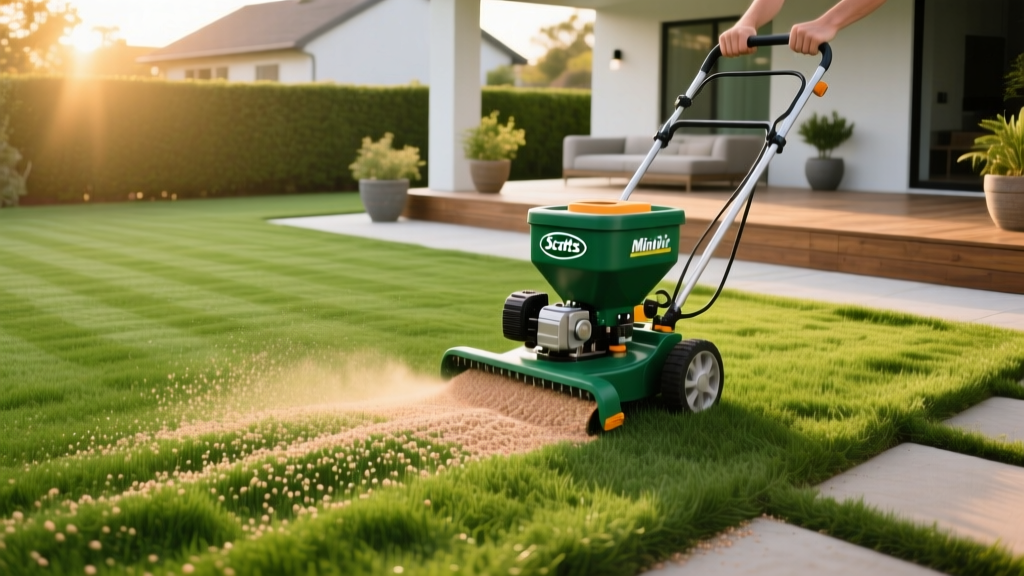
Exact Scotts Mini Spreader Settings for Coverage & Cost
The Small Lawn Dilemma: Missing Spreader Settings
Standard fertilizer bags prominently display spreader settings for large, full-size models like the EdgeGuard or Classic Drop spreaders. However, if you maintain a townhouse lawn, a narrow backyard, or are spot-treating a specific zone, you likely use a compact model. Finding the correct Scotts mini spreader settings is a notorious pain point because manufacturers rarely print them on the main packaging. Applying too much fertilizer burns the grass, while under-applying wastes money and fails to control weeds. This guide provides the exact dial settings, coverage mathematics, and real-world cost breakdowns for the two most popular compact spreaders on the market.
Wizz vs. Mini Broadcast: Hardware Specifications
Scotts produces two primary compact spreaders. Understanding their mechanical differences is critical before dialing in your dosage. The battery-powered Wizz relies on a spinning impeller, while the push-driven Mini Broadcast uses a gravity-fed rotating disc.
| Feature | Scotts Wizz (Handheld) | Scotts Mini Broadcast (Push) |
|---|---|---|
| Power Source | 4x AA Batteries | Manual Push (Gear-driven) |
| Hopper Capacity | Up to 1,000 sq ft coverage | Up to 2,500 sq ft coverage |
| Spread Width | 5 feet (adjustable via arm) | 4 to 5 feet |
| Average 2026 Cost | $30 - $35 | $45 - $55 |
| Best Use Case | Spot treatments, steep hills, patching | Narrow flat lawns, uniform full-yard coverage |
Master Scotts Mini Spreader Settings Chart
The following settings are calibrated for standard Scotts granular products. Always verify against the specific product label, as formulation densities change slightly between product lines (e.g., Weed & Feed granules are heavier and larger than standard Turf Builder granules). According to the Scotts Spreader Settings Tool, these are the baseline dials for 2026 formulations.
| Product Name | Wizz Setting | Mini Broadcast Setting | Bag Coverage |
|---|---|---|---|
| Scotts Turf Builder (Regular) | 3.5 | 3 | 5,000 sq ft |
| Scotts Halts (Pre-Emergent) | 3 | 2.75 | 5,000 sq ft |
| Scotts GrubEx | 3.5 | 3.25 | 5,000 sq ft |
| Scotts Weed & Feed | 4 | 3.5 | 4,000 sq ft |
| Scotts WinterGuard Fall Weed & Feed | 4.5 | 4 | 4,000 sq ft |
| Scotts Moss Control | 5 | 4.5 | 5,000 sq ft |
Calculating Dosage and Cost Per 1,000 Sq Ft
Using a mini spreader on a small lawn is highly cost-effective, but it requires precise math to avoid over-purchasing. Let us break down the actual cost of treating a 2,000 sq ft townhouse lawn using Scotts Turf Builder.
The 2026 Pricing Breakdown
- Bag Cost: A standard 14.29 lb bag of Scotts Turf Builder costs approximately $38.00.
- Total Coverage: 5,000 sq ft.
- Cost Per 1,000 Sq Ft: $7.60.
- Application Cost for 2,000 Sq Ft Lawn: $15.20.
Because the mini spreader hopper cannot hold the entire bag, you must measure your dosage by weight or volume. For a 2,000 sq ft application of Turf Builder, you need exactly 5.71 lbs of product. Use a standard kitchen scale to weigh the granules before pouring them into the Wizz or Mini Broadcast hopper. This prevents leftover product from sitting in the hopper, which leads to moisture absorption and clumping.
The 50% Overlap Calibration Trick for Handhelds
Push spreaders have physical wheels that dictate your path, but handheld spreaders like the Wizz rely entirely on your walking speed and arm position. The most common failure mode with the Wizz is uneven striping (alternating dark green and yellow grass) caused by improper overlap.
Pro Calibration Framework:
To achieve a true 5-foot spread pattern with the Wizz, you must overlap each pass by 50% (2.5 feet).
The Pavement Test: Pour a small amount of fertilizer onto a dry driveway. Turn on the Wizz and walk at your normal mowing pace. Measure the actual width of the granule scatter. If it only spans 4 feet, adjust your overlap to 2 feet. If it spans 6 feet, adjust to 3 feet. Never rely blindly on the '5-foot' marketing claim, as battery voltage and granule size alter the throw distance.
To achieve a true 5-foot spread pattern with the Wizz, you must overlap each pass by 50% (2.5 feet).
The Pavement Test: Pour a small amount of fertilizer onto a dry driveway. Turn on the Wizz and walk at your normal mowing pace. Measure the actual width of the granule scatter. If it only spans 4 feet, adjust your overlap to 2 feet. If it spans 6 feet, adjust to 3 feet. Never rely blindly on the '5-foot' marketing claim, as battery voltage and granule size alter the throw distance.
According to turfgrass management guidelines from Penn State Extension, calibrating your spreader over a hard surface is the only way to guarantee uniform distribution before applying to living turf. Always sweep up the test granules from the pavement to prevent concrete staining and runoff into storm drains.
Troubleshooting Edge Cases and Failure Modes
Even with the correct dial settings, mini spreaders are prone to specific mechanical and environmental issues that ruin dosage accuracy.
1. The Wizz Battery Voltage Drop
The Scotts Wizz impeller speed is directly tied to battery voltage. As standard alkaline AA batteries drain, the impeller slows down, reducing the spread width from 5 feet to 3 feet. This causes massive over-application in your later passes. The Fix: Never use standard alkaline batteries in the Wizz. Invest in Lithium AA batteries (like Energizer Ultimate Lithium). They maintain a constant voltage curve until they are completely dead, ensuring the impeller spins at the exact same RPM for the entire application.
2. Static Cling and Hopper Bridging
In low-humidity environments (common in early spring or late fall), dry fertilizer granules build up a static electrical charge against the plastic hopper walls. This causes the granules to stick to the sides and 'bridge' over the auger hole, resulting in zero product flow even when the dial is open. The Fix: Before filling the hopper, wipe the entire interior plastic surface with a standard laundry dryer sheet. This neutralizes the static charge and allows granules to flow smoothly via gravity.
3. Moisture Clumping in the Mini Broadcast
The push-driven Mini Broadcast lacks the sealed agitator found in premium models. If you are spreading Weed & Feed on a morning with heavy dew, moisture wicks up into the hopper, turning the bottom layer of fertilizer into a solid brick. The Fix: Only apply granular products when the grass blades are completely dry. If you must spread in high humidity, add a handful of uncooked white rice to the hopper; the rice acts as a desiccant and mechanical agitator to break up minor clumps before they reach the spreader disc.
Frequently Asked Questions
Can I use the Wizz for grass seed?
Yes, but grass seed is significantly lighter and larger than fertilizer. Set the Wizz dial to 3.5 for standard Kentucky Bluegrass or Fescue mixes, and walk 20% faster than your normal pace to prevent over-seeding. Always mix seed with a starter fertilizer to add weight and improve the throw distance.
How do I clean the mini spreader after use?
Never use a hose to wash out the Wizz or Mini Broadcast, as water will rust the internal metal springs and ruin the battery contacts. Instead, use a stiff-bristled dry brush to sweep out residual granules, followed by a blast of compressed air to clear the auger mechanism.