Lawn Care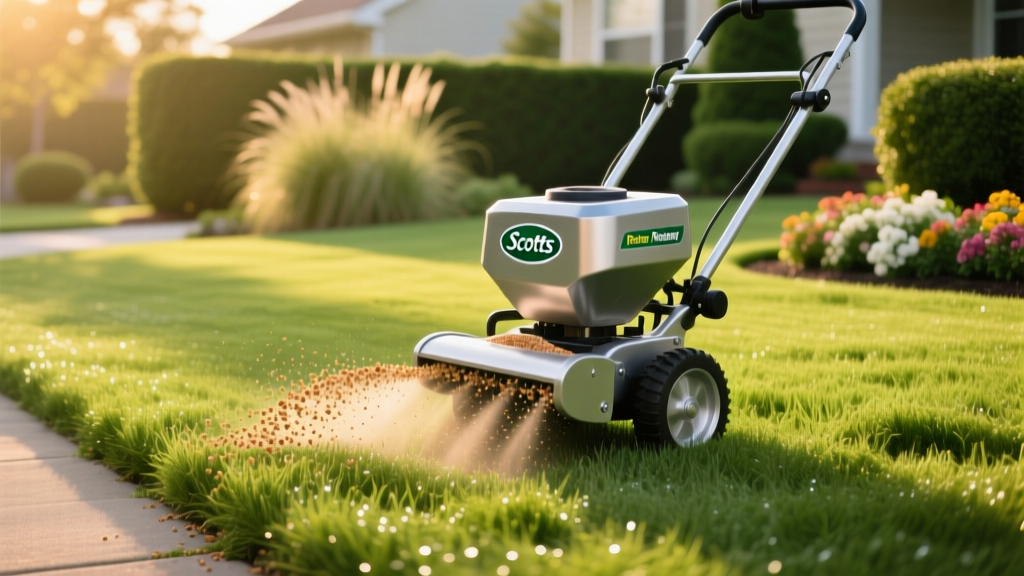
Scotts Rotary Spreader Settings Chart: Exact Calibration & Coverage Guide
The True Cost of Guesswork: Why Spreader Calibration Matters
Applying granular fertilizer, weed control, or grass seed with a rotary spreader is an exercise in applied geometry and chemistry. Guessing your dial setting based on 'what looks right' inevitably leads to two outcomes: under-application, which starves your lawn and wastes your time, or over-application, which causes severe fertilizer burn and violates local environmental runoff regulations. The official Scotts Spreader Settings Tool provides a baseline, but manufacturing tolerances, granule size variations, and walking speed mean that a printed chart is only a starting point. True precision requires understanding the exact dosage, coverage mathematics, and real-world cost per square foot of your lawn care inputs.
The Master Scotts Rotary Spreader Settings Chart
The settings below apply specifically to Scotts rotary (broadcast) spreaders, including the EdgeGuard Mini, EdgeGuard Max, and Elite models. Drop spreaders require entirely different calibration. These settings assume a standard walking speed of 3.0 miles per hour (roughly one normal step per second).
| Product Category | Specific Product | Target Rate (lbs/1,000 sq ft) | EdgeGuard Mini Setting | EdgeGuard Max / Elite Setting |
|---|---|---|---|---|
| Standard Fertilizer | Scotts Turf Builder Lawn Food | 2.50 | 3.5 | 3.5 |
| Winterizer | Scotts Turf Builder WinterGuard | 2.30 | 3.25 | 3.25 |
| Weed & Feed | Scotts Turf Builder Weed & Feed | 2.60 | 3.5 | 3.5 |
| Pest Control | Scotts GrubEx Season-Long Grub Killer | 2.80 | 3.75 | 3.75 |
| Grass Seed (Overseed) | Scotts Sun & Shade Mix (20 lb bag) | 3.00 | 4.0 | 4.5 |
| Grass Seed (New Lawn) | Scotts Sun & Shade Mix (20 lb bag) | 8.00 | 5.5 | 6.0 |
Warning: The Humidity Factor
Granular fertilizers and weed killers are highly hygroscopic (moisture-absorbing). If your relative humidity is above 70%, or if your spreader hopper was not completely dried after its last wash, the granules will clump. This alters the aerodynamics of the broadcast pattern, reducing your effective coverage by up to 15%. Always store product in climate-controlled environments and run a dry rag through the hopper before loading.
Granular fertilizers and weed killers are highly hygroscopic (moisture-absorbing). If your relative humidity is above 70%, or if your spreader hopper was not completely dried after its last wash, the granules will clump. This alters the aerodynamics of the broadcast pattern, reducing your effective coverage by up to 15%. Always store product in climate-controlled environments and run a dry rag through the hopper before loading.
How to Calibrate Your Spreader in 15 Minutes
University turfgrass extensions universally recommend the 50-square-foot test method to verify spreader output. According to guidelines published by the EPA on calibrating application equipment, verifying your output prevents both chemical waste and environmental contamination. Here is the exact mathematical framework to calibrate your Scotts rotary spreader.
Step 1: Calculate the 50 Sq Ft Test Weight
You need to determine exactly how many ounces of product should be dispensed over a 50-square-foot area (a 10 ft by 5 ft rectangle).
- Find the bag rate: Look for the 'lbs per 1,000 sq ft' number on the product label (e.g., 2.5 lbs).
- Convert to ounces: Multiply by 16. (2.5 lbs x 16 = 40 oz per 1,000 sq ft).
- Calculate the 50 sq ft dose: Divide the total ounces by 1,000, then multiply by 50. (40 / 1000 = 0.04 oz per sq ft. 0.04 x 50 = 2.0 ounces).
Step 2: Execute the Driveway Test
- Measure and mark a 10 ft by 5 ft rectangle on your driveway or a tarp.
- Fill your spreader with the exact calculated weight of product (e.g., 2.0 oz) plus a little extra to ensure the hopper feeds properly.
- Set your dial to the chart recommendation (e.g., 3.5).
- Walk over the 10-foot length at your normal pace, starting 2 feet before the mark and stopping 2 feet after.
- Collect and weigh the dispensed product. If you dispensed 2.4 oz, your setting is too high; dial it back to 3.25. If you dispensed 1.6 oz, dial it up to 3.75.
Coverage & Cost Breakdown: What You Are Actually Spending
Understanding the cost per 1,000 square feet allows you to budget accurately and compare generic alternatives against name-brand products. Below is a real-world cost analysis based on average 2026 retail pricing for standard suburban lawn sizes.
| Product | Bag Size & Coverage | Avg. Retail Price | Cost per 1,000 sq ft | Cost for 5,000 sq ft Lawn |
|---|---|---|---|---|
| Turf Builder Lawn Food | 40 lbs (15,000 sq ft) | $45.99 | $3.06 | $15.30 |
| Scotts GrubEx | 28.85 lbs (10,000 sq ft) | $32.99 | $3.30 | $16.50 |
| Sun & Shade Seed (Overseed) | 20 lbs (26,000 sq ft) | $79.99 | $3.07 | $15.35 |
| Turf Builder WinterGuard | 40 lbs (15,000 sq ft) | $42.99 | $2.86 | $14.30 |
'The most common financial mistake homeowners make is buying the 5,000 square foot bag for a 4,500 square foot lawn, then dumping the remaining 10% on the front yard because they don't want to store it. This localized over-application burns the turf and negates the entire fertilizer investment.' — Regional Turfgrass Management Guidelines
The EdgeGuard Feature: Asset or Liability?
Scotts EdgeGuard technology uses a physical deflector on the right side of the spreader to block granules from landing in flower beds or driveways. While highly effective for protecting hardscapes, it fundamentally alters the broadcast pattern. When EdgeGuard is engaged, your spreader is no longer throwing a symmetrical 180-degree fan; it is throwing an asymmetrical 140-degree fan. Never overlap passes with EdgeGuard engaged using the center of the spreader as your guide. You must align the right wheel of the spreader with the exact edge of the previous application swath, or you will create visible striping (alternating bands of dark green and light green grass) due to under-overlap.
Common Calibration Mistakes & Troubleshooting
Symptom: Alternating Light and Dark Green Stripes (Striping)
- Cause: Inconsistent overlap or walking speed variations.
- Fix: Rotary spreaders throw furthest in the center and taper at the edges. You must overlap the previous wheel track by exactly 50% of the spreader's width. Maintain a metronomic walking pace; slowing down at the end of a row dumps excess product, creating dark green burn spots.
Symptom: Product Clumping in the Hopper
- Cause: High ambient humidity or residual moisture in the spreader.
- Fix: Do not leave fertilizer in the hopper overnight. If clumping occurs, empty the hopper, break up the chunks manually (do not run them through the impeller, which will shatter the granules and alter the application rate), and wipe the interior with a dry microfiber cloth.
Symptom: Edge Burn on Driveways or Garden Beds
- Cause: EdgeGuard deflector is damaged, or the spreader is tilted.
- Fix: Ensure the spreader wheels are on the same elevation plane. If one wheel is on the lawn and the other is on a raised driveway curb, the broadcast pattern tilts, bypassing the EdgeGuard deflector. Keep both wheels on the grass whenever possible.
Expert FAQs on Spreader Dosage
Can I use a Scotts drop spreader setting on a rotary spreader?
No. Drop spreaders release product directly downward through a fixed-width gate, measured in linear feet. Rotary spreaders use a centrifugal impeller to broadcast product outward in a fan pattern. The mechanics are entirely different, and using a drop setting on a rotary dial will result in severe over-application and turf burn.
Does walking speed actually change the spreader setting?
Yes. The dial setting controls the size of the gate opening, but your walking speed dictates the time the gate is open per square foot. If the chart assumes 3.0 mph and you walk at 2.0 mph, you are applying 50% more product per square foot than the dial intends. Calibrate your physical pace before calibrating the machine.
How do I clean the spreader after applying GrubEx or weed killers?
Use a garden hose to rinse the hopper, impeller, and wheels over a gravel or mulch area—never over a storm drain or directly onto the lawn, as this concentrates the chemical residue. Allow the spreader to dry completely in direct sunlight, and apply a light spray of silicone lubricant to the metal gate mechanism to prevent rust and sticking.