
Lawn Care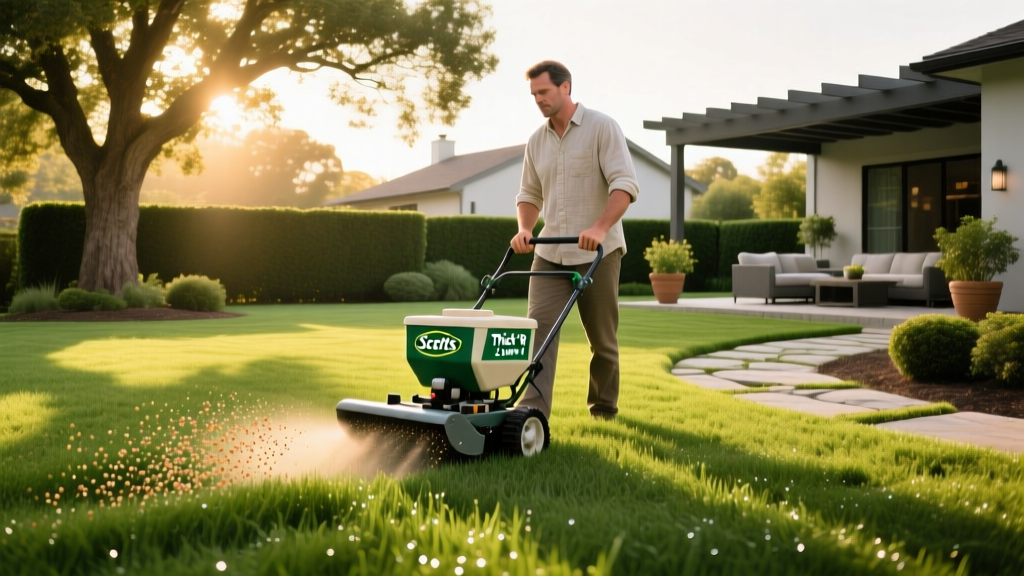
Scotts Thick'R Lawn Review: 3-in-1 Application Guide 2026
The Anatomy of Scotts Thick'R Lawn: What is Actually in the Bag?
Scotts Thick'R Lawn markets itself as a 3-in-1 solution combining grass seed, starter fertilizer, and a soil improver. While the convenience is undeniable, understanding the exact composition is critical for setting realistic expectations and avoiding application failures. Unlike standard overseeding where you buy seed and fertilizer separately, this pre-mixed blend alters how you must prepare your soil.
Seed Blend Composition and Germination Timelines
The 'Sun & Shade' variant relies on a three-species mix. Perennial Ryegrass acts as the nurse crop, germinating in 5 to 7 days to stabilize soil and provide quick green-up. Fine Fescue offers shade tolerance, sprouting in 10 to 14 days. Kentucky Bluegrass (KBG) provides long-term rhizomatous spreading but takes 14 to 28 days to germinate. A common failure mode occurs when homeowners stop watering at day 10, assuming the product failed, effectively killing the slower-germinating KBG before it breaches the surface.
Fertilizer and Soil Improver Metrics
The fertilizer component is typically a low-nitrogen, high-potassium starter blend (often around 1-0-2 or 2-0-4 NPK, varying slightly by state phosphorus regulations). This prevents burning tender seedlings while promoting root development. The 'soil improver' consists primarily of biochar and humic acid. According to turfgrass research, humic acid increases the soil's Cation Exchange Capacity (CEC), allowing clay-heavy soils to retain moisture and nutrients more effectively during the critical establishment phase.
2026 Product Lineup & Pricing Matrix
| Variant | Bag Size | Coverage | Avg. 2026 Retail Price | Best Use Case |
|---|---|---|---|---|
| Sun & Shade | 40 lbs | 4,000 sq ft | $79.00 - $84.00 | Mixed light conditions, general thinning |
| Tall Fescue | 40 lbs | 4,000 sq ft | $82.00 - $87.00 | Transition zone lawns, high heat/drought |
| Bermudagrass | 10 lbs | 2,000 sq ft | $32.00 - $36.00 | Warm-season southern lawns, full sun |
| Centipedegrass | 10 lbs | 2,000 sq ft | $34.00 - $38.00 | Acidic soils, low-maintenance southern yards |
Where Thick'R Lawn Succeeds (and Where It Fails)
This product is not a universal fix. Its pre-mixed nature creates specific advantages and severe limitations depending on your lawn's current state.
Ideal Scenarios for Success
- Minor Thinning and Bare Spots: Perfect for lawns that are 70-85% healthy but suffer from winterkill, dog spots, or minor foot-traffic wear.
- Time-Constrained Homeowners: Eliminates the need to calibrate separate spreaders for seed and fertilizer, reducing application time by roughly 40%.
- Sandy or Low-CEC Soils: The humic acid component provides an immediate buffer for nutrient retention in poor soils.
Critical Failure Modes
Do Not Use On: Heavily compacted lawns, lawns with more than 0.5 inches of thatch, or lawns already at 100% density. The seed in Thick'R Lawn is coated and heavy; if it lands on top of a thick thatch layer or existing dense canopy, it will not reach the soil, will fail to germinate, and will ultimately be eaten by birds or wash away.
Furthermore, because the seed is pre-mixed with fertilizer, you cannot adjust the seeding rate independently of the fertilizer rate. If you have a severely damaged lawn requiring 8 lbs of seed per 1,000 sq ft, applying Thick'R Lawn at that density will over-apply the fertilizer, risking salt burn to existing mature grass.
Step-by-Step Application Protocol for Maximum Germination
To achieve the results shown on the packaging, you must prioritize seed-to-soil contact. Follow this exact protocol, adapted from Penn State Extension's overseeding guidelines.
Phase 1: Soil Preparation (Days 1-2)
- Mow Low: Drop your mower deck to 1.5 inches. Bag the clippings to expose the soil surface.
- Core Aerate: This is non-negotiable for established lawns. Pull 3-inch deep plugs at 2-inch intervals. This creates micro-trenches for the heavy, coated seeds to fall into, ensuring soil contact.
- Leveling (Optional): If your lawn has severe undulations, apply a 50/50 topsoil-sand mix to low areas before seeding.
Phase 2: Application and Calibration
Apply the product at a rate of 10 lbs per 1,000 sq ft. For the most common residential spreaders, use these exact 2026 calibration settings:
- Scotts EdgeGuard Mini: Setting 7.5
- Scotts EdgeGuard DLX: Setting 7.5
- Scotts Standard Broadcast: Setting 5.5
Pro Tip: Apply in two perpendicular passes (North-South, then East-West) at half the recommended spreader setting to ensure uniform distribution and avoid striping.
Phase 3: The Watering Schedule
Seed germination relies entirely on consistent surface moisture. According to UMass Extension turfgrass protocols, the seedbed must remain moist but not saturated.
- Weeks 1-2: Water 2 to 3 times daily for 5-10 minutes per zone. The goal is to keep the top 0.5 inches of soil damp.
- Weeks 3-4: As ryegrass and fescue sprout, reduce frequency to once daily, but increase duration to 15 minutes to encourage deeper root growth.
- Week 5+: Transition to standard deep watering (1 inch per week, applied in 1-2 sessions).
Troubleshooting: Why Your Seed Did Not Sprout
If you applied Thick'R Lawn and see no results after 14 days, diagnose the issue using this matrix before attempting a re-application.
| Symptom | Probable Cause | Corrective Action |
|---|---|---|
| Patchy germination; only green in shaded areas | Surface drying out in full sun zones between waterings | Increase mid-day watering cycles by 5 minutes; apply a thin layer of peat moss over bare spots to retain moisture. |
| Seed sprouted but turned yellow and died | Fungus (damping off) due to overwatering or poor drainage | Reduce watering frequency. Apply a systemic fungicide containing azoxystrobin if the problem persists. |
| No germination anywhere after 21 days | Seed trapped in thatch; lack of soil contact | Rake heavily to break up thatch, re-aerate, and re-apply seed (use plain seed, not Thick'R, to avoid fertilizer buildup). |
| Existing lawn turned brown after application | Fertilizer burn from overlapping passes | Water deeply for 30 minutes daily for a week to leach excess salts out of the root zone. |
Expert Verdict: Should You Buy It?
Scotts Thick'R Lawn is a highly effective product for a very specific user profile: the homeowner with a moderately thin lawn who lacks the time, equipment, or desire to source and calibrate separate seed and starter fertilizer. At roughly $80 for a 4,000 sq ft bag, it carries a 20% to 30% price premium over buying bulk seed and standard starter fertilizer separately. However, the inclusion of biochar and humic acid provides a genuine soil-health benefit that justifies the cost for poor soils. If your lawn requires heavy renovation (over 50% bare dirt), skip this product, core aerate, and opt for a high-purity, uncoated seed blend paired with a dedicated liquid starter fertilizer for better economic and agronomic results.

