
Lawn Care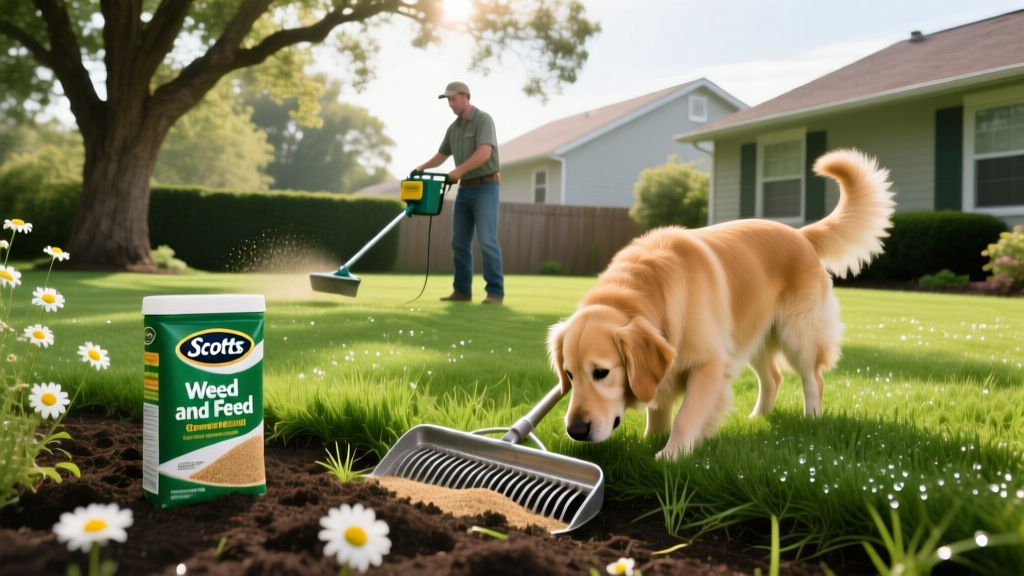
Is Scotts Weed and Feed Safe for Dogs? Toxicity & Re-Entry Guide
The Short Answer: Is Scotts Weed and Feed Safe for Dogs?
If you are asking whether is scotts weed and feed safe for dogs immediately after application, the answer is unequivocally no. Scotts Turf Builder Weed & Feed 3 contains synthetic broadleaf herbicides that pose moderate toxicity risks to canines through dermal contact and ingestion. However, the product can be used in households with dogs if you follow a strict application, watering, and re-entry protocol. Once the granules are fully dissolved, watered into the soil, and the grass blades are completely dry, the risk of acute exposure drops to negligible levels.
⚠ Critical Safety Rule: Never allow dogs onto the lawn during the application process or while granules are visible on the grass blades. The safe re-entry time is typically 24 to 48 hours post-watering.
Breaking Down the Active Ingredients
To understand the risk profile, we must look at the exact chemical composition of the most popular formulation, Scotts Turf Builder Weed & Feed 3. This product combines a high-nitrogen fertilizer (NPK 20-0-0) with three distinct synthetic auxin herbicides designed to mimic plant growth hormones, causing broadleaf weeds to grow themselves to death.
| Active Ingredient | Concentration | Target Weeds | Canine Toxicity Profile |
|---|---|---|---|
| 2,4-D | 0.72% | Dandelion, Clover, Plantain | Moderate. Causes GI upset, lethargy, and ataxia if ingested in large doses. Mild skin/eye irritant. |
| Mecoprop-p | 0.18% | Chickweed, Knotweed | Low to Moderate. Similar GI irritation profile to 2,4-D; low dermal absorption rate. |
| Dicamba | 0.06% | Thistle, Bindweed | Moderate. Highly toxic if concentrated, but at 0.06% poses minimal risk once watered into soil. |
According to the Environmental Protection Agency (EPA), 2,4-D is not classified as a known carcinogen, but acute exposure in dogs can lead to the uncoupling of oxidative phosphorylation at the cellular level if massive quantities are ingested. In practical lawn-care scenarios, the primary risk is gastrointestinal irritation rather than systemic cellular failure.
Understanding Canine Exposure Pathways
Dogs interact with lawns differently than humans. Their low center of gravity, lack of footwear, and grooming habits create unique exposure vectors.
1. Dermal Contact (Paw Pads and Bellies)
When granular weed and feed sits on the surface of the grass blade, it acts as a concentrated chemical reservoir. If a dog walks across the lawn before the product is watered in, the granules can become trapped between their toe pads. The moisture from their sweat glands (which dogs excrete through their paws) can begin to dissolve the granule, leading to localized chemical burns or contact dermatitis. Furthermore, breeds with low-slung bellies (like Basset Hounds or Corgis) risk direct abdominal skin contact when lying on treated grass.
2. Ingestion (Grazing and Grooming)
The Pet Poison Helpline notes that the most common cause of fertilizer and herbicide toxicity in dogs is secondary ingestion. A dog walks on the treated lawn, gets granules stuck to their paws and fur, and then ingests the chemicals while grooming themselves. Direct grazing on treated grass is a secondary vector; while most dogs do not eat enough grass to reach a lethal dose of 2,4-D, even small amounts can trigger severe hypersalivation, vomiting, and diarrhea.
The Safe Re-Entry Protocol: Step-by-Step
If you choose to use Scotts Weed and Feed, you must manipulate the physical state of the product to eliminate the exposure risk. Follow this exact protocol to transition the lawn from hazardous to safe:
- Apply to Dry Grass: Ensure the lawn is completely dry before spreading. Moisture will cause the granules to stick to the grass blades, making them harder to wash down to the soil later.
- Isolate the Dog: Keep your dog indoors or in an untreated, fenced area during the spreading process. Dust and granular kickback can easily land on their coat.
- Water the Lawn Immediately: You must apply between 0.25 and 0.5 inches of water. Pro Tip: Place an empty tuna can on the lawn; when it fills to the halfway mark, you have applied enough water. This dissolves the granule, washes the herbicide off the grass blade, and pushes it into the topsoil where the weed roots are located.
- Enforce a 24 to 48-Hour Drying Period: Do not let the dog outside until the grass blades are 100% dry to the touch. In humid climates or shaded areas, this can take a full 48 hours. The ASPCA Animal Poison Control emphasizes that damp, treated environments prolong the risk of dermal absorption.
Pet-Safe Lawn Care Alternatives (2026 Pricing & Efficacy)
If the re-entry protocol is too restrictive for your household, or if you have a dog that obsessively grazes on grass, you should pivot to pet-safe alternatives. Below is a comparison of the most effective non-toxic weed control methods available to homeowners.
| Alternative Product | Active Mechanism | Avg. Cost per 5,000 sq ft | Pet Re-Entry Time |
|---|---|---|---|
| Iron HEDTA (e.g., Fiesta) | Chelated iron causes oxidative stress in broadleaf weeds, turning them black and killing them within hours. | $25 - $35 | Safe once dry (2-4 hours) |
| Corn Gluten Meal | Natural pre-emergent. Inhibits root formation in germinating weed seeds. Adds nitrogen to soil. | $40 - $50 | Immediate (100% Non-Toxic) |
| Manual Extraction + Boiling Water | Physical removal of taproots; thermal destruction of crown tissue. | $0 (Labor only) | Immediate (once cool) |
Why Iron HEDTA is the Best Direct Substitute
For homeowners who need the broadleaf-killing power of 2,4-D without the toxicity, liquid Iron HEDTA (often sold under the brand name Fiesta or as generic chelated iron liquid herbicides) is the gold standard. Dogs and cats lack the specific sensitivity to iron overload via dermal contact that broadleaf plants possess. While it will not kill crabgrass (a grassy weed), it is highly lethal to dandelions, clover, and thistle. It requires multiple applications spaced 14 days apart, but it allows your dog back onto the lawn as soon as the liquid spray has evaporated.
Emergency Protocol: What If Your Dog Eats Treated Grass?
If your dog breaches the perimeter and ingests grass that has not yet been watered in, do not wait for symptoms to manifest. Take the following immediate actions:
- Remove the Dog: Immediately bring the dog indoors and wipe their paws and underbelly with a damp towel to prevent further dermal absorption and secondary ingestion during grooming.
- Check the Label: Locate the Scotts product bag and find the EPA Registration Number and the exact active ingredient list. You will need this for the veterinarian.
- Call Poison Control: Contact the ASPCA Animal Poison Control Center (888-426-4435) or the Pet Poison Helpline (855-764-7661). Note that these services charge a consultation fee (typically $75-$95), but they provide exact dosage-to-weight toxicity calculations.
- Monitor for Ataxia: Watch for muscle weakness, stumbling (ataxia), severe lethargy, or vomiting. Do not induce vomiting with hydrogen peroxide unless explicitly instructed to do so by a veterinary professional, as the chemical composition of the herbicide can cause secondary esophageal damage if regurgitated.
Maintaining a pristine, weed-free lawn does not require compromising your dog's health. By understanding the exact chemical behavior of synthetic auxins like 2,4-D and strictly enforcing a watering-and-drying re-entry protocol, you can safely integrate traditional weed and feed products into your lawn care regimen. If your dog's behavior makes strict protocols impossible, pivoting to Iron HEDTA provides a highly effective, zero-toxicity safety net.

