
Lawn Care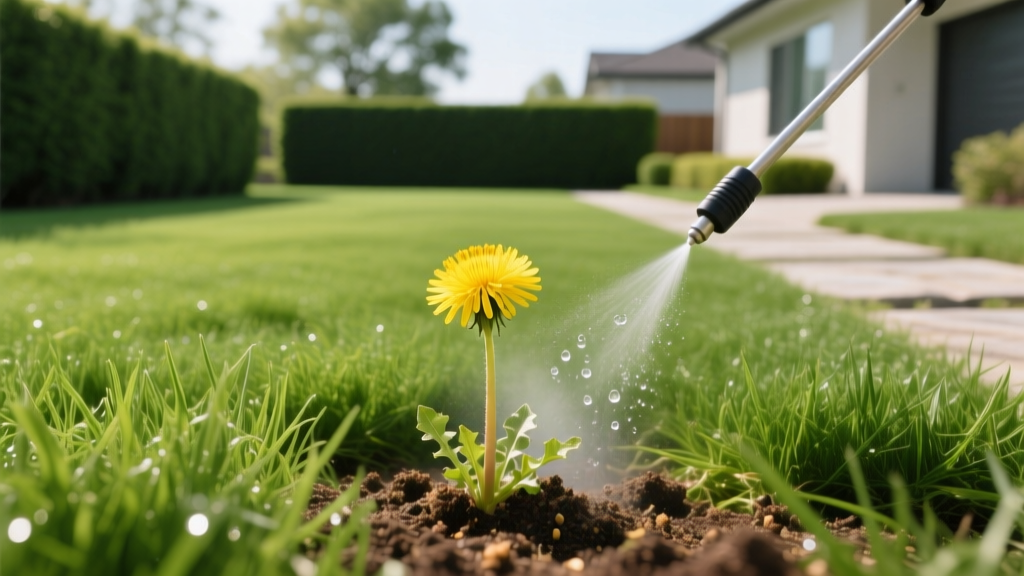
Best Dandelion Killer for Lawns: 2026 Spot-Treatment Guide
The Biology of the Dandelion Taproot: Why Pulling Fails
Dandelions (Taraxacum officinale) are perennial broadleaf weeds characterized by a deep, brittle taproot that can extend 10 to 15 feet into uncompacted soil. However, the critical regenerative tissue—the crown—is located in the top 1 to 2 inches of the soil profile. When homeowners attempt to pull dandelions by hand, the taproot almost invariably snaps below the crown. If even a half-inch of the crown remains in the soil, the plant will regenerate multiple new rosettes from the severed tissue, effectively turning one weed into three.
This biological reality makes systemic chemical spot-treatment the most effective eradication strategy. A proper dandelion killer for lawns utilizes systemic active ingredients that are absorbed through the foliage and translocated down into the taproot, destroying the regenerative crown and preventing future emergence.
Active Ingredients: Selecting the Right Chemistry
Not all herbicides are created equal. When selecting a selective herbicide (one that kills broadleaf weeds but spares monocot grasses), you must look at the active ingredient profile. According to the U.S. Environmental Protection Agency, synthetic auxins like 2,4-D remain the backbone of broadleaf control, but modern formulations often combine multiple modes of action to prevent resistance and ensure complete root kill.
| Active Ingredient | Mode of Action | Best For | Grass Safety | Avg. Price (Concentrate) |
|---|---|---|---|---|
| 2,4-D (Amine) | Synthetic Auxin (Group 4) | General broadleaf, young dandelions | Safe on most cool/warm-season grasses | $25 - $35 / gal |
| Dicamba | Synthetic Auxin (Group 4) | Mature dandelions, clover, chickweed | Safe on most turf; avoid near tree roots | $40 - $60 / gal |
| Triclopyr (Ester) | Synthetic Auxin (Group 4) | Hard-to-kill woody & broadleaf weeds | Safe on cool-season; toxic to St. Augustine | $50 - $70 / gal |
| FeHEDTA (Iron) | Iron Toxicity / Oxidative Stress | Organic lawns, sensitive environments | Extremely safe; may temporarily darken turf | $45 - $60 / gal |
Top Dandelion Killers for Lawns (Product Breakdown)
Based on efficacy, translocation speed, and turf safety, here are the top spot-treatment formulations currently on the market.
Best Overall Selective: Ortho WeedClear Lawn Weed Killer
Ortho WeedClear utilizes a three-way blend of 2,4-D, Dicamba, and Quinclorac. This specific triad is highly effective against mature dandelions because the Dicamba accelerates vascular destruction while the 2,4-D induces uncontrolled cellular growth. The ready-to-use (RTU) spot sprayer includes a built-in fan nozzle that delivers a coarse droplet size, minimizing drift onto nearby ornamental beds. Expect to pay around $15 for a 32-ounce RTU bottle, which treats roughly 5,000 square feet of spot-spraying.
Best Iron-Based / Organic: Fiesta Turf Weed Killer (FeHEDTA)
For homeowners maintaining organic lawns or those near sensitive waterways, FeHEDTA (chelated iron) is the gold standard. Dandelions lack the regulatory mechanisms to process high levels of iron, leading to rapid oxidative stress and tissue necrosis within hours. University of Minnesota Extension notes that while iron-based herbicides provide excellent top-kill, they often require a second application 3 to 4 weeks later to completely eradicate the deep taproot. Fiesta concentrate retails for about $55 per gallon.
Best Ready-to-Use Spot Sprayer: Spectracide Weed Stop for Lawns
Spectracide Weed Stop relies on a 2,4-D and Mecoprop-p (MCPP) blend. It is formulated specifically for rapid visual results, often showing wilting in dandelion rosettes within 12 hours. It is an excellent, budget-friendly choice ($10 to $12 per 32oz bottle) for small suburban lawns with light to moderate dandelion pressure.
The Critical Role of Surfactants
If you are mixing your own concentrate rather than using an RTU bottle, you must add a Non-Ionic Surfactant (NIS). Dandelion leaves are coated in a waxy cuticle that repels water-based sprays. An NIS reduces the surface tension of the herbicide solution, allowing it to spread evenly across the leaf surface and penetrate the cuticle.
💡 Pro Mixing Tip: Add 0.25% v/v (roughly 1/2 teaspoon per gallon of water) of a high-quality NIS like Hi-Yield Spreader Sticker to your tank mix. Do not use dish soap as a substitute; the degreasing agents in dish soap can strip the protective wax off your turfgrass, causing severe phytotoxicity.
Step-by-Step Spot-Treatment Protocol
To achieve a 100% kill rate on the taproot without damaging the surrounding turf, follow this precise application sequence:
- Prep the Foliage (Day -2): Do not mow for 48 hours before application. You need maximum leaf surface area to absorb the chemical and translocate it to the root.
- Check the Forecast: Ensure no rain is expected for at least 24 hours post-application. Rain will wash the systemic herbicide off the foliage before it penetrates the cuticle.
- Mix and Agitate: If using a concentrate, fill your pump sprayer halfway with water, add the herbicide and surfactant, then fill the rest with water. Agitate thoroughly.
- Targeted Application: Spray the dandelion rosette until the leaves are visibly wet, but not to the point of runoff. Dripping herbicide onto the soil surface wastes the product and increases the risk of turf root uptake.
- Post-Application Wait (Day +2): Wait a minimum of 48 hours before mowing. This allows the chemical to travel down the phloem into the taproot.
- Fertilize and Overseed: Once the dandelion turns black and collapses (usually 10-14 days later), rake out the dead debris and drop a pinch of grass seed and topsoil into the void to prevent new weeds from colonizing the bare spot.
⚠️ Temperature & Volatilization Warning: Never apply hormonal herbicides (2,4-D, Dicamba) when daytime temperatures exceed 85°F. At high temperatures, these chemicals can vaporize (volatilize) and drift as invisible gases, causing severe twisting and cupping damage to non-target plants like tomato vines, grapevines, and ornamental shrubs hundreds of feet away.
Optimal Seasonal Timing for Root Kill
While spring applications provide quick visual satisfaction, Michigan State University Extension emphasizes that early fall (September through mid-October) is biologically the most effective time to apply a dandelion killer for lawns.
In the fall, dandelions are actively translocating carbohydrates from their leaves down into their taproots to store energy for the winter. When you apply a systemic herbicide during this physiological shift, the plant essentially acts as a pump, drawing the lethal chemical deep into the root crown. Fall applications result in a 95%+ kill rate, whereas mid-summer applications often only achieve a 60% kill rate because the plant's energy flow is directed upward toward flowering and seed production rather than downward into the roots.
Post-Treatment Lawn Recovery
Eradicating the weed is only half the battle. Dandelions thrive in compacted, low-pH soils where turfgrass struggles. After a successful spot-treatment program, perform a core aeration to relieve soil compaction and apply a soil amendment based on a professional soil test. Maintaining a dense, aggressive turf canopy through proper nitrogen fertilization and tall mowing heights (3.0 to 4.0 inches for cool-season grasses) will shade the soil surface, preventing dormant dandelion seeds from receiving the UV light required for germination.

