
Lawn Care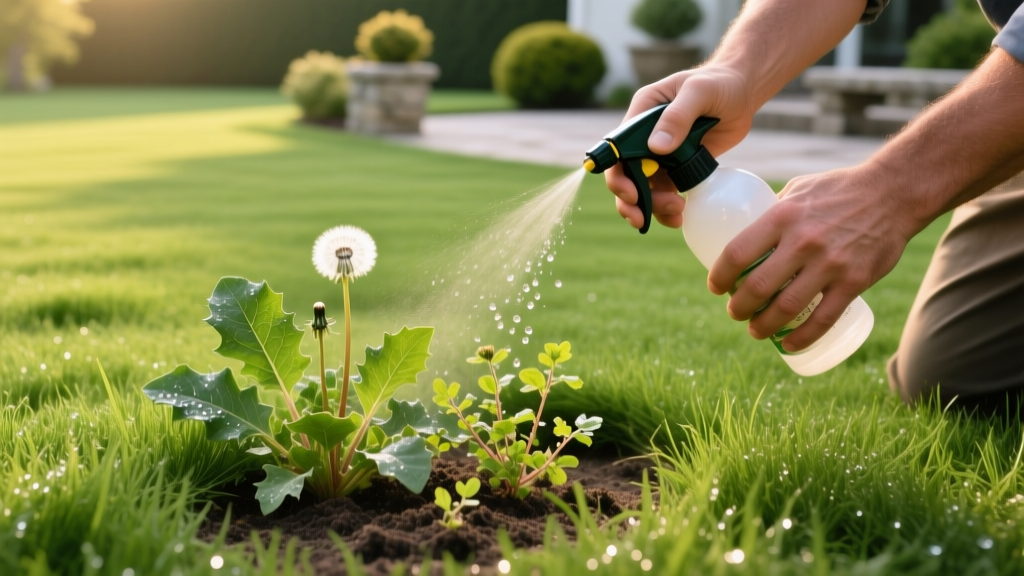
How to Kill Weeds But Not Grass: Selective Spot-Treatment Guide
The Science of Selective Herbicides
Applying a non-selective herbicide like glyphosate will obliterate both the weed and the surrounding turf. To kill weeds but not grass, you must use selective herbicides—chemical compounds engineered to exploit the metabolic and structural differences between monocots (grasses) and dicots (broadleaf weeds).
Broadleaf selective herbicides primarily utilize synthetic auxins, such as 2,4-D, Dicamba, and MCPP. These chemicals mimic natural plant growth hormones. When absorbed by a broadleaf weed, the synthetic auxin triggers rapid, unregulated cellular division and elongation. The weed essentially grows itself to death, twisting its stems and collapsing its vascular system. Grasses, being monocots, possess a different vascular structure and can rapidly metabolize and detoxify these synthetic auxins before they cause systemic damage.
Expert Insight: The effectiveness of a selective herbicide is heavily dependent on the weed's growth stage. Spot-treating young, actively growing weeds (rosette stage for dandelions, pre-tiller stage for crabgrass) requires 30% less active ingredient and yields a 95%+ kill rate compared to treating mature, flowering weeds.
Identifying Your Weed Type and Grass Tolerance
Before mixing any chemicals, you must identify both the weed species and your specific turfgrass. A product that safely kills weeds in Kentucky Bluegrass might severely damage St. Augustine grass. Below is a decision matrix for matching active ingredients to your lawn type.
| Turfgrass Species | Safe for Broadleaf Weeds (2,4-D, Dicamba) | Safe for Grassy Weeds (Quinclorac, Fenoxaprop) | Alternative Safe Active Ingredients |
|---|---|---|---|
| Kentucky Bluegrass / Fescue | Highly Tolerant | Highly Tolerant | Mesotrione (Tenacity) |
| Bermudagrass / Zoysia | Highly Tolerant | Highly Tolerant | Sulfentrazone, Metsulfuron |
| St. Augustine / Centipede | Severe Damage Risk | Moderate Tolerance (Quinclorac) | Atrazine, Penoxsulam |
| Bahiagrass | Moderate Tolerance | Highly Tolerant | Metsulfuron-methyl |
Broadleaf Weed Spot-Treatment (Dandelion, Clover, Plantain)
For cool-season and warm-season grasses (excluding St. Augustine and Centipede), a 3-way or 4-way herbicide is the gold standard. SpeedZone Broadleaf Herbicide for Turf (containing 2,4-D, MCPP, Dicamba, and Carfentrazone) is an industry favorite due to its rapid burn-down effect. Carfentrazone acts as a PPO inhibitor, causing cellular membrane destruction within 24 hours, while the auxins provide long-term root kill.
- Mixing Ratio: 1.0 to 1.5 fluid ounces of SpeedZone per 1,000 square feet.
- Carrier Volume: 1.0 to 1.5 gallons of water per 1,000 square feet to ensure adequate coverage without runoff.
- Cost: Approximately $140 per gallon, yielding a spot-treatment cost of roughly $0.05 per application.
Grassy Weed Spot-Treatment (Crabgrass, Dallisgrass, Poa Annua)
Grassy weeds are monocots, meaning broadleaf herbicides will not harm them. You need specific graminicides or selective grassy-weed herbicides. Quinclorac (found in products like Drive XLR8) is highly effective against crabgrass and dallisgrass in Bermuda, Zoysia, and Fescue lawns. For Poa Annua and certain tough grassy weeds in cool-season lawns, Fenoxaprop-p-ethyl (Acclaim Extra) is the preferred choice.
Step-by-Step Spot-Treatment Application Protocol
Proper calibration and application technique dictate the success of your treatment. Follow this exact protocol to kill weeds but not grass.
- Preparation (Day -2): Mow your lawn 48 hours before application. This allows the weed to generate new, tender leaf tissue, which absorbs herbicide much faster than mature, waxy leaves.
- Mixing the Solution: Fill your 1-gallon pump sprayer halfway with water. Add the precise measured dose of herbicide. Add a non-ionic surfactant (NIS) at a rate of 0.25% v/v (approximately 1/2 teaspoon per gallon). The surfactant breaks the surface tension of the water, allowing the chemical to spread and penetrate the weed's waxy cuticle. Agitate the sprayer gently, then fill the rest with water.
- Targeted Spraying: Adjust your sprayer nozzle to a solid cone or flat fan pattern. Hold the wand 12 to 18 inches above the weed. Spray only until the weed leaves are visibly wet (glistening). Do not spray to the point of runoff.
- Post-Application (Day +2): Wait at least 48 hours before mowing or watering the lawn. The herbicide needs this time to translocate from the leaves down to the root system.
Critical Warning: Temperature and Volatilization
Never apply ester-based herbicides (or any 2,4-D products) when ambient temperatures exceed 85°F. At high temperatures, the active ingredients can vaporize (volatilize) and drift onto nearby desirable plants, vegetable gardens, or sensitive turf, causing severe phytotoxicity. If treating in mid-summer, apply in the early morning when temperatures are below 80°F.
Never apply ester-based herbicides (or any 2,4-D products) when ambient temperatures exceed 85°F. At high temperatures, the active ingredients can vaporize (volatilize) and drift onto nearby desirable plants, vegetable gardens, or sensitive turf, causing severe phytotoxicity. If treating in mid-summer, apply in the early morning when temperatures are below 80°F.
Common Failure Modes and Edge Cases
Even experienced homeowners make mistakes that result in dead grass or surviving weeds. According to University of Minnesota Extension turfgrass specialists, the most common reasons for spot-treatment failure include:
- Omitting the Surfactant: Weeds like plantain and wild violet have highly hydrophobic (water-repelling) leaves. Without a non-ionic surfactant or a methylated seed oil (MSO), the herbicide droplets will bead up and roll off onto the soil, wasting the chemical and potentially harming grass roots.
- Treating Drought-Stressed Weeds: When weeds are drought-stressed, they close their stomata and halt active growth to conserve water. Herbicides require active transpiration to move through the plant's phloem. Always water the lawn lightly 24 hours before treatment to ensure weeds are actively growing.
- Using the Wrong Formulation for the Season: 2,4-D comes in 'amine' and 'ester' formulations. Amines are safer for warm weather and less prone to volatilization, while esters are far more effective in cool weather (below 65°F) because they penetrate waxy leaf cuticles much faster. Use amines in spring/summer and esters in late fall.
Cost Breakdown: Spot-Treating vs. Blanket Application
While blanket spraying the entire lawn seems easier, it is economically and environmentally inefficient. Here is a comparative cost analysis based on treating a 5,000 square foot lawn with a professional-grade 3-way herbicide (priced at $140/gallon).
Treatment Economics Matrix
Blanket Application (5,000 sq ft):
- Chemical Required: 5.0 to 7.5 fl oz
- Total Chemical Cost: $5.50 - $8.20
- Environmental Impact: High (introduces chemicals to entire soil profile)
Targeted Spot-Treatment (Assuming 15% weed coverage = 750 sq ft):
- Chemical Required: 0.75 to 1.12 fl oz
- Total Chemical Cost: $0.82 - $1.23
- Environmental Impact: Low (minimal soil introduction)
Data synthesized from UC Davis Integrated Pest Management guidelines for residential turf.
Post-Treatment Lawn Recovery and Soil Health
Killing the weed is only half the process; filling the void is what prevents future infestations. According to the EPA's guidelines on safe lawn care, maintaining a dense turf canopy is the ultimate biological weed control.
Once the treated weeds have browned and collapsed (usually 10 to 14 days post-application), rake out the dead organic matter to expose the bare soil. Immediately overseed the bare spots with a grass seed blend that matches your existing lawn. For cool-season lawns, apply a starter fertilizer (high in phosphorus, such as a 10-18-10 NPK ratio) to accelerate root establishment. For warm-season lawns, plug the bare areas with healthy stolons or sprigs from thicker parts of the yard.
By combining precise selective herbicide chemistry with aggressive turf recovery protocols, you can effectively kill weeds but not grass, maintaining a pristine, uniform lawn without relying on expensive commercial lawn services.

